Haplogroup O2a2b1a1a1

– 4 min read


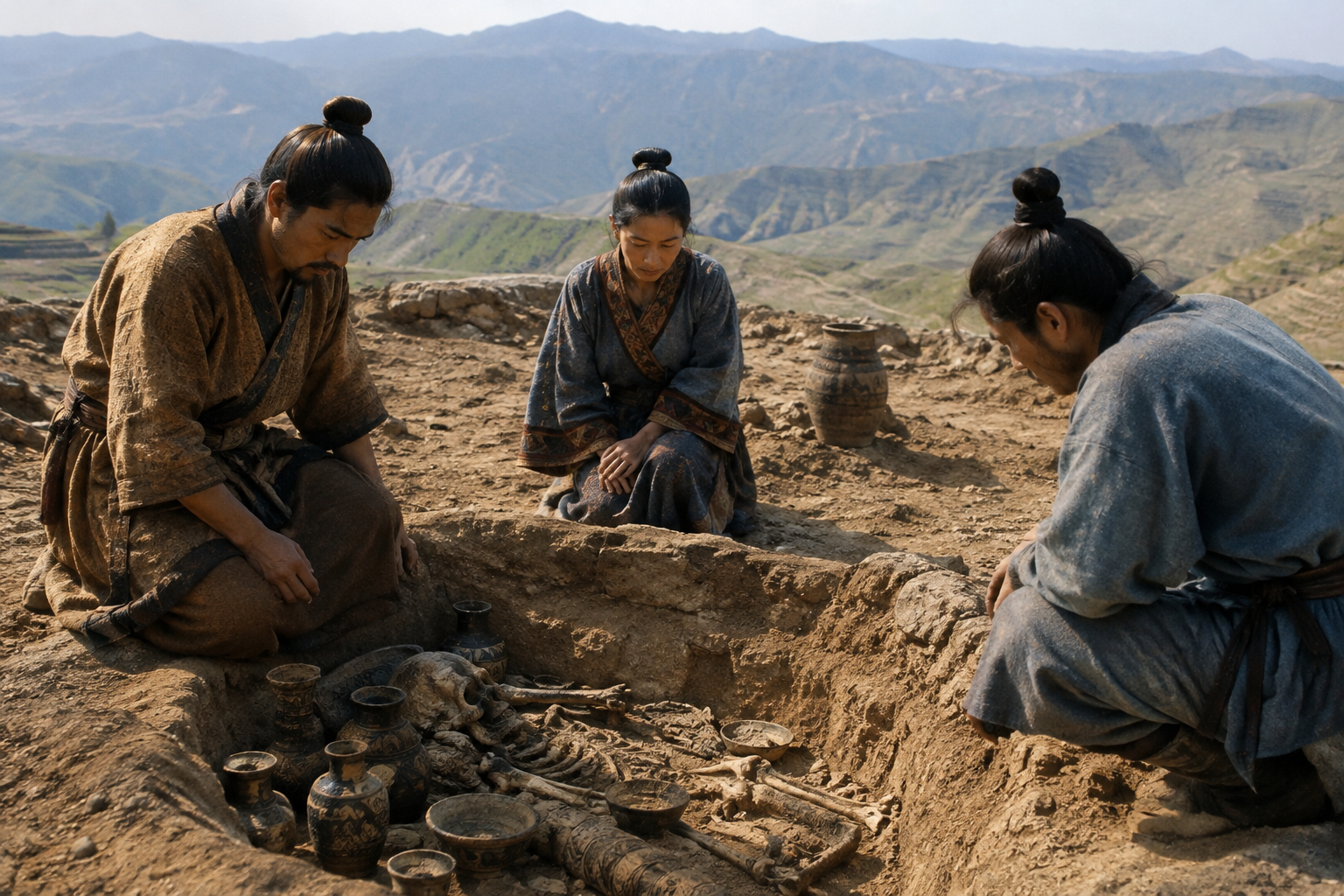
At Maojiaping in Gangu, near Tianshui in Gansu, one male burial dated to about 1050 BC has become an unexpectedly useful signpost for the Y-DNA haplogroup O2a2b1a1a1. The individual is recorded as MaojiapingM8, from the early Qin or Western Zhou horizon in northwestern China. On its own, a single burial would be interesting but limited. What makes it more valuable is that it can be set beside earlier men from Bronze Age Gansu who appear in the same paternal branch.
That matters because Y-DNA follows one direct male line only: father to son across generations. It does not sum up a person's whole ancestry, language, or identity. But when the same branch turns up in related regions across several centuries, it can help show that some paternal lines persisted locally through major cultural change, from the late Bronze Age communities of Gansu into the political world that produced early Qin.
The clearest earlier evidence comes from the Mogou Cemetery at Lintan in Gannan, Gansu, associated here with the Bronze Age Qijia Culture. Two men from around 1450 BC are especially relevant: MogouM391_R5 and MogouM441_R1. They predate MaojiapingM8 by several centuries, yet they place the same paternal branch in broadly the same wider region.
That is the real historical interest of O2a2b1a1a1 in this case. We are not looking at a lone outlier, but at a small cluster of male-line evidence from Bronze Age Gansu. The pattern suggests that this branch was present among communities living in the contact zone between the Yellow River world and the higher, more westerly landscapes of today's Gansu.
Research on ancient burials in Bronze Age Gansu has increasingly shown that this was not an isolated backwater at all, but a corridor of movement, exchange, and local continuity. One relevant MyTrueAncestry discussion is here:
An ancient DNA study connected with these materials is linked through research on ancient population history in this part of China. Without overstating what can be wrung from a single archive link, the broader value of such work is clear enough: it places burials like those at Mogou into a bigger picture of population structure, interaction, and continuity in Bronze Age northwestern China.
Gansu is one of those regions that repeatedly turns out to be more important than older textbook histories allowed. It sits between the Central Plains, the northeastern Tibetan Plateau, and the routes leading further toward Inner Asia. In archaeological terms, that means cultures there can look both local and connected at once.
So when O2a2b1a1a1 appears in Mogou and later at Maojiaping, the simplest responsible reading is not a dramatic migration tale but a durable regional paternal presence. Men carrying this branch were part of populations living in Gansu during the Bronze Age and remained there into the early first millennium BC, when political formations later associated with Qin were beginning to take shape.
That sort of continuity is often more revealing than a flashy one-off result. It suggests that the making of early northwestern states did not happen by replacing everybody already there. At least some male lines appear to have persisted through the transition.
MaojiapingM8, dated here to about 1050 BC, sits in a particularly interesting historical position. This is the period when the Western Zhou order was emerging after the fall of Shang, and when the far northwest was a zone of negotiation between expanding political systems and older regional societies. The site's association with early Qin gives the sample added weight, though one must be careful: a site label is not the same thing as a neat ethnic badge.
Still, the appearance of O2a2b1a1a1 in this context helps anchor the branch in a real archaeological landscape. It shows the lineage in a man from the very sort of frontier world where later Chinese states were consolidated - not in abstract genealogies, but in an excavated burial from Gansu. That is the point where genetics becomes historically vivid.
For readers interested in how ancient DNA is reshaping our understanding of early Chinese populations beyond a single site, this related article is worth a look:
It is worth pausing over the name itself. O2a2b1a1a1 is a very specific branch inside the much larger haplogroup O, which today is widespread across East and Southeast Asia. One of the most common mistakes in popular DNA writing is to take the huge history of a parent haplogroup and paste it wholesale onto a much narrower twig. That would be misleading here.
What the present evidence actually supports is narrower, but still substantial. This branch appears in three ancient male individuals from Gansu and nearby northwestern Chinese contexts spanning roughly four centuries, from around 1450 BC to around 1050 BC. That is enough to say that O2a2b1a1a1 was part of the paternal landscape of Bronze Age and early Zhou-era Gansu. It is not enough, by itself, to assign the branch to a single people, language family, or ruling house.
Another MyTrueAncestry post that speaks to the wider paternal story in East Asia is this one:
Three men are not a dynasty, and nearby sites are not automatically one family. Yet repetition does matter. When MogouM391_R5, MogouM441_R1, and MaojiapingM8 all point toward O2a2b1a1a1, the branch stops being an isolated label and starts to look like part of a regional pattern.
That pattern fits what archaeologists increasingly see in Gansu: cultural change without simple population replacement, and frontier history built from communities already rooted in the region as well as outside contacts. It is the sort of result that gives texture to broad historical labels like "Qijia," "Western Zhou," or "early Qin." Those labels describe archaeological and political worlds; Y-DNA lets us glimpse one thread of biological continuity moving through them.
There is also a useful comparison here with later Chinese kinship studies, where ancient DNA has begun to illuminate how lineages, marriage patterns, and burial communities worked in practice rather than in idealized texts. One example from a much later period is here:
For someone who carries O2a2b1a1a1 today, the strongest ancient signal in this evidence points toward northwestern China, especially Bronze Age and early first-millennium-BC Gansu. Not a single tribe, not a guaranteed royal pedigree, and not a complete portrait of your ancestry - but a documented paternal foothold in a region that linked the Central Plains to the wider inner Asian world. That is a solid and rather evocative place to begin.


Comments