Haplogroup O2a2b1a1

– 5 min read


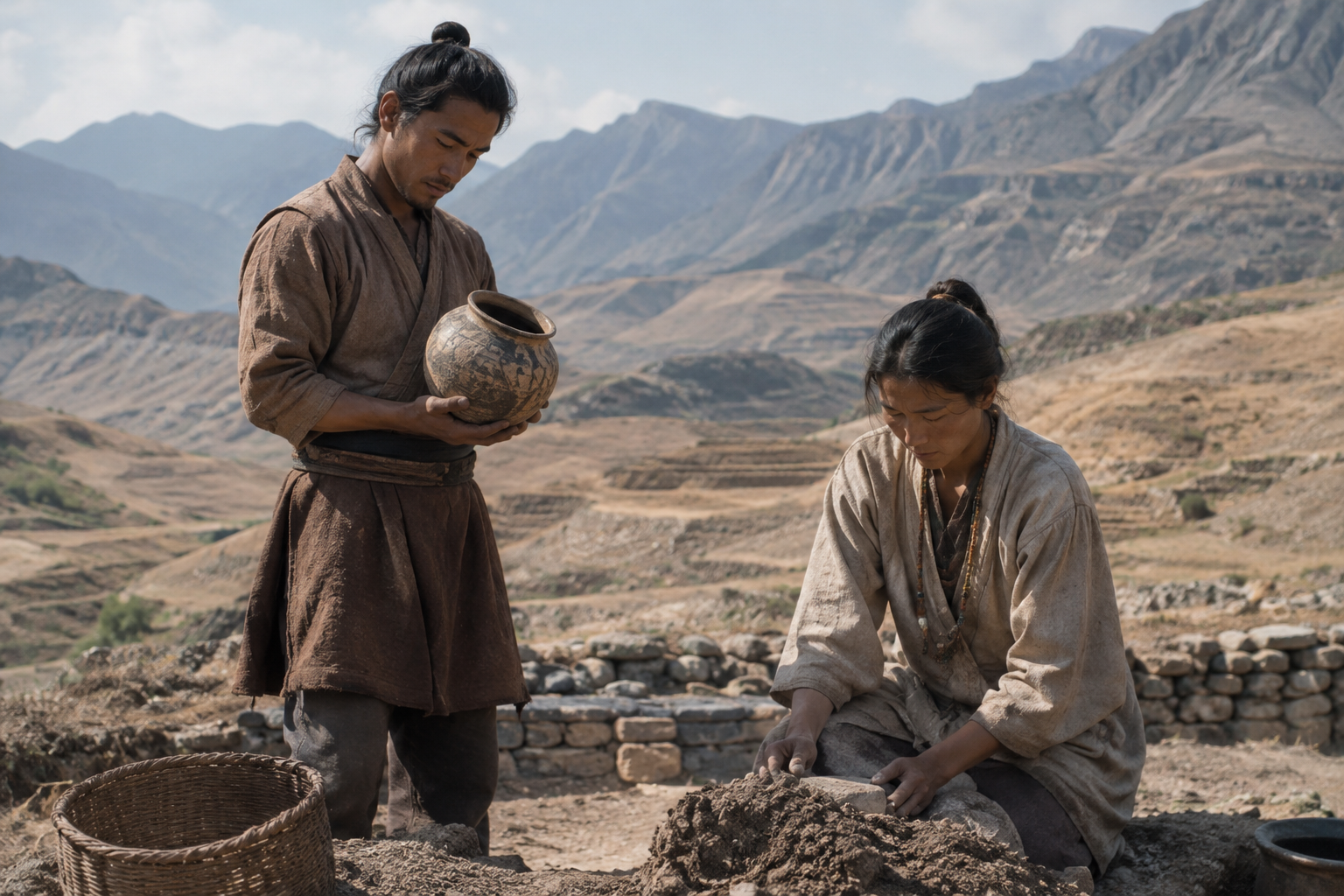
At Chokhopani in Nepal, high in the trans-Himalayan world, one ancient male labeled CHO001a offers a striking glimpse of paternal history around 785 BC. The site matters because it sits in a region that was never a sealed mountain pocket: it was a corridor, linking the Tibetan Plateau, the Himalayan valleys, and the broader world of Inner Asia. In that setting, the Y-DNA haplogroup O2a2b1a1 appears not as an abstract label, but as part of a real Bronze Age community living at altitude.
Another reported ancient match comes from farther east, at the Zhanqi site in Minxian, Gansu, where the individual ZhanqiM65 is dated to about 1000 BC and associated with the Siwa culture of Bronze Age China. Put those two finds together and the interesting question is not whether one man "founded" the other population, because ancient DNA does not work like that, but how a paternal branch linked to East Asian lineages appears in two very different but historically connected landscapes: the northeastern edge of the Tibetan world and the Gansu corridor.
Y-DNA follows a direct paternal line: father to son to son across generations. That makes haplogroups useful for tracing one very specific thread of ancestry, though never a person's whole background, language, or identity. In this case, O2a2b1a1 is a narrow branch within the much larger East Asian Y-chromosome family O, and its importance here lies in where it turns up in ancient remains rather than in any sweeping claim about a single people.
The evidence supplied for this article points to O2a2b1a1 in two Bronze Age contexts on or near the great upland and corridor zones of Asia. That is already enough to say something worthwhile. It suggests that paternal lines of this kind were present in populations moving through, settling in, or interacting across the mountain-and-steppe interface long before later imperial states gave those routes written names.
An ancient DNA study on the region that includes Himalayan and adjacent populations can be found here: https://www.nature.com/articles/s41586-024-07546-2. It is relevant not because it turns one haplogroup into a tidy origin story, but because it places these ancient individuals into a broader discussion of mobility and mixture across highland Asia.
Chokhopani has become well known in discussions of Himalayan prehistory because it helps break an old habit of treating mountain populations as timeless isolates. The sample CHO001a, dated to around 785 BC, belongs to a world in which upland communities were already part of broader networks. Geography here is destiny in the most material sense: passes, river valleys, and seasonal movement mattered, and genetics helps show that these were human landscapes of connection.
For someone carrying O2a2b1a1 today, CHO001a is interesting because he anchors this paternal branch in an ancient Himalayan setting rather than only in later historical populations. That does not mean every modern bearer descends from Nepal, still less from this one man. It does mean that by the late Bronze Age or early Iron Age horizon, closely related paternal lines were present in the trans-Himalayan sphere.
That wider Himalayan picture matters. The plateau and its margins were shaped by repeated contacts between populations with different ancestry profiles, subsistence strategies, and local histories. A lineage like O2a2b1a1 therefore fits best into a story of long-term interaction, not romantic isolation.
The second ancient individual, ZhanqiM65, comes from the Zhanqi site in Minxian, Gansu, and is dated to about 1000 BC within the Siwa culture. Gansu is one of those regions archaeologists return to again and again because it is a crossroads. To its west lie routes toward Central Asia; to its south and southwest, the approaches to the Tibetan world; to its east, the agricultural heartlands of northern China.
That makes ZhanqiM65 especially valuable for interpreting O2a2b1a1. Here the haplogroup is not appearing in a purely high-altitude context, but in a Bronze Age corridor zone where communities could absorb influences from farming regions, pastoral frontiers, and mountain networks alike. A genetic signal in Gansu is therefore historically richer than a dot on a map. It belongs to a landscape where cultural frontiers were permeable.
A related research resource for the Bronze Age Gansu material is available at https://ngdc.cncb.ac.cn/gsa-human/browse/HRA014036. Used carefully, material like this helps place individual burials such as ZhanqiM65 into the wider population history of northwestern China.
It would be easy, and wrong, to turn Nepal and Gansu into opposite ends of a simple migration arrow. Ancient DNA rarely supports such tidy diagrams. What these two finds really show is something more interesting: by the early 1st millennium BC, paternal lines associated here with O2a2b1a1 were present in both a Himalayan upland community and a northwestern Chinese Bronze Age culture.
That pattern fits a broader archaeological reality. The eastern Tianshan, the Hexi and Gansu corridors, the Tibetan margins, and the Himalayan passes were never isolated chapters. They were overlapping zones of exchange in which people, animals, crops, technologies, and marriage networks could all move, sometimes slowly and unevenly, over centuries.
So the value of O2a2b1a1 is not that it labels a single ancient "tribe." It helps us see continuity of paternal lines across landscapes that written history often treats separately. Genetics, at its best, nudges us to redraw the map in human rather than modern political terms.
East Asian Y-Chromosome Migrations
There is also a chronological point worth stressing. Both CHO001a and ZhanqiM65 belong to periods before the better-documented imperial systems that later structured movement across Asia. We are looking at Bronze Age and early first-millennium-BC communities, not subjects of the Han, Tang, or later Tibetan polities. That makes these samples particularly useful, because they show that some of the paternal structure of the region was already in place before written states began recording and reorganizing it.
This is where archaeology keeps us honest. A haplogroup can survive dramatic cultural change. The same paternal branch may pass through people who spoke different languages, lived under different political systems, or adopted different burial customs. O2a2b1a1, then, is best understood as part of a durable male-line history running through changing societies of highland and corridor Asia.
With only two ancient examples in view here, the most responsible conclusion is also the most revealing one. O2a2b1a1 is documented in Bronze Age contexts from both Chokhopani in Nepal and the Zhanqi site in Gansu, placing this paternal branch within an old arc of connection between the Himalayan world and northwestern China. For a modern tester, that does not promise a neat ethnic label or a royal pedigree. What it does offer is something better: evidence that your direct paternal line belongs to a deep history of movement and continuity across some of Asia's most important frontier landscapes.
Comments