Haplogroup O2a1b1a1a1

– 5 min read


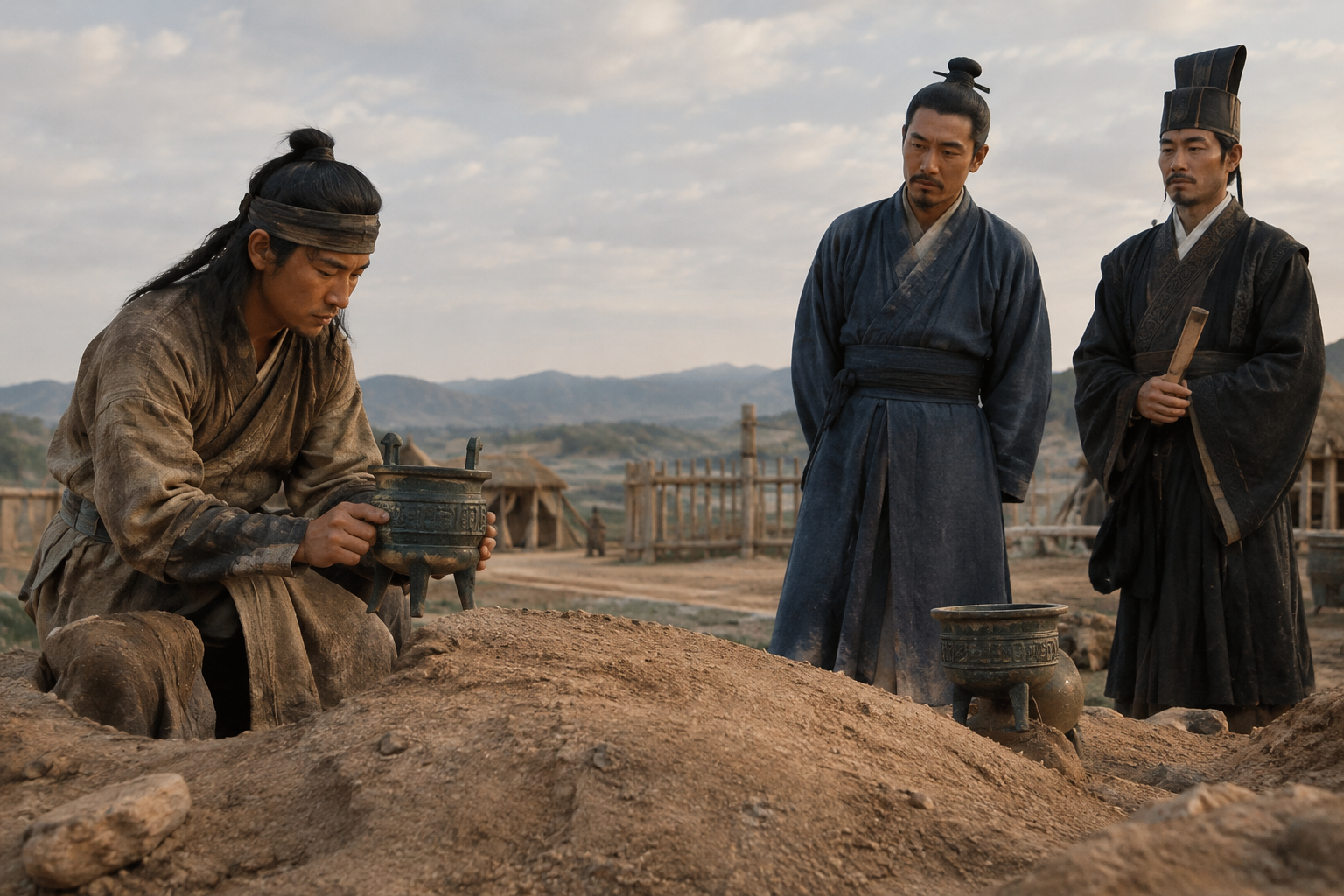
At Mogou cemetery in Lintan, Gansu, archaeologists uncovered a Bronze Age community linked to the Qijia horizon and dated here to around 1450 BC. Among the men buried there was the individual identified as MogouM391_R2, reported in association with the Y-DNA haplogroup O2a1b1a1a1. That single label may look forbiddingly technical, but it matters because it places a direct paternal line inside one of the great early farming worlds of northwestern China.
The interest of this haplogroup is not that it gives us a neat heroic origin story. Quite the opposite. What makes O2a1b1a1a1 interesting in the ancient record provided here is that it appears in two very different settings: first in Bronze Age Gansu, on the frontier where farming societies, local traditions, and steppe contacts met; and later in an individual from the Western Han period at Linzi in Shandong, M16, dated here to around 100 BC. In other words, this is not a line trapped in one place or one moment. It turns up in very different historical landscapes across northern China.
Mogou is the more revealing of the two finds because the site sits in a region that has become central to debates about how populations moved through ancient northwestern China. Gansu was not a remote backwater. It was a corridor: a place where millet-farming communities, highland routes, and steppe-facing contacts all brushed up against one another over long periods.
The sample MogouM391_R2, assigned here to O2a1b1a1a1, belongs to that world. The cemetery itself is associated with the Qijia cultural sphere, a Bronze Age archaeological tradition known from northwestern China and often discussed in relation to regional interaction, metallurgy, and changing lifeways. A Y-chromosome result from such a burial does not tell us everything about the man or his community, but it does let us trace one paternal strand through a place where several larger historical processes were meeting.
That matters because northwest China in the Bronze Age is often described too simply, as if it were either purely "Central Plains" or purely "steppe". The archaeology is more awkward and more interesting than that. Communities in Gansu could be local, connected, and changing all at once. A reported O2a1b1a1a1 lineage at Mogou is one small but concrete sign that paternal diversity in this region had deep roots inside agricultural societies as well as frontier settings.
A MyTrueAncestry article on the wider site context is worth reading here:
O2a1b1a1a1 is a very specific Y-DNA branch, and Y-DNA follows only the direct paternal line: father to son to son across time. That makes it powerful for reconstructing male-line continuity, but limited as a description of a whole person. A man with this haplogroup could have had ancestors from many different maternal and non-paternal branches, just as people do now.
It is also important not to inflate the evidence. The broader O haplogroup and its sub-branches are major parts of East Asian paternal history, but the presence of this exact subclade in two ancient individuals does not by itself tell us where the entire branch first formed, nor does it prove a single unbroken local dynasty between Bronze Age Gansu and Han-period Shandong. What it does show is that a paternal line associated with O2a1b1a1a1 was present in ancient northern Chinese populations across very different regions and centuries.
That is a useful distinction for anyone reading ancient DNA. Archaeological culture, political allegiance, spoken language, and Y-chromosome lineage are not the same thing. A Qijia-associated burial is not "the same" as a Han subject simply because a paternal branch may appear in both.
The second ancient individual, M16, comes from Linzi in Zibo City, associated here with the Western Han dynasty and dated to around 100 BC. By then we are in a completely different historical setting from Bronze Age Mogou. Linzi had long been a place of consequence, first as the capital of the state of Qi and later as part of the imperial Han order. This was an urbanized, bureaucratic, text-producing world, not a Bronze Age cemetery on the northwestern frontier.
That contrast is exactly why M16 is so useful. The appearance of O2a1b1a1a1 in a Western Han context suggests that this paternal line was not confined to one marginal corridor or one archaeologically distinctive population. It could also be found in the east, in a region deeply entangled with the political and demographic structures of early imperial China.
We should be careful, though, about what kind of continuity we imagine. The gap between around 1450 BC and around 100 BC is immense. States rose, territories changed, and populations mixed repeatedly. So the significance is not that M16 "descends from" MogouM391_R2 in any direct historical sense. Rather, both samples show that this branch belonged within the broader human geography of ancient northern China over a long stretch of time.
For broader background on long-term population history in northern China, this related piece gives useful context:
If these two samples had both come from the same cemetery, the story would mostly be about local kin lines. But they do not. One is from Gansu in the Bronze Age; the other from Shandong in the Han period. That spread matters because it hints at a branch that participated in the making of northern Chinese populations across regional divides.
Northwestern China is often the place where archaeologists look for evidence of contact: movement of crops, animals, metalworking traditions, and people. Eastern China, especially the old Qi region and later Han territory, represents a different kind of historical density: older states, larger populations, and more durable administrative systems. When the same paternal branch appears in both settings, it reminds us that the male-line history of ancient China was not built from isolated provincial stories. It was built from interaction across corridors, basins, and state systems.
That larger picture is one reason research on ancient East Asian Y chromosomes has become so valuable. Studies focusing on paternal lineages can help distinguish whether patterns seen in whole-genome ancestry were accompanied by stable local male lines, incoming male lines, or a mixture of both. A broader MyTrueAncestry discussion of that issue can be found here:
The Gansu evidence sits comfortably beside an expanding body of work on northwestern Chinese burials and population history. One relevant research lead for the broader regional context is an ancient DNA study examining population history in Bronze Age Gansu. Even without overstating any single sample assignment, that kind of work helps explain why cemeteries such as Mogou have become so important: they offer actual biological evidence from a zone long known archaeologically as a meeting ground.
The second useful research lead is genetic material associated with ancient individuals from northern Chinese contexts. For readers following specific sample IDs such as MogouM391_R2 and M16, this sort of research infrastructure matters because it anchors discussion in recoverable evidence rather than in broad historical guesswork.
And if you want to keep the Han-and-later East Asian picture in view, another related article connects genetics to historical social structure in a later Chinese setting:
For someone who belongs to O2a1b1a1a1 today, the most grounded takeaway is not a claim to one named people or one royal pedigree. It is something subtler and more interesting: this paternal line is visible in both a Bronze Age cemetery in Gansu and a Western Han individual in Linzi, placing it within the long, regionally connected history of ancient northern China. It speaks to continuity of male lines across very different social worlds, from frontier Bronze Age communities to the population landscape of an imperial age.



Comments