Haplogroup O1b2a1

– 4 min read


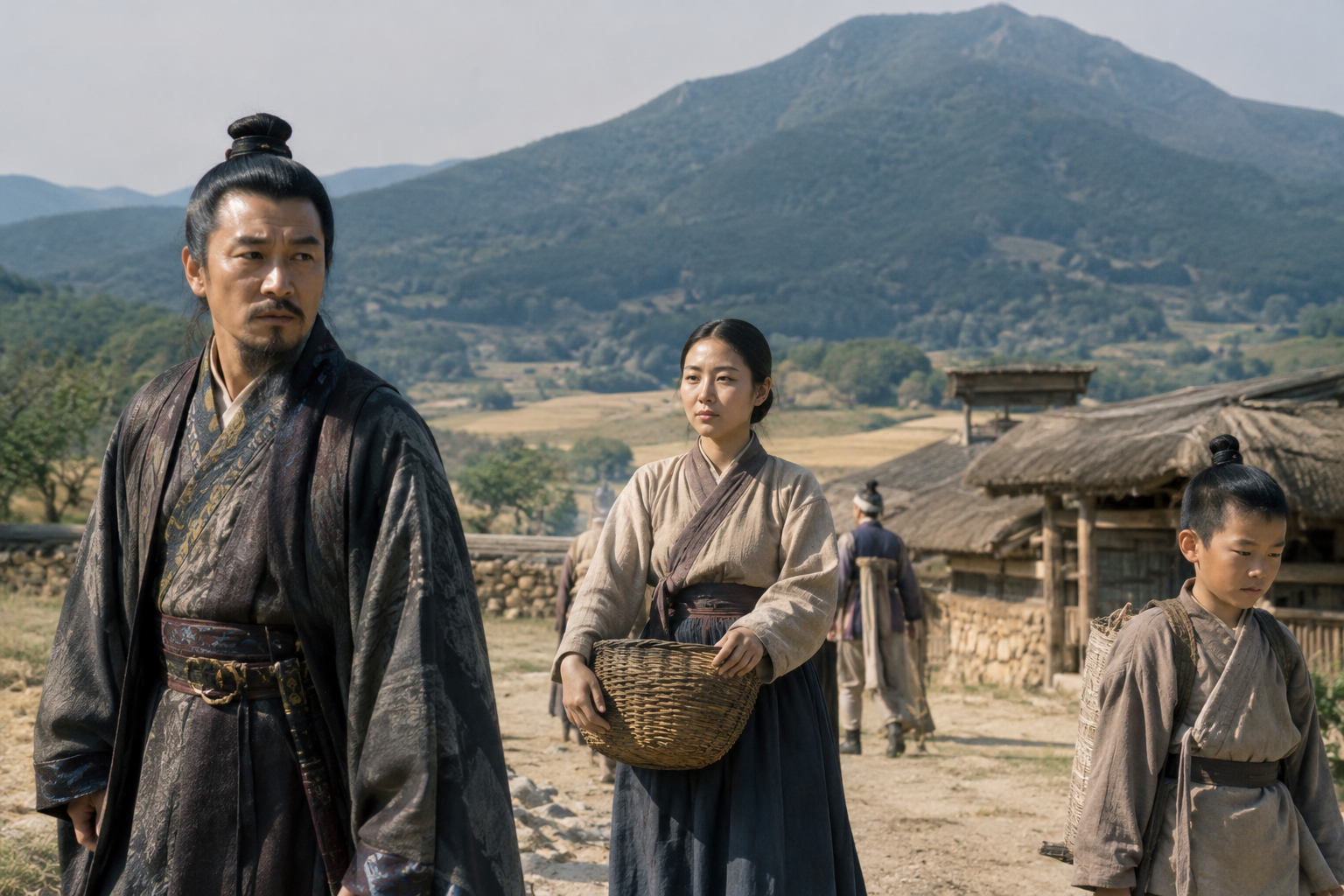
At Joyeong-dong in Gyeongsan, in southeastern Korea, ancient DNA has put a single man from around AD 500 into sharper focus than the bare bones of a cemetery usually allow. The individual labelled JOY012, dating to the Three Kingdoms period, has been associated with the Y-DNA haplogroup O1b2a1 - a paternal line that today is especially relevant to the history of Korea and nearby parts of East Asia.
That is already interesting, because the Three Kingdoms period was not some misty, half-legendary age. It was a time of organized states, fortified centres, court competition, and dense local communities. A Y-chromosome result from that world does not tell us everything about JOY012's ancestry or identity - Y-DNA traces only one direct paternal line - but it does give us one clear thread running through a period when the Korean peninsula was politically divided and culturally dynamic.
Gyeongsan sits in the historic orbit of the Silla kingdom, one of the three major polities that gave the period its name. By around AD 500, this was a landscape of growing political centralization, expanding elite networks, and well-established burial customs. Even when a published summary gives us only a sample label, place, and date, that combination matters: it places JOY012 inside a real archaeological setting rather than in an abstract map of haplogroup frequencies.
The importance of O1b2a1 here is not that it magically identifies a kingdom, a language, or an ethnicity. It is that it shows this paternal branch was present in peninsular Korea during the Three Kingdoms era in an excavated human being, not merely inferred backward from modern populations. For family historians, that distinction is crucial. Ancient DNA anchors a lineage in time.
O1b2a1 belongs within the broader Y-DNA haplogroup O, one of the major paternal lineages of East and Southeast Asia. But the article haplogroup is the narrower branch, not the whole tree. It would be sloppy to take everything ever said about haplogroup O and simply pour it into the history of O1b2a1.
What can be said with confidence is more modest and more useful. O1b2a1 is widely discussed in connection with the paternal history of populations in Korea and Japan, and its appearance in a Three Kingdoms individual fits that broader regional pattern. JOY012 therefore provides an ancient data point suggesting that a line still important in East Asia today was already part of the peninsula's male population in late antiquity.
That matters especially because discussions of East Asian Y-DNA can become trapped between two bad habits: either treating haplogroups as timeless ethnic badges, or treating them as so vague that they tell us nothing at all. In reality, they are somewhere in between. A lineage like O1b2a1 is neither a kingdom nor a culture, but it can mark continuity in paternal descent across very long stretches of history.
Some readers may wonder whether a single ancient sample can really carry much historical weight. The answer is yes, provided we are careful about the scale of the claim. JOY012 does not stand for all of Silla, all of Korea, or all men of the Three Kingdoms period. But he does show that this branch was present in a documented archaeological population at that date and place.
That may sound restrained, but archaeology often advances by exactly this sort of restraint. A securely placed individual is better than a dozen grand speculations. In the Korean case, where written history, archaeology, and genetics are all increasingly being brought into conversation, even one well-contextualized paternal lineage can help frame larger questions about continuity, kinship, and regional population structure.
A broader ancient DNA study connected with these Korean burials is hosted at this research archive. Without inventing details not given in the sample summary, the key point is that JOY012 belongs to a growing body of evidence placing genetic data directly into the social landscapes of early Korean history.
For O1b2a1, the most sensible historical question is not whether one man "founded" anything, but whether this branch reflects long-term continuity in the populations of the peninsula and its maritime neighbourhood. Ancient Y-chromosome work across East Asia increasingly shows that present-day distributions did not appear overnight. They were shaped by repeated episodes of settlement, mixing, local persistence, and political change.
In that light, JOY012 is valuable because he sits before many later upheavals: before the full sweep of medieval state formation, before early modern demographic transformations, and before the modern nation-state. He belongs to a period when local and regional lineages were already embedded in historical societies. That makes O1b2a1 in this context less a tale of sudden migration than a sign of deep-rooted paternal presence.
There is also a useful comparison to be made with neighboring Japan, where paternal-line questions are often discussed in relation to long-term population formation and interaction between older and later components. Anyone interested in how genetics and history intersect in that sphere may also want to look at MyTrueAncestry's piece on the Imperial House of Japan, which explores a different but geographically connected setting.
One reason articles like this matter is that East Asian paternal history has long been harder for the general public to visualize than the better-publicized stories from Bronze Age Europe. Yet the underlying questions are just as compelling. Which lines endured locally? Which spread with farming, political expansion, or maritime contact? Which branches remained regionally concentrated for millennia?
O1b2a1 is part of that conversation. JOY012 does not answer every one of those questions, but he gives us a firm chronological foothold. He shows that by the Three Kingdoms period this paternal branch was not a modern abstraction but part of the lived human landscape of southeastern Korea.
That larger East Asian backdrop is explored in another MyTrueAncestry post, Ancient Y Chromosomes Reveal Coastal and Inland Migrations that Shaped East Asian Paternal History. It is a useful companion because it places individual branches like this one into longer regional patterns without pretending that every local case means the same thing.
East Asian Y-chromosome migrations
The strongest point about haplogroup O1b2a1 in this case is simple and solid: it appears in JOY012, an ancient man from Joyeong-dong in Gyeongsan around AD 500, placing this paternal lineage securely in Three Kingdoms Korea. For someone researching their own direct male line, that does not promise descent from a court, a clan, or a famous house. What it does offer is something better grounded: evidence that this branch formed part of the real population history of early historic Korea, in a world we can date, locate, and excavate.



Comments