Haplogroup O1b1a2b1

– 5 min read


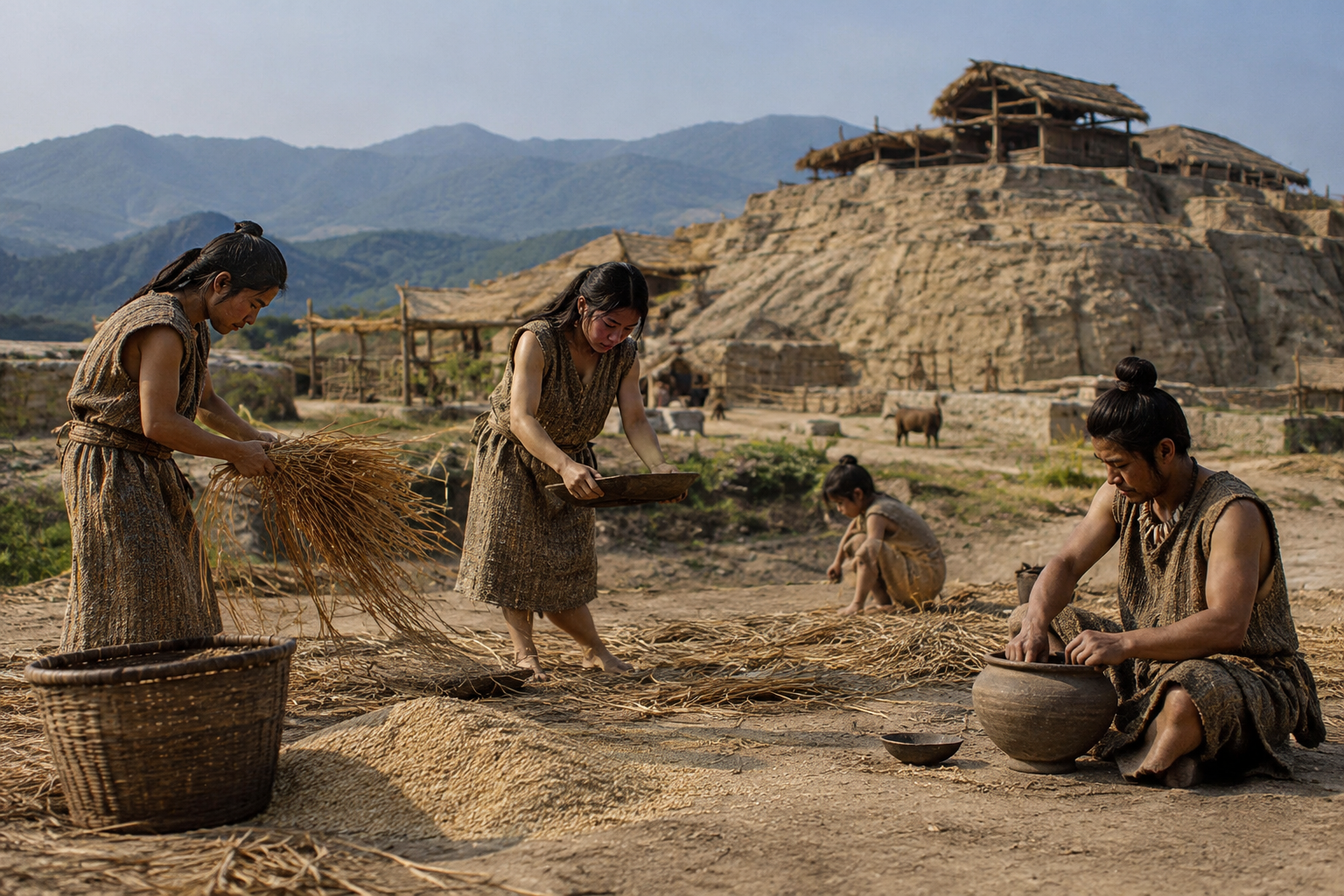
At Shimao in Shaanxi, on the northern edge of the Loess Plateau, archaeology has already given us one of late prehistoric China's most arresting urban sites: massive stone walls, monumental architecture, and evidence for a society that was anything but small or isolated. Now ancient DNA adds another, quieter detail. One male individual from this world, Shimao_HCT_8, dated here to around 1365 BC, is associated with the Y-DNA haplogroup O1b1a2b1.
That may sound like a string of letters and numbers, but it matters because Y-DNA follows one direct paternal line: father to son across generations. It does not define a person's whole ancestry or identity, yet in the right archaeological setting it can help us ask a sharper question. In the case of O1b1a2b1, the interest lies not in grand claims, but in seeing this paternal branch turn up at a major northern Chinese center linked to the long transition from late Neolithic societies into the Bronze Age world.
Shimao has become famous because it does not fit old, tidy maps of early Chinese civilization. It sits in northern Shaanxi rather than the Central Plains heartland, and its stone-built scale forced archaeologists to reconsider where large, complex societies emerged in late prehistoric North China. The site belongs to a frontier zone in the best sense of the word: not a margin, but a meeting ground where ideas, people, animals, and technologies could move.
That makes Shimao_HCT_8 especially useful. Even a single Y-chromosome result from such a place helps anchor paternal history in a real settlement rather than in modern maps of haplogroup frequency. Instead of treating O1b1a2b1 as an abstract lineage, we can place it in a documented archaeological landscape shaped by fortifications, hierarchy, and long-distance interaction.
An ancient DNA study connected with these northern Chinese findings has helped widen that landscape considerably, showing how genetic evidence can illuminate social and regional links around major sites rather than just isolated graves. Research on the broader ancient population context can be found here: https://www.nature.com/articles/s41586-025-09799-x.
The first thing to say carefully is that O1b1a2b1 is a specific branch within the wider Y-DNA tree, not a synonym for all of haplogroup O, and certainly not for all East Asian paternal history. A narrower branch has its own story, and that story cannot simply be borrowed wholesale from its larger parent lineage.
With the evidence here, the secure point is modest but valuable: this branch is represented in an ancient male from the Shimao horizon. That means O1b1a2b1 was part of the paternal diversity present in northern China by the late prehistoric to early Bronze Age transition reflected by this burial. It does not by itself prove that the lineage originated at Shimao, that all elite men there shared it, or that one burial stands for the entire city.
Still, ancient DNA works precisely through these modest anchors. A single identified paternal line in a major site can later be compared with nearby cemeteries, later dynastic populations, and present-day distributions. What matters is not a fantasy of instant certainty, but the fact that the lineage is now attached to a time, a place, and an excavated human being.
Shimao belongs to a period when northern China was being remade by growing social complexity. Communities were building larger settlements, fortifying key places, expanding exchange networks, and negotiating relations across ecological zones stretching toward the steppe. In that setting, paternal lineages such as O1b1a2b1 are historically interesting because they may help track which male lines persisted locally and which appear in new contexts as populations mixed and political worlds changed.
That is where Shimao's geography matters so much. Northern Shaanxi was not sealed off. It lay between the Yellow River agricultural sphere and regions with stronger ties to pastoral frontiers. When a lineage appears here, the important historical question is not whether it was somehow "purely local" or "purely incoming", but how such lineages participated in the making of societies that were already connected across considerable distances.
In other words, O1b1a2b1 at Shimao sits inside a story of interaction. Ancient cities do not emerge from thin air. They emerge from networks of households, labor, marriage, migration, and political ambition. Y-DNA cannot reconstruct all of that, but it can mark one strand of continuity through it.
Readers sometimes assume that only a large cemetery with dozens of men can tell us anything worthwhile. In fact, archaeology often advances by combining a few high-quality observations from especially important places. Shimao_HCT_8 is valuable because the site itself is valuable. A paternal lineage recovered from an ordinary, poorly contextualized location might remain little more than a technical footnote; at Shimao it becomes part of a bigger debate about urbanism, inequality, and regional interaction in ancient China.
There is also a practical point here for genetic genealogy. Ancient Y-DNA evidence from East Asia is still uneven. Some regions and periods remain sparsely sampled, while others are only now producing enough genomes to reveal patterns. Every securely placed lineage helps refine that map. For men who belong to O1b1a2b1 today, Shimao does not provide a neat family tree, but it does provide something arguably better than myth: proof that this paternal branch was present in a major northern Chinese archaeological setting deep in antiquity.
That kind of finding is especially useful because it ties genetic data back to excavated human history. We are not dealing with legend, later surname tradition, or retrospective claims of descent. We are dealing with an identified ancient individual from a famous site whose paternal line can now be discussed alongside walls, settlement patterns, and regional change.
As more ancient Y chromosomes are published from East Asia, a broader picture is coming into view: coastal and inland routes, regional persistence, and repeated episodes of mixing rather than any single one-way population story. O1b1a2b1 should be read within that developing framework. Its appearance in ancient northern China is not a final answer, but a data point that may eventually help connect late Neolithic and Bronze Age communities across larger parts of East Asia.
That is why it is wise to resist overstatement. We should not leap from one Shimao male to sweeping claims about language, ethnicity, or a whole ruling house. But neither should we shrug off the evidence. Archaeology is full of cases where one well-placed discovery changes the questions historians ask. A lineage attached to Shimao does exactly that: it invites us to think about paternal continuity and regional diversity in one of the most dynamic zones of early Chinese history.
East Asian Y-chromosome migrations
For O1b1a2b1, the clearest ancient foothold here is not a royal pedigree or a legendary ancestor, but Shimao_HCT_8 from Shimao in Shaanxi, around the late prehistoric to early Bronze Age threshold represented by this burial. That is a strong kind of evidence because it is specific. It places this paternal branch in a major archaeological center where the making of complex society in northern China can be studied in stone, soil, and now DNA as well.
If this is your haplogroup, the responsible takeaway is a good one: your direct paternal line belongs to a branch with documented presence in ancient North China at a site that mattered. That does not collapse your ancestry into one city or one man, but it does give your Y-line a genuine place in the archaeological record.
Comments