Haplogroup O1b1a1a
– 5 min read


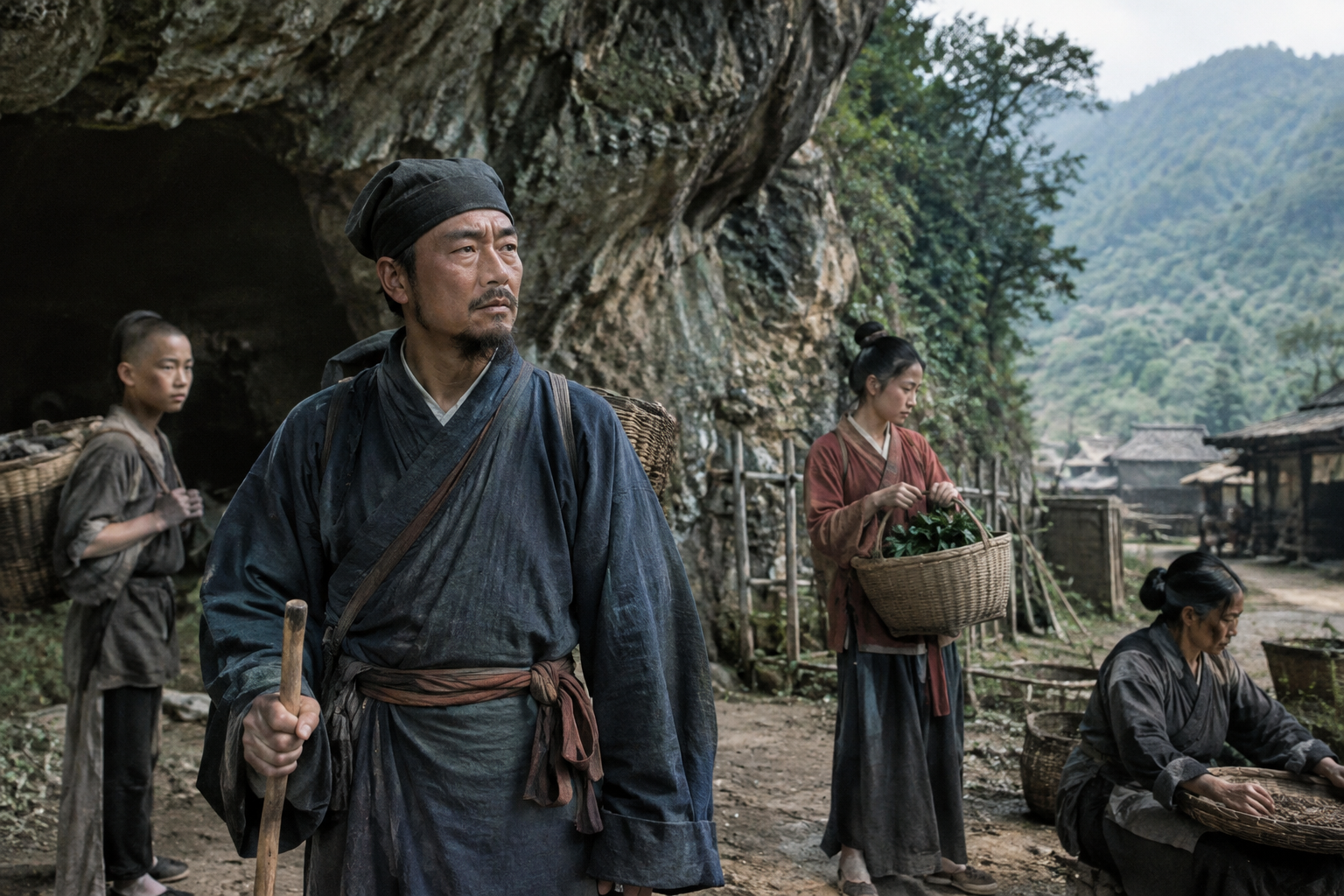
At Huatudong in Guangxi, one late historical burial offers a small but telling glimpse into the paternal history of southern China. The individual identified as NHT_3-1, dated to around AD 1600 in the Late Ming Dynasty, has been associated here with the Y-DNA haplogroup O1b1a1a. That may sound like a dry string of letters and numbers, but in archaeological terms it matters because it anchors this lineage in a very specific place and time: the far south of China, in a region long shaped by migration, frontier settlement, and contact between different language communities.
For anyone exploring this haplogroup today, the first thing to keep in view is scale. Y-DNA follows one direct paternal line only: father to son to son. It does not describe a person's whole ancestry, culture, or identity. But when an ancient sample like NHT_3-1 turns up in Guangxi during the Ming period, it gives us a firm historical setting in which this paternal branch was part of lived society rather than a modern abstraction.
Guangxi was no backwater in the Ming period. It sat within a complicated southern zone tied to internal Chinese state expansion, older regional populations, trade routes, military administration, and persistent local cultural diversity. A man carrying a paternal line classified here as O1b1a1a in this setting reminds us that haplogroups do not belong only to prehistory; they also belonged to farmers, soldiers, townsmen, and villagers living in historically documented states.
What makes NHT_3-1 useful is not aristocratic glamour or a famous inscription, but precision. We have a place, a broad date, and a haplogroup association in southern China. That is enough to say something careful and worthwhile: by the late Ming, this paternal line was present in Guangxi, a region central to the formation of many southern East Asian populations as we know them today.
An ancient DNA study of this wider regional history, published in Cell, helped bring southern Chinese population formation into much sharper focus. Without forcing more certainty than the sample allows, that broader research context makes Guangxi an especially meaningful place to encounter O1b1a1a.
Southwest China Cave-Burial DNA
O1b1a1a is a sub-branch within the wider O haplogroup complex, one of the major paternal groupings in East and Southeast Asia. That wider family has a deep history and a broad geographic spread, but the narrower label matters because branches inside O often have very different regional stories. One of the common mistakes in popular genealogy is to take everything known about a large parent haplogroup and apply it wholesale to a smaller subclade. That is exactly what we should avoid here.
With the evidence at hand, the responsible claim is modest and solid. We can place an O1b1a1a-associated paternal line in Late Ming Guangxi through NHT_3-1. We should not turn that single sample into proof of a single migration event, a specific ethnic label, or an uninterrupted clan genealogy stretching neatly from antiquity to the present.
Still, even one datapoint can be historically suggestive when it sits in the right landscape. Guangxi has long been one of the key regions for understanding how southern East Asian populations formed through mixture, continuity, and local differentiation. A lineage found there in the Ming period belongs within that larger southern history rather than in any narrow tale of one people moving intact across the map.
The historical importance of Guangxi lies in its position between cores and frontiers. Over many centuries, this was a zone where imperial institutions met older regional populations, where upland and lowland communities interacted, and where language families such as Sinitic, Kra-Dai, and Hmong-Mien were part of the human landscape. A Y-line such as O1b1a1a appearing here fits that complexity rather well.
That does not mean the lineage can be assigned to one linguistic family simply because of geography. Archaeology and genetics are full of warnings against that kind of shortcut. But it does mean that the paternal history of this branch is likely tied to the same long southern processes that shaped the peoples of Guangxi and neighboring provinces: local continuity in some places, incoming movement in others, and repeated blending over time.
This is one reason East Asian Y-chromosome studies have become so interesting. They increasingly show that coastal routes, inland corridors, and regionally specific expansions all mattered, rather than a single neat wave replacing everybody else. O1b1a1a belongs in that more textured map of paternal history.
East Asian Y-Chromosome Migrations
People often expect ancient DNA to mean the Neolithic or Bronze Age. But a Ming-period individual can be just as informative, especially in regions where older male-line sampling is still uneven. Late historical genomes help bridge the awkward gap between deep prehistory and modern populations. They show us that the lineages seen today were already embedded in recognizable historical societies, not merely reconstructed from present-day statistics.
In that sense, NHT_3-1 acts as a checkpoint. He does not tell us where O1b1a1a first arose, and he does not stand for every male line in Guangxi. What he does show is that this branch had a place in southern China's population history by around AD 1600, during a dynasty whose records, transport networks, and frontier policies make the region especially relevant for studying long-term demographic change.
That is also why southern Chinese ancient DNA has wider implications than local curiosity. It helps explain how present-day populations came to differ from one another even while sharing broad East Asian ancestry. Some differences reflect very old structure; some reflect later demographic expansions; some reflect marriage patterns and regional isolation. Y-DNA can illuminate only one thread of that story, but it is sometimes a revealing one.
Archaeologically and historically, Guangxi cannot be separated from the wider southern arc that runs across South China and toward mainland Southeast Asia. That matters because O1b1a1a is a lineage whose significance is best understood in that wider southern setting. The branch appears far more at home in discussions of southern East Asian population structure than in grand narratives centered only on the Yellow River heartland.
The best reading of the evidence, then, is not that one Ming man "represents" a whole people, but that he marks the presence of this paternal branch in a region where several major southern population histories intersected. That is valuable because archaeology in southern China increasingly shows continuity and diversity together: communities changing through time, but not dissolving into a single uniform block.
The same pattern turns up again and again in East Asian archaeogenetics. Social identities can shift faster than lineages; language can spread without total population replacement; and paternal lines can persist through major political change. A Ming individual in Guangxi is therefore not a late epilogue to the story of O1b1a1a. He is part of the story.
For members of the MyTrueAncestry community with Y-DNA haplogroup O1b1a1a, the clearest lesson from NHT_3-1 is regional rather than dynastic. This branch is historically at home in the population world of southern China, and at least one documented ancient bearer appears in Late Ming Guangxi. That does not prove a direct connection to one burial, one ethnicity, or one surname line. But it does place your paternal ancestry within a real and important southern East Asian historical landscape shaped by continuity, movement, and long local development.





Comments