Haplogroup O1a1a2a
– 5 min read


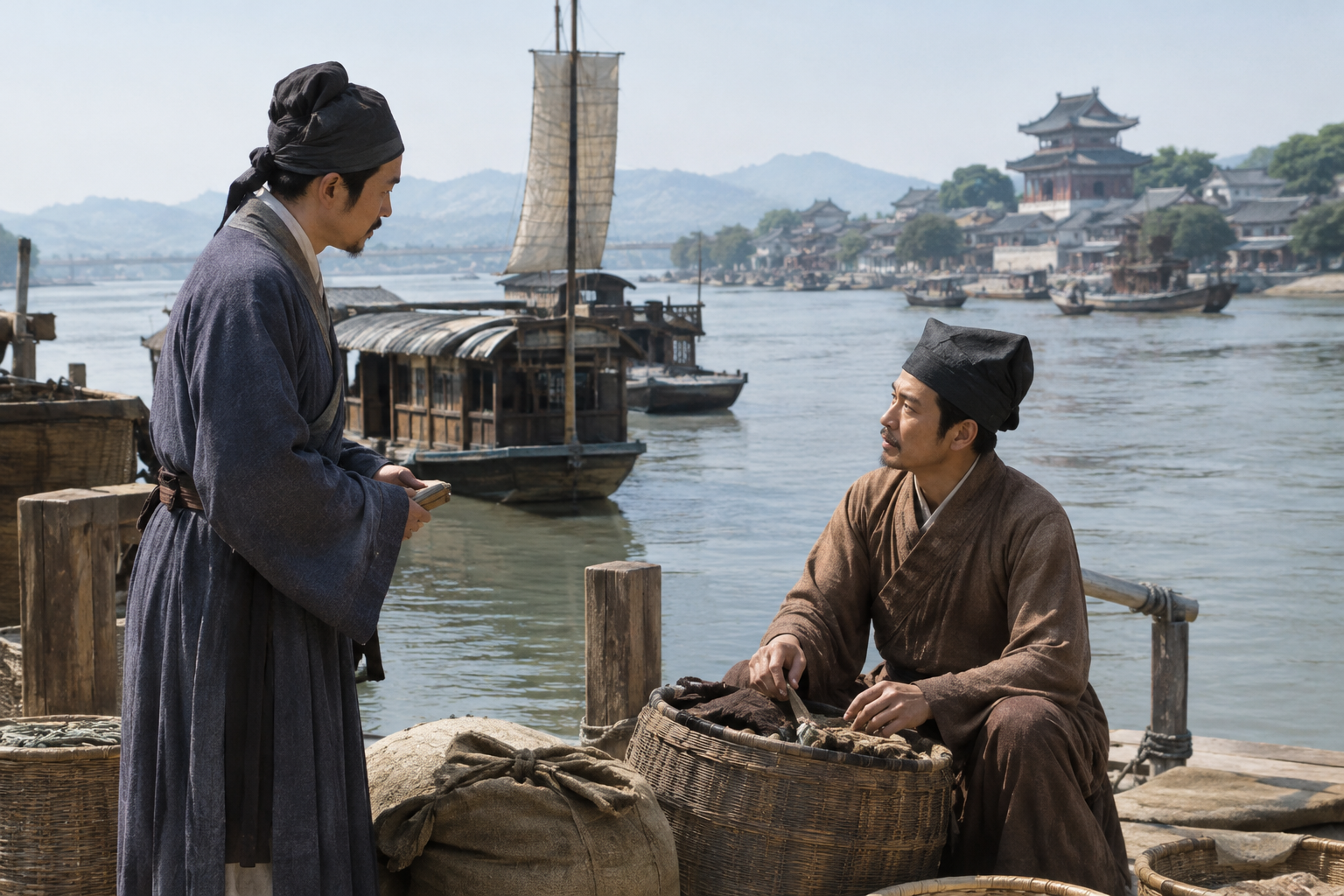
Two men from the Yangtze River region, identified as 21LHKMM16L and 21LHKMN112, are presently the clearest ancient signposts here for Y-DNA haplogroup O1a1a2a. Both are dated to around AD 960 and come from medieval China in the long span from Song to Qing periods. That may sound modest at first glance, but in ancient DNA terms it is rather valuable: instead of a vague modern distribution map, we have actual male line evidence anchored to a specific river world at the opening of the Song era.
The Yangtze was not just a river. It was one of the great arteries of Chinese history, tying together farming landscapes, market towns, transport corridors, and imperial administration. When a paternal lineage like O1a1a2a appears in this setting, it places that line inside a historically dense and economically powerful region, not on the margins of the record. Y-DNA traces one direct paternal line only, not a person's whole ancestry, but it can still tell us something precise about how male lines persisted in real communities.
The date matters. Around AD 960, China was entering the Song dynasty, a period often associated with remarkable commercial growth, expanding literacy, new urban forms, and a more integrated internal economy. The Yangtze basin was central to that transformation. So these two O1a1a2a-linked men belong not to some shadowy prehistory, but to a world of fields, waterways, tax registers, local lineages, and increasingly busy regional exchange.
That is one reason the evidence is so interesting. Ancient Y-chromosome results are often discussed in terms of deep origins alone, but historical-period samples let us see something else: continuity and social placement. These men show that the branch was present in medieval east-central or south-central China within a major settled population zone. The lineage was not merely surviving somewhere in the abstract; it was part of a lived historical landscape.
O1a1a2a is a specific branch within the broader East Asian Y-chromosome family usually grouped under haplogroup O. That broader parent haplogroup has a long and complicated history across East and Southeast Asia, but one has to be careful here: the ancient samples in hand support discussion of this branch in a medieval Yangtze context, not sweeping claims about every movement ever associated with haplogroup O.
In other words, it would be rash to turn two medieval men into a grand migration epic all by themselves. What they do support is a more disciplined point. O1a1a2a was present among males living in a major Chinese riverine zone by the early second millennium AD, and that presence fits a wider picture in which Chinese population history was shaped by both deep regional continuity and repeated episodes of movement, mixing, and local expansion.
That broader caution is especially important in East Asia, where ancient DNA is rapidly refining older assumptions. A useful comparison comes from MyTrueAncestry's discussion of 6,000 Years of Genomic History in the Middle Yellow River, which shows how population histories in China become much more interesting once they are tied to actual archaeological regions rather than treated as one uniform block.
There is a temptation, when confronted with only two sample IDs, to dismiss them as thin evidence. Archaeologically, though, repeated appearance in the same broad region and period can be quite informative. It suggests that O1a1a2a was not a one-off anomaly in the medieval Yangtze basin. Even without claiming close kinship or elite status, the pair hints at a lineage established enough to appear more than once in the recoverable record.
The exact sample IDs deserve to remain visible because ancient DNA history is built from such particulars. 21LHKMM16L and 21LHKMN112 are not literary symbols; they are excavated individuals whose remains preserved enough paternal genetic signal to connect them to this branch. That is how the field advances: one securely attributed burial, then another, and only after that any larger interpretation.
Research on these burials has been linked to a genetic study of medieval remains from China. Even where every archaeological detail is not publicly laid out in a short summary, the importance of such work is clear. It pushes ancient DNA beyond prestige tombs and famous rulers, into ordinary or semi-ordinary communities where demographic history actually happened.
The Yangtze basin has long been one of the places where Chinese history resists simplification. It is a zone of rice agriculture, major internal migration, military campaigning, state incorporation, and regional identity all at once. Any paternal lineage found here may reflect not just local continuity, but centuries of people moving along waterways, settling new lands, joining expanding administrations, or becoming part of lineages recorded only faintly in written sources.
That makes O1a1a2a especially interesting in context. A medieval Yangtze occurrence does not tell us the branch began there, but it does show that by this period it belonged within one of the most important demographic engines of East Asia. If your own paternal line falls under O1a1a2a, these samples place at least part of that story within a landscape that was central to the making of later Chinese population patterns.
There is also a useful historical contrast here. Elite clans and dynastic households often dominate written history, but ancient DNA keeps reminding us that regional populations were built through many layers of kinship and mobility. Studies of later imperial China, including clan-based work and cemetery studies, show how marriage networks, local descent groups, and regional settlement all shaped the genetic landscape. A lineage like O1a1a2a may therefore have spread not through a single dramatic event, but through the much more ordinary processes of family growth, agricultural settlement, and local persistence.
For the public, one of the hardest things to grasp about Y-DNA is scale. Historical narratives like "Song China" or "the Yangtze economy" are vast. A haplogroup is tiny by comparison: one narrow paternal thread running through that immense fabric. Yet this is precisely why such evidence is compelling. It allows us to ask where one male line can actually be seen, and in what kind of society.
O1a1a2a, in this case, is visible not in myth or genealogy alone but in two ancient individuals from a major medieval Chinese region. That anchors the branch in a concrete historical world. It also fits neatly beside other MyTrueAncestry discussions of East Asian paternal history, especially Ancient Y Chromosomes and East Asian paternal migrations, where ancient male-line evidence helps separate genuine historical structure from guesswork.
The most responsible thing to say about O1a1a2a is also the most useful. Ancient evidence places this paternal branch in the medieval Yangtze River world by around AD 960, through the individuals 21LHKMM16L and 21LHKMN112. That does not turn the lineage into a dynasty or an ethnicity, but it does give it a real archaeological foothold in one of the great population centers of Chinese history. For anyone exploring this haplogroup today, that is a meaningful starting point: a paternal line present in the riverine heartland of medieval China, where continuity and movement were constantly shaping the people who lived there.


Comments