Haplogroup N1c

– 5 min read


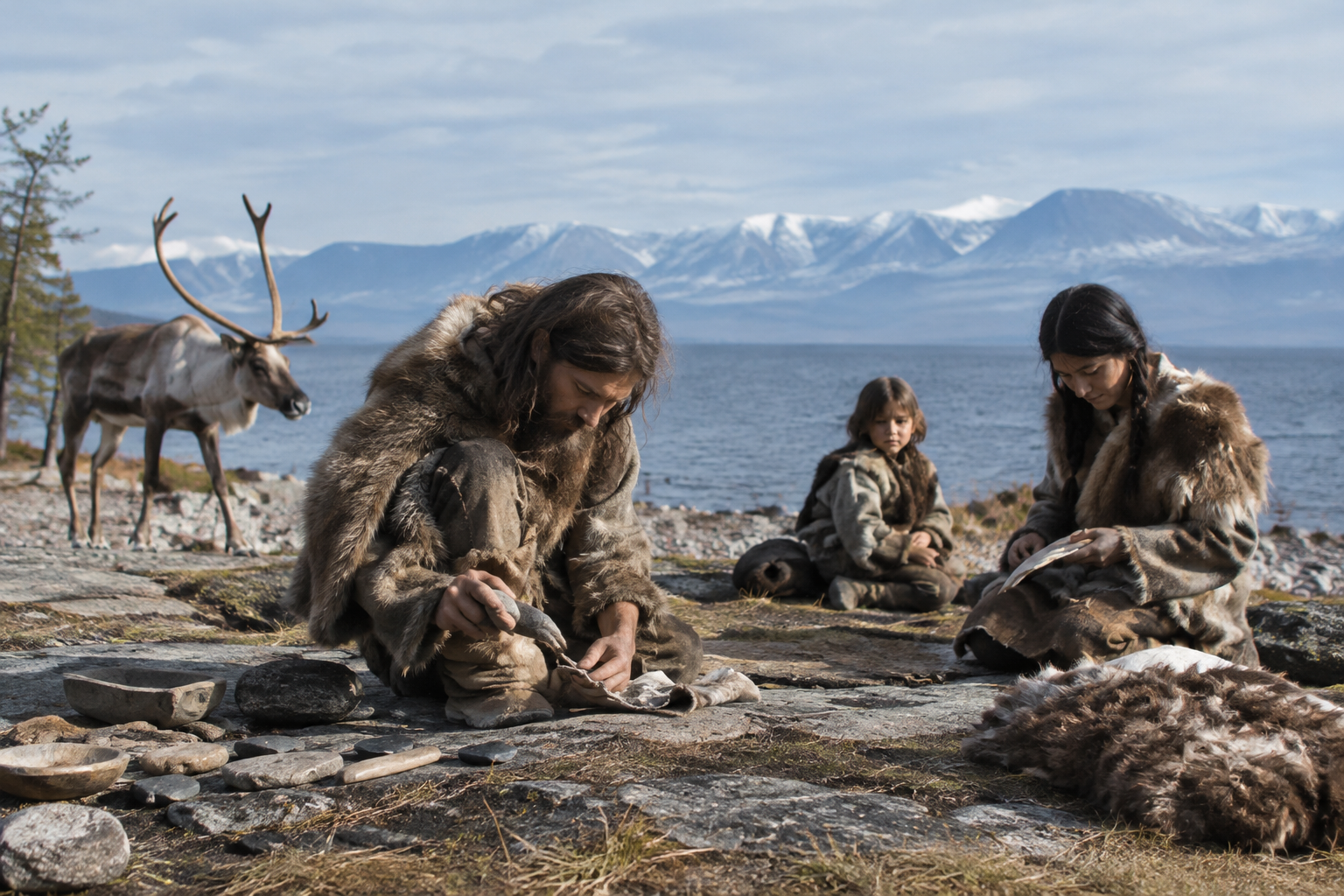
At Lokomotiv, near Lake Baikal in southern Siberia, archaeologists uncovered one of the most important early cemeteries in northern Eurasia. Among the ancient individuals from this Early Neolithic site is sample DA359, dated to around 5598 BC in the Cis-Baikal region of Russia. That matters for anyone interested in Y-DNA haplogroup N1c, because finds like this push the story of the lineage far away from the tidy modern maps people often imagine.
N1c is today best known from northern and northeastern Europe and across parts of northern Eurasia, especially among several Uralic-speaking and neighboring populations. But Y-DNA follows only one direct paternal line out of the thousands that make up a person's ancestry. Ancient DNA is so useful because it puts that paternal line back into real places, real burials, and real prehistoric communities. In this case, the setting is not medieval Finland or the Baltic, but an Early Neolithic cemetery by Baikal.
The Lokomotiv cemetery belongs to a much deeper human landscape than the later historical world usually associated with N1c. Cis-Baikal, the broad region west of Lake Baikal, has produced some of the best-preserved hunter-gatherer and early Holocene burials anywhere in Eurasia. These cemeteries have long attracted archaeologists because they allow us to see communities, mortuary traditions, and biological continuity across millennia rather than just isolated skeletons.
Sample DA359 is important precisely because it is so early. A paternal lineage associated with N1c appearing in this context reminds us that the history of the haplogroup belongs to the long prehistoric formation of northern Eurasian populations, not simply to later ethnic labels. It also cautions against forcing ancient people into much later identities. An Early Neolithic man buried near Baikal was not "Finnish" or "Baltic" in any historical sense; he was part of a local forager world whose descendants and genetic legacies would be reshaped many times over.
A genetic study connected with these Baikal-region remains is linked through this ancient DNA research archive, which has helped place Cis-Baikal populations into the wider picture of northern Eurasian prehistory. Even without overclaiming from a single sample, DA359 stands as a useful anchor point: N1c-related paternal ancestry was present in the wider north Asian sphere very early indeed.
People often meet haplogroups backwards. They start with modern frequency maps, then read history into them as if the present distribution had always existed. Ancient DNA has rather spoiled that comforting habit. A lineage common today in the forests and lake districts of northeastern Europe may have a much older archaeological background stretching deep into Siberia and the forest zone of northern Eurasia.
That is where DA359 becomes especially interesting. The value of the sample is not that it solves the entire origin story of N1c on its own; it does not. Its value is that it fixes the lineage, or an immediately relevant branch-level assignment, in a concrete Early Neolithic setting. Once a haplogroup appears in securely dated ancient remains, the conversation changes. We are no longer guessing only from present-day populations. We are dealing with a man who lived in a known region, in a known prehistoric mortuary landscape, around the sixth millennium BC.
It also helps explain why N1c is so often discussed alongside northern mobility, forest-zone adaptation, and long-distance population connections across Eurasia. The archaeological world around Baikal was never cut off from wider processes. Over time, northern Eurasia saw repeated movements of people, technologies, and languages through river corridors, taiga, steppe margins, and lake basins. Y-chromosome lineages could expand, contract, and shift in prominence within those changing networks.
If one were writing old-fashioned migration history, one might be tempted to draw a bold arrow from Baikal straight to the Baltic and declare the matter settled. Archaeology is rarely so obliging. What the evidence supports more carefully is that lineages related to N1c belonged to the deeper population history of northern Eurasia, and that later expansions carried some branches westward into the forest belt where they became especially prominent.
This is why N1c is so often discussed in relation to Uralic-speaking populations, northeastern Europe, and the Volga-Baltic world. But language and Y-DNA are not the same thing. A haplogroup can spread through demographic expansion, founder effects, elite reproduction, or population mixing, and later become common among communities speaking very different languages. The direct lesson from the Baikal evidence is not "this sample proves a language family," but rather that the paternal roots of some later northern Eurasian populations reach into a much older eastward sphere than medieval chronicles could ever tell us.
For MyTrueAncestry readers, that makes N1c one of those haplogroups that can feel geographically deceptive. Its modern strongholds may suggest a mainly European story, but its ancient background reaches into the great northern arc connecting Siberia and Europe.
Later ancient DNA from Finland, the Baltic, or medieval northern Europe can show where branches of N1c became established in historically recognizable populations. Useful though that is, it tells only the later chapters. Cis-Baikal gives us something earlier and in some ways more precious: evidence from before the rise of those later regional identities.
The Baikal cemeteries are valuable because they sit in a zone where northern Eurasian population history can be studied over long spans of time. They illuminate communities living by hunting, fishing, and seasonal resource use in one of the world's most demanding but productive environments. When a paternal lineage tied to N1c turns up there, the haplogroup stops being merely a modern ancestry result and becomes part of the archaeology of prehistoric lifeways.
That perspective also helps temper simplistic ideas about ancestry purity or linear descent. The man represented by DA359 was not a mascot for a modern nation. He belonged to an ancient community whose descendants would have mixed, moved, divided, and recombined over thousands of years. Yet his Y-chromosome still matters, because paternal lines can preserve traces of those deep histories even when languages, material culture, and population structure have changed dramatically.
There is a reason N1c keeps appearing in discussions of the forest zone, the Volga region, the eastern Baltic, and Finland. Over later prehistory and history, some branches of this paternal lineage became unusually successful across the north. Ancient DNA has increasingly shown that northern Europe was never a closed genetic island. It was connected eastward through repeated pulses of contact and movement, some subtle and some substantial.
That larger theme sits behind many recent archaeogenetic studies of Finland and adjacent regions. For readers interested in where later northern populations fit into that picture, one useful comparison is the growing body of work on early medieval Finland and Baltic connections. Those studies belong to a much later period than Lokomotiv, but they make more sense once one has grasped that the story did not begin in the Middle Ages.
There is also a broader methodological point here. Ancient Y-chromosome evidence works best when set alongside archaeology rather than treated as destiny. A cemetery like Lokomotiv tells us about a community in place; the haplogroup adds one thread of male-line descent within that community. Put together, they offer a sharper and more human account of prehistory than either can alone.
If your paternal line belongs to N1c, the most responsible historical takeaway is not a single origin myth but a very long northern Eurasian background. Sample DA359 from Early Neolithic Lokomotiv shows that this lineage, or a directly relevant branch association, was already present in the Baikal world around 5598 BC. That makes N1c a lineage with deep roots in the ancient populations of northern Eurasia and a later history that would unfold across the forest belt into northeastern Europe.
For family historians, that is both humbling and rather thrilling. Your direct paternal line may connect not just to recent regional histories, but to communities living beside Lake Baikal in the early Holocene, in a world far older than nations, surnames, or written history.




Comments