Haplogroup N1b1

– 5 min read


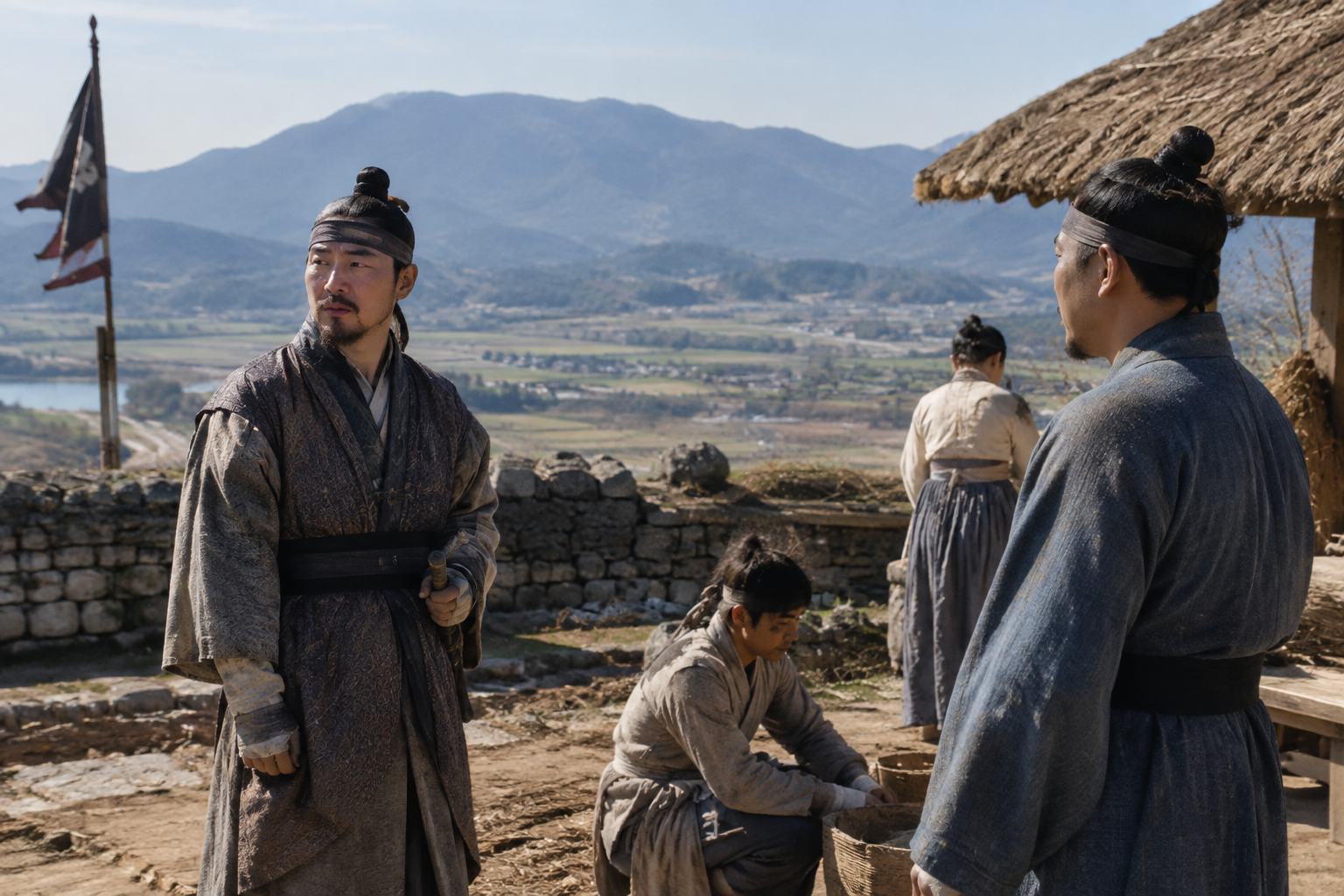
At Joyeong-dong in Gyeongsan, in southeastern Korea, ancient DNA has put a very precise label on one otherwise anonymous man: sample JOY021, dated to around AD 500, in the era of the Korean Three Kingdoms. His Y-chromosome was reported as N1b1, a paternal lineage that immediately catches the eye because it is much more often discussed in the wider story of northern Eurasia than in the archaeology of early Korea.
That is exactly why JOY021 matters. He is not a cartoon representative of a whole kingdom, nor proof of some sweeping one-way migration. But he is a real excavated individual from a real historical landscape, and his paternal line offers a useful glimpse into how varied male ancestry could be in the peninsula during the centuries when Silla, Baekje, and Goguryeo were competing, expanding, and absorbing people from different regions.
Gyeongsan lies close to the old Silla heartland in southeastern Korea. By around AD 500, this was a politically lively and socially layered region, tied into networks of warfare, marriage, trade, and elite competition. Archaeology from the broader area has long shown that the peninsula was no sealed box. Goods, technologies, and styles moved; people almost certainly did too.
JOY021 sits within that larger picture. The value of a Y-DNA assignment such as N1b1 is not that it tells us everything about him. It does not. Y-DNA tracks one direct paternal line only: father to son, and so on. But in combination with place and date, it can show that lineages associated more broadly with northern and northeastern Eurasian histories had a place, however modest or local, in the human mix of early historic Korea.
An ancient DNA study examining these Korean burials has helped bring that complexity into focus, and the underlying research materials are associated with this archived study resource. Even without overloading the evidence, JOY021 is enough to remind us that the peninsula's past was peopled by individuals whose paternal origins did not always fit modern nationalist expectations.
The haplogroup in question here is N1b1, a branch within the broader Y-chromosome haplogroup N. That wider haplogroup has a long and complicated history across northern Eurasia, showing up in different populations at different times and at different subclade levels. The crucial point is that one should not lazily pour the whole history of haplogroup N into this narrower label.
In JOY021's case, the evidence supports discussion of N1b1 as the reported paternal assignment. That does not automatically tell us where his immediate father or grandfather was born, what language his household spoke, or whether he would have identified with any later ethnic category. Ancient DNA is wonderfully revealing, but archaeology is full of traps for the overconfident.
Still, N1b1 in a Three Kingdoms context is historically suggestive. It points to the kind of paternal diversity one would expect in a region connected to Manchuria, the Yellow Sea world, and inland exchange routes. States such as Silla did not arise in genetic isolation. They were political creations built out of local continuities, alliances, incorporation of outsiders, and the ordinary untidy business of human reproduction over centuries.
One of the most useful lessons from ancient DNA in East Asia is that old kingdoms were seldom biologically neat. Archaeologists have long known this from material culture alone. Cemeteries, settlement changes, imported objects, and shifting mortuary customs all hint at contact and mixture. Genetics has not replaced that older work; it has sharpened it.
JOY021 should therefore be read as a clue to variation rather than as a mascot for a grand theory. A single man with N1b1 in Gyeongsan around AD 500 does not mean that N1b1 dominated Silla territory, nor that it arrived in one dramatic episode. It does, however, fit a peninsula history in which different streams of ancestry met and were folded into emerging states.
This is especially important because early Korean history is often told through kingdoms and courts, as if political borders mapped neatly onto populations. They did not. Borders shifted. Elites intermarried. Captives were taken. Specialists moved. Communities absorbed newcomers. A paternal lineage like N1b1 is best understood inside that moving, historical landscape.
East Asian Y-Chromosome Migrations
Part of what makes JOY021 so interesting is that haplogroup N, in its broader sense, is often associated with histories far to the north of the Korean peninsula: Siberia, parts of northeastern Asia, and in some branches even much farther west into Uralic-speaking regions of Europe. That does not mean JOY021 came from any one of those places, still less that N1b1 in Korea must be recent or foreign in a simple sense. It means his paternal line belongs to a family of lineages with a very wide northern footprint.
That wider setting matters because Korea was never cut off from continental processes. The peninsula sits at the edge of the mainland, but edges are busy places. They receive, redirect, and rework influences. Some paternal lines may have deep local roots within northeastern Asia; others may reflect movements over shorter or longer distances. The job of good history is to keep those possibilities open until evidence narrows them.
For readers interested in how ancient paternal lines illuminate movement across East Asia more broadly, MyTrueAncestry has also explored cases from northern China and adjacent regions, where shifting populations can sometimes be followed over long spans of time.
Middle Yellow River Genomic History
It is fashionable to dismiss single samples as too small to say anything. That is only half right. One sample cannot stand in for a whole people, but one sample can still change the questions we ask. JOY021 tells us that by around AD 500, a man carrying Y-DNA N1b1 was living and dying in the Gyeongsan area. That fact is modest, but it is not trivial.
In archaeology, modest facts accumulate. A cemetery here, another burial there, a new genome from a nearby valley, a kinship pattern in one tomb cluster, a different isotopic signal in another. Before long, the old smooth picture gives way to a much more convincing rough one. That is often how real history works: not as revelation from a single king's inscription, but as a mosaic built from stubborn fragments.
There is a useful comparison here with other East Asian studies showing that burial communities can be both locally rooted and genetically varied. Even where close kinship networks are present, lineages need not be uniform across an entire region or period.
If your paternal haplogroup is N1b1, JOY021 offers a grounded and rather intriguing point of contact with the ancient world of Korea's Three Kingdoms period. Not proof of royal descent, not a shortcut to ethnicity, and not a complete map of your ancestry - but evidence that this paternal branch was present in at least one documented man living near the Silla sphere around AD 500. For family historians, that is the right sort of excitement: specific, archaeological, and honest about its limits.




Comments