Haplogroup N1a1a1a1a3a

– 6 min read


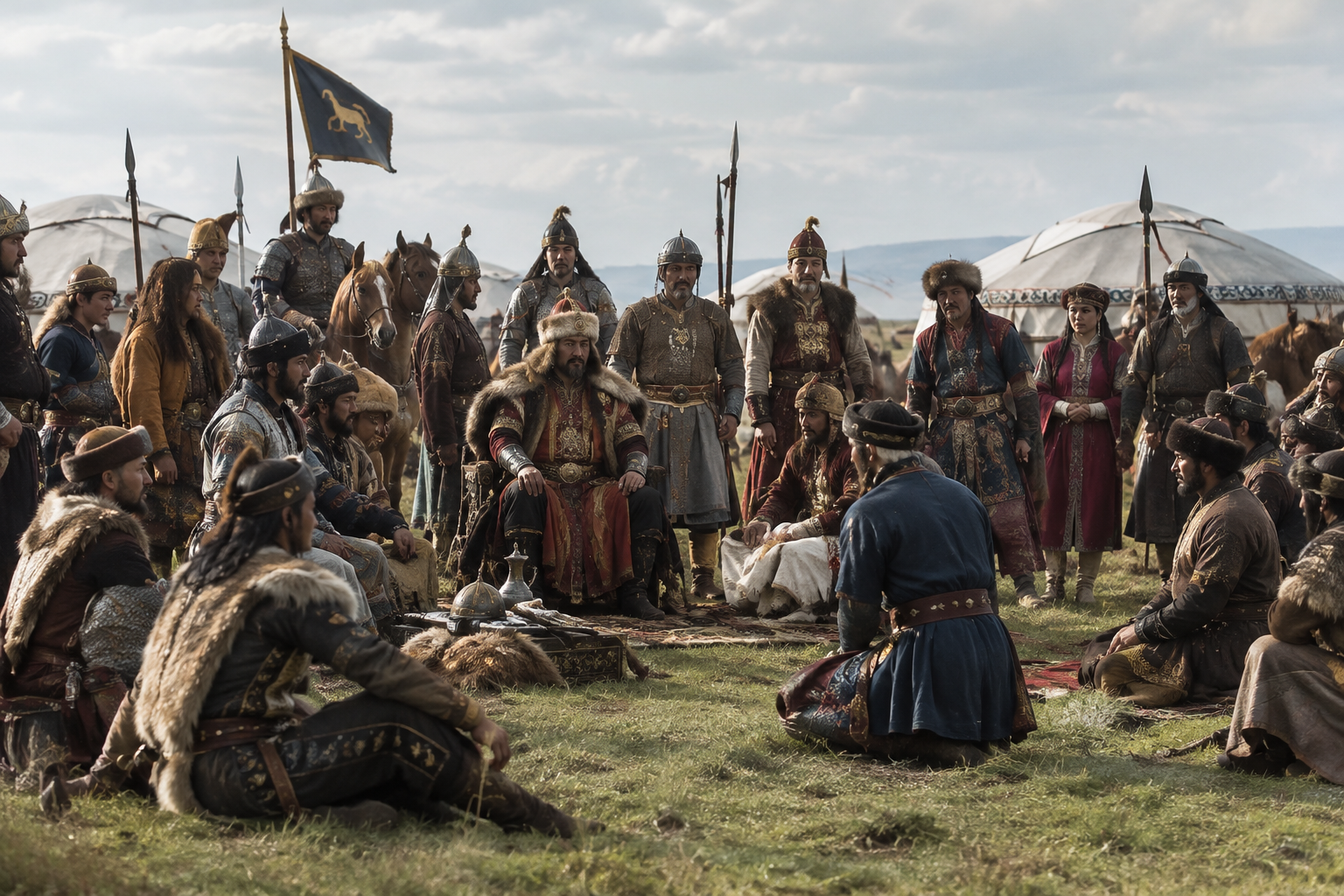
Haplogroup N1a1a1a1a3a is one of those Y-chromosome lineages that becomes especially interesting when ancient DNA pulls it out of the abstract world of mutation labels and drops it into real graves, real landscapes, and real moments of political change. In this case, the story does not begin in a tidy medieval pedigree or a well-documented royal tomb. It begins with the Avar world of the 7th and 8th centuries, in elite burials across the Carpathian Basin and as far west as Austria.
That matters because Y-DNA traces a direct paternal line: father to son to grandson, and so on. It is powerful, but also limited. A Y-haplogroup does not describe a person's whole ancestry, culture, language, or identity. What it can do is illuminate one narrow but important thread of the past. For N1a1a1a1a3a, the evidence supplied here points most clearly to an Avar-period elite context, where paternal continuity, political power, and mobility across the steppe and into Central Europe seem to have gone hand in hand.
N1a1a1a1a3a is a very specific downstream branch within the broader Y-DNA haplogroup N family, a major paternal lineage with a long history across northern Eurasia. Broadly speaking, haplogroup N has deep associations with populations spread across parts of Siberia, the forest-steppe, and northeastern Europe. But one must be careful here: the full history of haplogroup N cannot simply be pasted onto this narrow subclade. A branch as specific as N1a1a1a1a3a represents a much smaller paternal history within that larger tree.
What the sample set strongly suggests is that this particular lineage was present among high-status Avar men in the Carpathian Basin during the early medieval period. That does not prove where the branch first arose, nor does it mean every Avar carried it. What it does show is that this paternal line had become prominent in at least some elite circles of the Avar Khaganate, one of the most formidable powers in Central Europe after the collapse of Roman authority in the region.
If you want a wider look at the eastern and steppe-side background against which lineages like this are often discussed, MyTrueAncestry readers may also enjoy this broader piece on the subject.
Explore Ancient DNA of the Steppe
What is striking about the supplied ancient DNA evidence is not merely the presence of the haplogroup, but its repetition in elite contexts. At Kunpeszer in Hungary, a cluster of early Avar elite graves dated to 609 AD produced multiple individuals assigned to this branch: KUP006, KUP026, KUP022, KUP005, KUP002, KUP001, and KUP027. One sample can be intriguing. Seven or eight in related archaeological circumstances begin to look like a pattern.
And it is a pattern with social implications. Such concentration in elite burials suggests that certain paternal lines may have been important in the inner structure of Avar power. This does not necessarily mean all these men were close biological kin, though some may well have been. It does suggest that the ruling or military strata of the khaganate could preserve and reproduce particular paternal lineages over generations.
The same impression is reinforced by other sites. The Early Avar Leader Hungary Kunpeszer-Felsopeszeri ut Homokbanya Year:645 AD ID:KFP-6 places the lineage in a leadership context. So does High Ranking Khagan Retinue Avar Kunpeszer-Felsopeszeri Hungary Year:650 AD ID:A1822. Most dramatic of all is Khagan Ruler Avar-Period Budapest Hungary Year:650 AD ID:A1802. The phrase "Khagan ruler" is not a casual label. It places this paternal lineage in the orbit of the supreme political authority of the Avar state.
Then there are the later elite burials at Kunszallas-Fulopjakab: A1812, A1813, A1814, A1815, A1817, A1819, and A1821, dated to around 700 AD. Add to these KFJ018 and KFJ033 from 650 AD, CSPF-213 from 685 AD, and I16741 from 750 AD, and we are looking at something more enduring than a single burial episode. This was a paternal line with staying power inside the Avar-period elite world.
For a broader regional discussion of how genetics is reshaping our view of this same landscape, see:
Discover Post-Roman DNA in Hungary
The Avars arrived in Europe in the 6th century as part of the wider turbulence of the steppe world. Written sources describe a mounted confederation, militarily formidable, politically flexible, and deeply entangled with Byzantium, Slavs, and the remnants of Roman provincial society. Archaeology has long shown the mixture: horse gear, prestige weapons, belt sets, steppe-style elite display, and local adaptation in the Carpathian Basin.
The genetic evidence adds another layer. A lineage such as N1a1a1a1a3a appearing so frequently in Avar elite graves fits well with the historical impression that the khaganate included powerful eastern-derived paternal networks. That does not mean the Avars were genetically uniform. Far from it. Steppe empires were often coalitions, bringing together people of varied origins under a military-political umbrella. But elite male lines could still carry disproportionate importance in the transmission of authority.
There is also a geographical point worth pausing over. One of the supplied samples, LEO009, comes from an Early Medieval Avar Grave Austria Leobersdorf Baden Year:720 AD. That is west of the Avar heartland in Hungary and reminds us that Avar influence was not static. It stretched into the frontier zones of Central Europe, where imperial pressure, local settlement, and elite burial display all intersected. In other words, this haplogroup is not just turning up in "the East"; it is visible in the western edge of the Avar world as well.
If the frontier setting interests you, this article offers another useful comparison for how mobile and mixed post-Roman populations could be in Central Europe:
Read About the Origins of the European Huns
In this case, the supplied field for associated noble families and castles is empty, and that absence is worth stating plainly. There is a temptation in genetic storytelling to leap from an ancient elite burial to a later dynasty, a castle, or an aristocratic house and declare some hidden continuity. But without specific family data, that would be invention dressed up as confidence.
What we can say, responsibly, is that haplogroups like N1a1a1a1a3a help illuminate the kind of paternal structures from which later noble traditions eventually emerged: elite male descent lines, status displayed in burial, and power anchored in territory. In the Avar case, those territories were not stone-castle lordships in the later medieval sense. They belonged to an earlier political order based on mobile power, military retinues, and regional dominance across the plains and river corridors of the Carpathian Basin.
That contrast is historically useful. Medieval castles often preserve memory in masonry. Avar elite graves preserve memory in goldwork, horse equipment, weapons, and now DNA. Both are ways societies marked rank, belonging, and inheritance - but in very different political worlds.
Readers interested in how later Hungarian ruling traditions are investigated through genetics may want to compare this Avar evidence with a later dynastic case:
Explore the DNA of the Arpad Dynasty
The real interest of N1a1a1a1a3a lies in how vividly it appears in one historical setting. Some haplogroups are known through broad modern distributions. This one, from the evidence supplied here, stands out because ancient DNA catches it in the act - embedded in the upper ranks of the Avar world.
That does not make every modern carrier an "Avar," still less the descendant of a khagan. Shared haplogroups can connect men across vast spans of time with no recoverable family tree between them. But it does mean that if this paternal line appears in a modern result, one historically grounded possibility is a connection, somewhere along the paternal chain, to the eastern and steppe-linked histories that fed into the early medieval Carpathian Basin.
Ancient DNA is so valuable precisely because it gives us this sort of correction to the written record. Chronicles tell us about rulers, wars, embassies, and raids. Graves tell us about status and ritual. Genetics adds an entirely different question: which paternal lines were present, persistent, and perhaps privileged within those structures of power?
For N1a1a1a1a3a, the answer supplied by the archaeology is unusually clear. This was not just any lineage drifting anonymously through the past. In the Avar period, it appears repeatedly among men buried with the marks of command, wealth, and political significance.
If your Y-DNA belongs to a branch like N1a1a1a1a3a, ancient DNA can place that paternal line in a much bigger historical setting - not by proving you descend from a specific ruler or noble house, but by showing where related lineages appear in the archaeological record. Uploading your DNA to MyTrueAncestry can help you explore whether your results show links to ancient individuals, populations, and regions such as the Avar-period Carpathian Basin discussed here.
Comments