Haplogroup N1a1a1a1a1a1a5b

– 5 min read


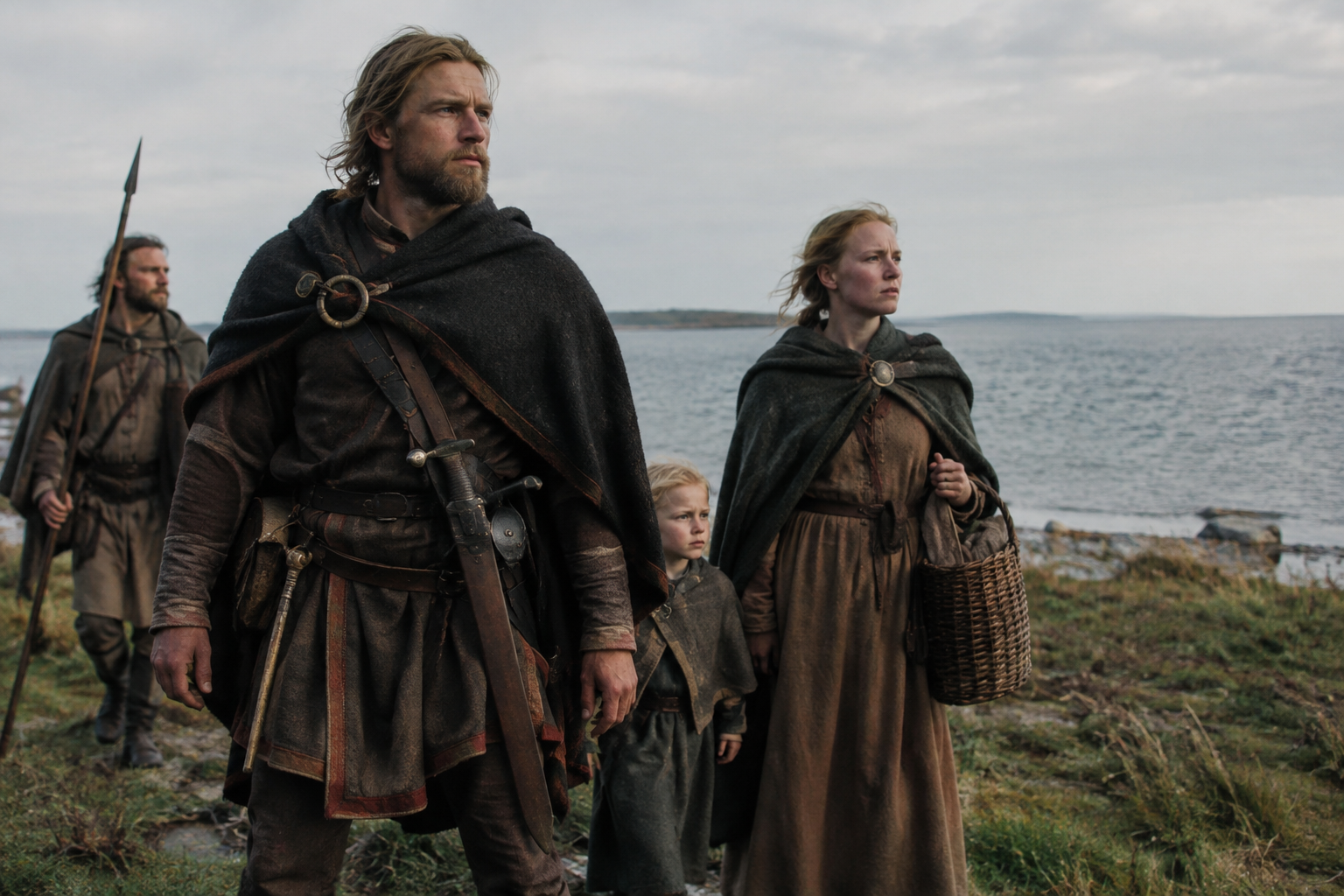
On the island of Saaremaa in Estonia, at Salme I, archaeologists uncovered one of the most arresting groups of early medieval dead in the Baltic world. Among them was an individual identified as VK505, dated to around AD 725 and associated here with the Y-DNA haplogroup N1a1a1a1a1a1a5b. Even with that single paternal clue, the setting matters enormously: Salme is not an abstract point on a genetic map, but part of a real episode of mobility, conflict, and seaborne contact in the Vendel Age, just before the classic Viking Age took shape.
This is what makes N1a1a1a1a1a1a5b interesting in an archaeological context. It turns up not in a remote prehistory beyond explanation, but in a maritime frontier where Scandinavia, the eastern Baltic, and Finnic-speaking regions all met. Y-DNA traces one direct paternal line rather than a person's whole ancestry, but in a site like Salme even that single line can illuminate the mixture of people moving around the northern seas in the 8th century.
Salme has become famous because it preserves evidence for a violent episode involving men buried in a distinctly martial context on Saaremaa. The burials belong to the Vendel Age, the period immediately preceding the Viking Age proper, when eastern routes across the Baltic were already busy with raiding, alliance, trade, and seasonal movement. VK505 belongs within that world, not as a legend from saga literature, but as a tested ancient individual from a site that has transformed discussion of northern mobility.
The importance of Saaremaa is geographical as much as historical. The island sits on sea lanes linking east-central Sweden, the Gulf of Finland, the Estonian coast, and farther routes into the eastern Baltic. A paternal lineage such as N1a1a1a1a1a1a5b appearing in this setting is a reminder that the Baltic was not a neat boundary between peoples. It was a contact zone, and often a rough one.
Research on these northern populations has helped place sites like Salme into a wider genomic frame, though caution is needed when moving from broad regional studies to a precise terminal branch. An ancient DNA study of the region, available at https://www.biorxiv.org/content/10.1101/703405v1, reflects the growing effort to understand how eastern Baltic and Scandinavian connections were shaped by both local continuity and long-distance movement.
Early Medieval Finland and Baltic links
The article haplogroup sits deep within haplogroup N, a major Y-chromosome family with a long history across northern Eurasia. That broad parent clade has often been discussed in relation to Uralic-speaking regions and populations spread across the forest and lake zones of the north, but one must not simply paste that entire story onto a very narrow branch such as N1a1a1a1a1a1a5b. The smaller the branch, the more careful we need to be.
What can be said responsibly is that a branch like this fits a northern Eurasian paternal background that is entirely plausible in the eastern Baltic world of the 8th century. At Salme, that matters because the site has often been framed through Scandinavian-style warfare and seafaring. VK505 complicates any tidy ethnic picture. A martial burial setting can contain men with different paternal origins, reflecting the realities of recruitment, alliance, fosterage, mercenary service, marriage networks, or earlier population blending.
It is easy to imagine islands as margins. Saaremaa was nothing of the sort. In the early medieval Baltic it was central to movement, a place where ships could land, crews could gather, and violence could erupt. The Salme dead are important precisely because they show the northern sea world before later written chronicles became fuller and more self-conscious.
VK505's association with N1a1a1a1a1a1a5b sits comfortably within that picture of a connected Baltic. The eastern side of the sea was home to communities speaking Finnic languages and participating in regional exchange systems that were old by the 8th century. Contacts with Scandinavia did not begin with Viking fame; they were already embedded in the geography of the sea.
That makes the paternal signal noteworthy. Rather than treating Salme as a purely Swedish or purely Estonian story, the genetics encourage a more entangled reading. A burial group may look culturally coherent in one sense and still preserve diverse male lines, because ships and warbands are social formations, not biological isolates.
One reason Salme matters so much is chronology. Around AD 725 places it in the closing Vendel Age, just before the conventional start of the Viking Age. That is exactly the moment when archaeologists want better evidence for who was moving, how armed groups were organized, and whether eastern routes were peripheral or fundamental to Scandinavian expansion. Salme argues strongly for the latter.
In that setting, N1a1a1a1a1a1a5b is less a badge of fixed identity than a sign of how layered these communities already were. The Baltic was a world in which language, material culture, ancestry, and political loyalty did not always travel together. A man could be buried in a context shaped by one cultural sphere while carrying a paternal line with deeper roots in another regional population history.
This is why ancient DNA has been so useful for the early medieval north. It does not replace archaeology; it makes the archaeology less complacent. Salme was already a remarkable discovery from its burial context alone. The genetic evidence adds a sharper point: the men involved in these events were not necessarily drawn from a single simple background.
Germanic languages and ancient genomics
For many readers, haplogroup N immediately raises the question of Finnic or Uralic connections. That is a sensible historical question, especially in the eastern Baltic, but it must be handled with care. A Y-chromosome lineage can hint at long-term paternal geography, yet it does not by itself assign a man his everyday language, political allegiance, or ethnic self-understanding.
Still, at Salme the question is worth asking because Saaremaa lay in a region where such northern lineages formed part of the deeper human background. If VK505 belonged to N1a1a1a1a1a1a5b, that sits neatly with a Baltic world in which local eastern populations and incoming Scandinavian groups were already interacting closely. One should imagine overlap and mixture, not separate colored blocks on a map.
That same caution is useful when reading broader regional studies. Northern populations changed over time, and paternal lineages could expand, contract, or move in ways that do not mirror whole populations exactly. The value of VK505 is therefore not that he "proves" one people replaced another, but that he gives us a specific male line inside a specific historical episode.
If your paternal line falls under N1a1a1a1a1a1a5b, Salme's VK505 offers a vivid but properly modest point of connection. It places this lineage in the eastern Baltic during a formative age of seaborne warfare and regional interaction, on a site that captures the world just before Viking expansion became historically famous. The strongest insight is not a grand claim about one tribe or dynasty, but something more interesting: this was a northern lineage present in a contact zone where Baltic and Scandinavian histories were already tightly intertwined.
Comments