Haplogroup N1a1a1a1
– 4 min read


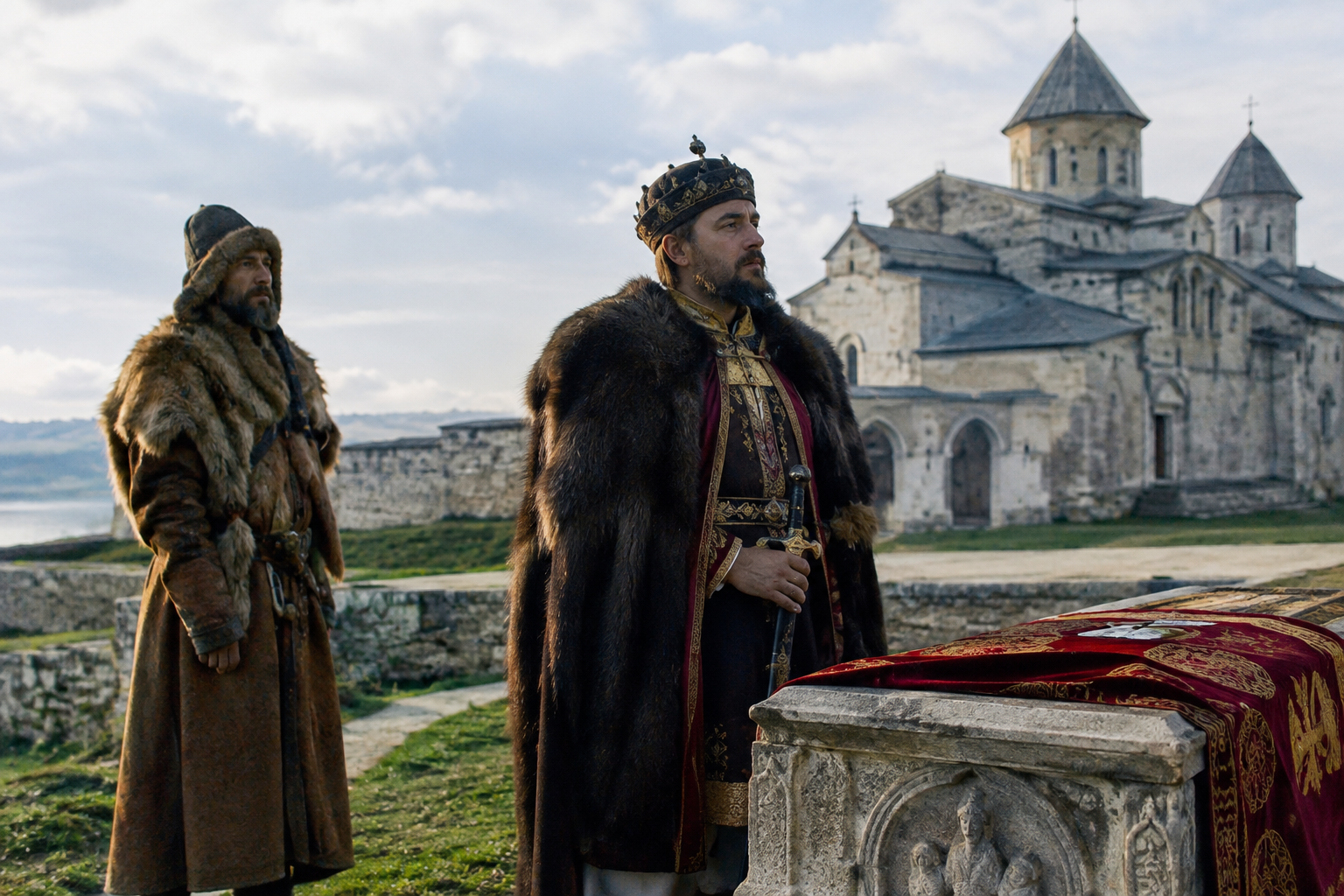
In the early 15th century, a man identified as HUASper57 was buried in a prominent grave at a Benedictine monastery in Hungary and associated with the Royal House of Aba. That is already an arresting historical setting: a noble burial, a monastic landscape, and a family remembered in medieval Hungarian politics. Genetically, this individual is reported in connection with Y-DNA haplogroup N1a1a1a1, a paternal line that also appears in a much earlier sample far to the east, at Uyelgi in the Trans-Ural region.
The pairing is what makes this haplogroup especially interesting. One sample belongs to a medieval Hungarian noble context around AD 1405; the other, Uyelgi19, comes from the Trans-Urals around AD 900. That does not mean one man was descended from the other, nor that a single lineage can explain whole peoples. But because Y-DNA traces one direct paternal line, this small cluster offers a sharp glimpse of how some male lines connected the forest-steppe world east of the Urals with later elites in the Carpathian Basin.
The earlier of the two samples, Uyelgi19, comes from Uyelgi in Trans-Ural Russia and dates to about AD 900. This is a crucial place in discussions of early medieval population movements linked to the wider Ural region and to the background of the Hungarian conquest era. A study of ancient individuals from the region, published in Scientific Reports, helped draw attention to eastern connections visible in the archaeology and genetics of this zone.
Uyelgi matters because it sits in a region long treated as a meeting ground rather than a sealed ethnic box. Archaeologists working across the southern Urals and Trans-Urals have been interested in how communities there combined local traditions with broader steppe links. When a paternal lineage such as N1a1a1a1 appears in this setting, it adds weight to the idea that some male lines later found in the Hungarian sphere had deeper roots in populations east of the Carpathians.
That said, one should be careful with labels. A haplogroup is not a language, not an ethnicity, and not a ready-made national origin story. Uyelgi19 tells us that this paternal branch was present in the Trans-Ural world around the turn of the 10th century; it does not, by itself, define the whole identity of the buried man or everyone around him.
Southern Urals and early Hungarians
For readers used to seeing Hungarian history told only from the Carpathian Basin westward, N1a1a1a1 is a useful corrective. This is one of the paternal branches often associated, in broad terms, with northern Eurasian and Ural-linked populations. That broad background should not be lazily copied onto every fine sub-branch, but it does help explain why the appearance of N1a1a1a1 in Hungarian medieval material is historically meaningful rather than surprising.
Early Hungarian ethnogenesis was not the product of a single origin point or a single paternal lineage. It involved mixtures of steppe, Ural-region, and European elements over time. A more recent ancient DNA study on medieval Hungarian elites, available as a bioRxiv preprint, has further highlighted how conquest-period roots and later elite histories can still preserve signals of those older eastern connections.
So when N1a1a1a1 turns up in both a Trans-Ural sample and a later Hungarian noble burial, the historical interest lies not in a simplistic tale of migration from point A to point B, but in continuity of one paternal strand across very different political worlds. The same branch can move through time from frontier cemeteries to aristocratic monasteries without implying that everything else stayed the same.
The later sample, HUASper57, is described as a prominent grave of Hungarian nobility associated with the Royal House of Aba, at a Benedictine monastery, dated around AD 1405. Even without embellishment, that is enough to place the individual in a very specific historical environment: Christian, monastic, aristocratic, and thoroughly embedded in the political order of late medieval Hungary.
This matters because it shows that a paternal line linked with deeper eastern horizons was not confined to the age of migration or conquest. By the 15th century, such a lineage could appear in a noble burial shaped by centuries of Hungarian statehood, Christianity, landed power, and aristocratic memory. In other words, the line had not remained on the edge of events. It had become part of the social fabric of a kingdom.
The Royal House of Aba is historically significant in medieval Hungary, with roots reaching back into the kingdom's early centuries. But genetics must be handled precisely here. A sample from a burial associated with that house does not prove the Y-DNA of every Aba descendant, nor does it allow us to flatten a complex noble kindred into one chromosome line. What it does provide is a rare and valuable paternal data point anchored in a recognizable elite setting.
The contrast between the two samples is almost the whole article. Uyelgi19 belongs to the Trans-Ural world around AD 900, a period relevant to the eastern background of populations linked with the Hungarian conquest era. HUASper57 belongs to a noble Christian burial in Hungary roughly five centuries later. The haplogroup N1a1a1a1 appears in both settings, bridging not a straight road but a long historical transformation.
Between those dates lies one of the great reorganizations of Eurasian history: mobile confederations, settlement in the Carpathian Basin, the formation of the Hungarian kingdom, conversion to Christianity, and the emergence of medieval noble houses whose identities were political and territorial as much as ancestral. A paternal lineage can survive across all that, but it survives as one thread among many. That is what makes Y-DNA so powerful and so limited at the same time.
Medieval Hungary's elite genomes
If you belong to Y-DNA haplogroup N1a1a1a1, these ancient matches suggest that your direct paternal line fits into a story with real depth in the Ural and Hungarian historical worlds. The evidence here does not prove descent from a named noble house, still less from a specific medieval individual. But it does place this branch in two compelling contexts: an early medieval Trans-Ural population and a later Hungarian noble burial associated with the House of Aba.
That combination is distinctive. It hints that some paternal lines carried east-derived ancestry into the heart of medieval Hungary and remained there long enough to appear in elite Christian settings centuries later. For family historians, that is often the most valuable sort of result: not a fantasy pedigree, but a firmer sense of the historical landscapes through which a paternal line may have travelled.




Comments