Haplogroup L1a2a
– 5 min read


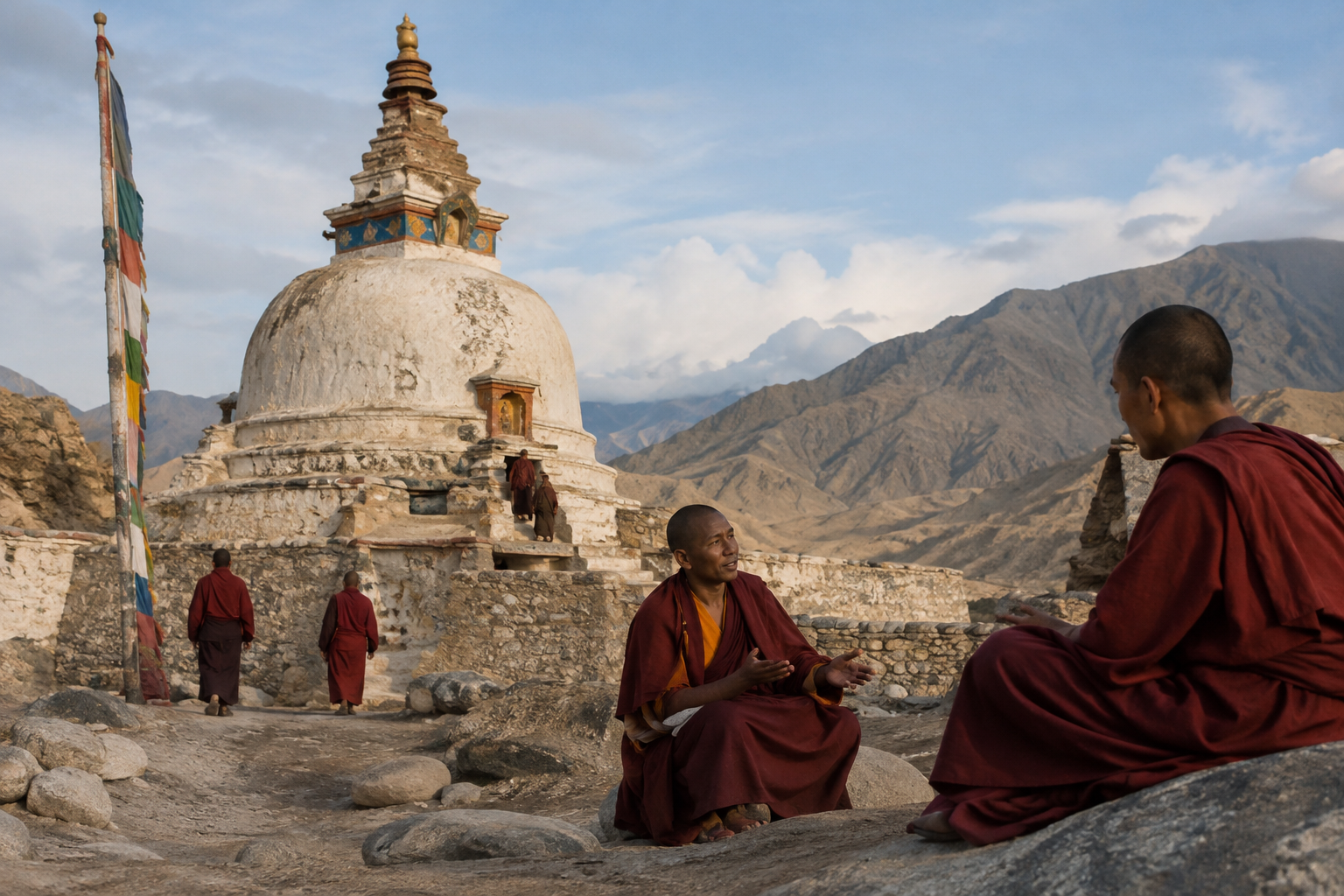
At Saidu Sharif, in the Swat Valley of present-day Pakistan, ancient DNA has put a very specific paternal line into a very specific historical landscape. One of the men recovered from the Buddhist monastery cemetery there, sample I7721, dated to around 300 BC, is associated here with the Y-DNA haplogroup L1a2a. That is already interesting, because Saidu Sharif sits in one of those borderland regions where South Asia, Central Asia, and the Iranian world met not in theory but in daily life.
The temptation with a lineage like L1a2a is to leap straight into grand migration stories. Better to start where the evidence is strongest. We have an ancient individual from an early historic religious site in Gandhara's orbit, from a valley famous for monasteries, trade routes, and cultural mixture. A Y-chromosome result does not tell us everything about him; it traces one direct paternal line only. But in the right setting, even that single line can be historically eloquent.
Saidu Sharif Buddhist Monastery is not some isolated mountain shrine. It belonged to the wider cultural world of ancient Gandhara, a region shaped by Achaemenid rule, contacts with the Hellenistic world after Alexander, and later the growth of Buddhist institutions along important routes through the northwest of the subcontinent. By around 300 BC, the Swat Valley was already part of a deeply connected zone.
That makes I7721 valuable beyond the bare fact of a haplogroup label. L1a2a is a branch within the broader Y-DNA haplogroup L, a lineage long associated above all with South Asia and nearby regions. Seeing a representative of this branch in the Swat Valley in the early historic period fits the archaeology rather well: this was not an empty corridor periodically "filled" by outsiders, but a settled and complicated human landscape with its own local paternal histories.
An ancient DNA study connected with these Swat Valley remains helped establish just how informative the region can be for questions of continuity and mixture in early South Asian history. For readers who want the research context behind these burials, one key scientific source is this ancient DNA study of the Swat Valley material.
Haplogroup L1a2a is not a culture, a language, or a kingdom. It is a branch on the paternal tree: father to son, back through time. That sounds narrow, and it is narrow, but narrow evidence can still matter a great deal when tied to archaeology. In this case, it places one paternal lineage from the wider L family firmly in an ancient population of the northwest subcontinent.
It is also important not to overstate the precision. The article haplogroup is L1a2a, but ancient samples are not always published at the same level of downstream resolution in every study. Where the reporting is broad, one should be careful not to pretend that every tiny branch has been nailed down with modern genealogical neatness. The point is not false precision; the point is that this paternal ancestry belonged in the population history of the Swat-Gandhara region long before the medieval and early modern periods.
For many MyTrueAncestry users, that is the real value. L1a2a is not appearing here as an imported curiosity dropped into the region by a single dramatic event. In the context of ancient northwest South Asia, it looks like part of a deeper local and regional story.
There is something especially revealing about finding such a lineage at a Buddhist monastery site. Monasteries are religious places, of course, but archaeologically they are also social crossroads. They stand at the intersection of patronage, travel, teaching, burial, and local community life. A cemetery attached to such a place can preserve not only belief, but the human diversity of the society sustaining it.
That matters for how we imagine the Swat Valley in the centuries around 300 BC. This was not a sealed ethnic box. It was a region in contact with upland groups, lowland agricultural communities, traders, pilgrims, and political powers reaching in from beyond the Hindu Kush. An individual like I7721, carrying a paternal line associated with L1a2a, belongs inside that world of interaction without needing to be turned into a symbol of any one conquest or text-defined people.
Ancient DNA from borderland regions often reveals exactly this sort of complexity: not a neat replacement of one people by another, but layers of ancestry and lineages surviving through change. That broader lesson appears in many parts of Eurasia, even when the local details differ sharply.
The Swat Valley has long attracted historians because it refuses simple categories. It is geographically in the northwest of South Asia, yet historically it has often been discussed through Central Asian, Iranian, and Hellenistic connections as well. That is precisely why a haplogroup article should resist crude labels. A paternal lineage found here may reflect long regional continuity, older movements into the valley, or mixing across neighboring zones over many generations.
What we can say responsibly is that I7721 shows the presence of this paternal branch in a place where cultural traffic was intense. Gandharan art, Buddhist institutions, and regional polities all developed in conversation with wider worlds, but none of that erased the older human base of the region. If anything, the genetics and the archaeology together suggest a population history made not of one origin story, but of accumulation.
That is one reason northwest South Asia has become so important in archaeogenetics. It complicates the old habit of dividing populations into tidy civilizational boxes. The people buried in and around sites like Saidu Sharif were living the consequence of centuries of interaction, and their DNA preserves part of that history in molecular form.
Now, one sample is one sample. It cannot stand in for the entire Swat Valley, still less for all bearers of L1a2a. But ancient Y-DNA evidence is often valuable precisely because it is so concrete. A lineage that may feel abstract in a modern test result suddenly becomes attached to a real cemetery, a real historical region, and an era when Buddhism, trade, and political change were reshaping the northwest.
This is where archaeology saves genetics from becoming too airy. Saidu Sharif is not just a dot on a map. It is part of the material history of Gandhara: monasteries, settlement, ritual life, and the human communities around them. When a lineage such as L1a2a appears there, the result is not merely technical classification. It becomes evidence that the paternal history of the region included branches still recognizable today.
Readers interested in how ancient DNA keeps sharpening our view of connected frontier regions may also find it useful to compare other studies of movement and mixture across Eurasia.
If your paternal line is L1a2a, Saidu Sharif offers a sober but fascinating anchor point. It suggests that this branch, or a closely related paternal line within that part of haplogroup L, was present in the ancient northwest of the subcontinent by around 300 BC, in a region shaped by both strong local roots and far-reaching connections. That does not make every modern bearer a descendant of I7721 in any simple recent sense. What it does offer is something better: a historically grounded glimpse of your lineage in an early Gandharan setting, where archaeology and genetics briefly meet the same man.



Comments