Haplogroup L1a

– 5 min read


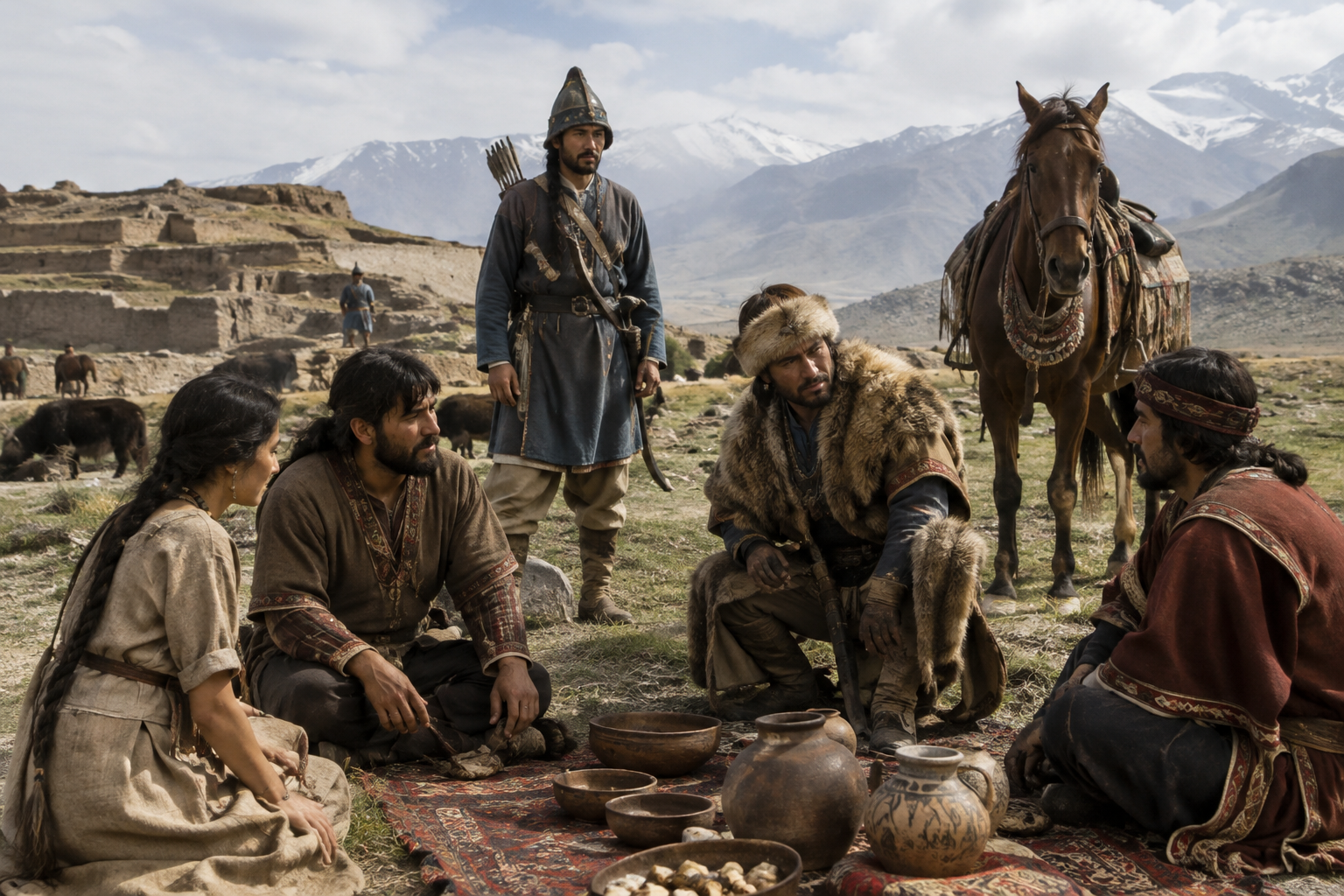
At Monjukli Depe in ancient Turkmenistan, archaeologists uncovered one of the more intriguing early signposts for haplogroup L1a: sample NEO310, dated to about 4600 BC. That is a strikingly early appearance in a site tied to the deep Neolithic history of southern Central Asia, where settled farming communities were already part of a much bigger story linking Iran, Central Asia, and the lands further east.
For anyone researching this paternal line, that matters because Y-DNA follows one direct male line only: father to son to son, across many generations. It does not describe a person's whole ancestry, but it can show where one thread of that ancestry surfaces in the archaeological record. In the case of L1a, the current sample set does not point to one empire, one tribe, or one famous dynasty. It points instead to something more historically interesting: persistence across a long corridor running from Neolithic settlement zones into later Iron Age and steppe-connected worlds.
Monjukli Depe sits in a region that was never isolated, however distant it can seem on a modern map. Southern Turkmenistan was part of the broad zone where early farming lifeways spread, adapted, and developed local forms. The appearance of NEO310 there around 4600 BC places L1a, or a reported lineage associated with this branch, in one of the oldest settled contexts in this article.
That does not mean Monjukli Depe was the "origin" of L1a, still less that every later L1a line descends from this one excavated man. But it does show that the lineage was present in a community living centuries before the Bronze Age urban florescence of Central Asia. Research on ancient Eurasian population history has increasingly shown that this region was a zone of movement and mixture rather than a cul-de-sac, as seen in wider ancient DNA work on Eurasian populations published in Science.
For L1a, then, the earliest clue here is not royal or martial. It is agricultural and local: a man from a settled Neolithic community in a region that would later become central to long-distance exchange between Iranian, Central Asian, and South Asian worlds.
Much later in time, the record shifts westward into the highland belt of Iran and Armenia. Sample I4233 from Hasanlu in Iron Age Iran, dated around 1350 BC, places the lineage in a famous archaeological landscape of fortified settlements and complex regional politics. Hasanlu is important because it belonged to a world of local polities, trade networks, and cultural contact zones rather than to a single neat ethnic category.
Then there is I16119 from Karmir Blur in Armenia, dated around 231 BC. Karmir Blur is associated with the great fortified tradition of the South Caucasus and the long afterlife of Urartian-era political landscapes. By the Hellenistic period, when this individual lived, the region had already seen centuries of imperial pressure, local continuity, and reorganization.
Taken together, Hasanlu and Karmir Blur are valuable because they show L1a in settled, stratified, historically busy regions of the Iranian plateau and South Caucasus. This is a useful corrective to the lazy habit of treating paternal lineages as if they belong naturally to only one people or one language family. In real history, a Y-chromosome branch can endure while kingdoms fall, languages shift, and identities are remade.
Another important data point is I12445 from Udegram, dated around 900 BC. Udegram lies in the Swat region of present-day Pakistan, an area with an extraordinarily layered history. This is a frontier in the proper historical sense: not an empty edge, but a zone where mountain routes, river valleys, and political worlds met.
That matters for L1a because the lineage has often been discussed in relation to South Asia and adjacent regions, yet ancient evidence is what gives such discussions weight. A sample from Iron Age Udegram helps anchor the branch in a real archaeological setting on the northern subcontinental interface. It suggests that by the early first millennium BC, this paternal line was present in communities linked to the wider cultural traffic between Central Asia and South Asia.
One should be careful here. A haplogroup is not a language, and it is not a caste, kingdom, or civilization. But an L1a-associated sample in Udegram does fit a broader historical picture in which the mountain corridors north of the Indus were transmitting people as well as goods and ideas.
Central and South Asian mixing
The most mobile-looking setting in this group is DA85 from Ekachat in the Tian Shan of Kyrgyzstan, dated to about AD 269 and described as Hunnic Period. This does not mean the individual can simply be labelled "a Hun" in the blunt way older popular history liked to do. The Hunnic world was not genetically uniform, and steppe confederations gathered people of varied origins.
Still, this sample is historically revealing. By the third century AD, the Tian Shan corridor connected Inner Asia, the steppe, and the settled lands to the south and west. An L1a-associated male here shows that the branch was not confined to early farming villages or Iranian plateau settlements. It also appeared in the kind of mixed frontier environment that characterized late antique Central Eurasia.
Ancient DNA studies of eastern steppe and corridor populations have repeatedly shown how much movement passed through these landscapes, even when local communities retained continuity of their own. Broader research on these interaction zones, including material connected with the Tian Shan and adjacent regions, can be seen in Nature.
Eastern Tianshan genetic mixing
With just these samples, the safest description of L1a is not that it belonged to one famous migration, but that it appears across a broad arc of Asia over a very long time. The evidence here runs from Neolithic southern Central Asia to Iron Age Iran, Armenia, and Udegram, then onward into the Hunnic-period Tian Shan. That is not a trivial spread. It places the branch in both settled and mobile settings, and in regions that were repeatedly connected by trade, pastoral movement, and imperial expansion.
Just as important is the pattern of continuity-with-change. The same paternal branch can appear in a farming settlement, a highland fortress zone, and a steppe-linked corridor without implying that all those men shared one recent identity. Archaeology is good at restoring that complexity. It reminds us that lineages survive through changing social worlds, not outside them.
If your Y-DNA belongs to L1a, this small but suggestive ancient record places your direct paternal line in some of Eurasia's most important contact zones: Neolithic southern Central Asia, the Iranian and Caucasian highlands, the northwestern edge of South Asia, and the Tian Shan world of late antiquity. That does not offer a single heroic origin story. Better than that, it offers a historically credible one: a lineage present again and again where regions met, mixed, and endured.

Comments