Haplogroup L15

– 5 min read


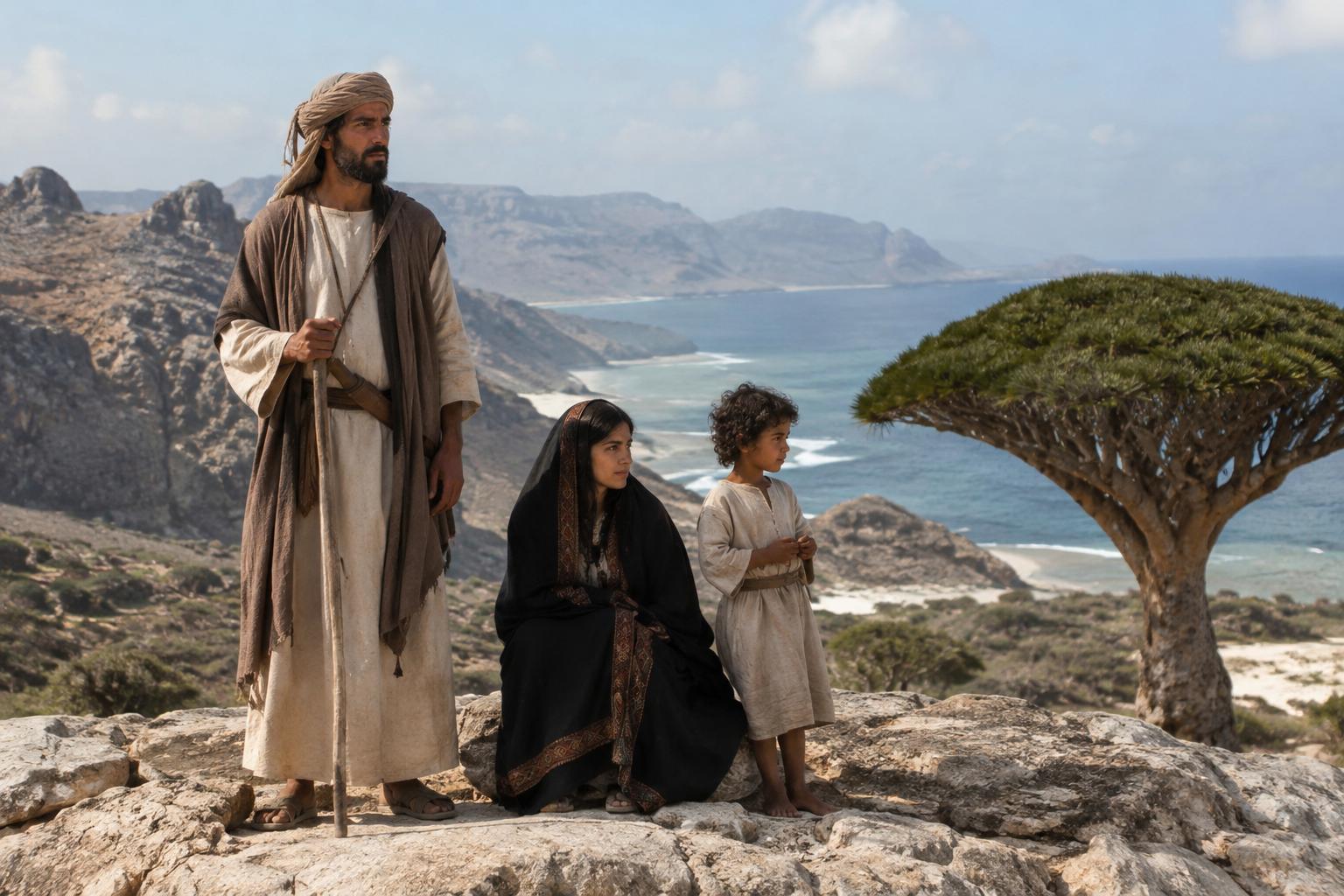
One of the most intriguing breadcrumbs for Y-DNA haplogroup L15 comes not from a great empire or a famous royal tomb, but from an island in the Arabian Sea. The ancient individual I21110, dated to around AD 900, was found at Momi, Zaflah, on Soqotra in Yemen. That matters because Soqotra has long sat at a maritime crossroads: remote enough to preserve local traditions, but connected enough to receive merchants, pilgrims, sailors, and settlers from several shores.
If you carry L15 today, that does not tell the whole story of your ancestry; Y-DNA follows just one direct paternal line. But it can still be historically revealing. In this case, the presence of L15 in early medieval Soqotra hints at paternal ancestry tied into the wider human traffic of southern Arabia and the northern Indian Ocean, rather than a neatly bounded, isolated population.
Soqotra often gets treated as a kind of romantic outlier, all dragon's blood trees and windswept isolation. Historically, though, that can be misleading. The island lay on sea routes linking Arabia, East Africa, and South Asia, and its communities were shaped by that position. An ancient DNA study of the region, published in research on medieval and earlier populations around the southern Arabian sphere, has helped place individuals like I21110 into that broader setting.
The sample itself is modest in the best archaeological sense: one person, one site, one paternal line. Yet that is exactly how archaeogenetics so often advances. A single male burial carrying L15 does not prove that all medieval Soqotrans belonged to the same lineage, nor that L15 was dominant there. What it does show is that this branch was present in an island community whose history makes sense only when we think in terms of mobility, exchange, and layered ancestry.
Haplogroup L is an old and geographically wide-ranging Y-chromosome lineage with important branches found across South Asia, parts of Iran, and regions around the Arabian Sea. L15 is a more specific branch within that larger paternal family. That distinction matters. It is quite wrong, historically and genetically, to take the whole spread of haplogroup L and simply paste it onto the narrower branch L15 as though nothing changed over time.
With the evidence here, the careful thing to say is this: L15 belongs to a paternal cluster whose wider history points toward connections across southern and southwestern Asia, and the Soqotra sample shows that one such line had reached, or persisted on, that island by about AD 900. Whether the ancestor who brought that lineage there arrived generations earlier or more recently is another question entirely.
And this is where archaeology does its useful corrective work. Genes can suggest relatedness and movement, but islands like Soqotra are documented historically as places where language, religion, trade, and family history did not always travel together. A paternal lineage may be old in one place, newly introduced in another, or mixed into a community that is culturally quite different from its place of earlier origin.
The place-name matters almost as much as the haplogroup. Momi, Zaflah is not just a dot on a map. It belongs to a landscape of settlement and burial on Soqotra that offers rare ancient DNA evidence from a region where preservation, sampling, and political access have often limited the picture. In other words, I21110 is important partly because southern Arabia and its islands remain underrepresented in ancient Y-DNA studies compared with Europe.
That imbalance can distort popular imagination. Readers are often surrounded by dramatic stories of steppe migrations, Viking cemeteries, or royal dynasties, while the Indian Ocean world looks oddly silent. But it was not silent. It was full of movement. A medieval man on Soqotra carrying L15 fits a historical zone where merchants from western India, Arabian ports, and the Horn of Africa interacted across centuries.
Bronze and Iron Age Mesopotamia DNA
Even so, restraint is essential. We should not turn I21110 into a merchant, sailor, or immigrant merely because the island was connected. The sample anchors L15 in a real early medieval context on Soqotra; the exact biography of that individual remains unknown.
For understanding L15, the most useful historical frame is not a modern national border but the Arabian Sea world. This was a zone of monsoon navigation, coastal trade, religious contact, and family formation over many centuries. Genetic lineages moved through it in ways that were often gradual and cumulative rather than dramatic and conquest-driven.
That is why a Yemeni island context can be so suggestive for a lineage also associated more broadly with populations to the east. The old habit of dividing ancestry into neatly separate boxes - Arabian, Persian, Indian, African - works rather poorly in ports, islands, and sea-lanes. Soqotra sits exactly in that awkward, historically fertile space where identities overlap and paternal lines may preserve traces of contacts that written sources only partially describe.
In practical terms, a modern tester with L15 may find that their paternal story points not to one single homeland but to a corridor of interaction stretching across coasts and islands. The Soqotra evidence supports that sort of historically entangled picture far better than any tidy origin myth.
The dating to around AD 900 places I21110 in a period when the Islamic world was already linking the Red Sea, the Gulf, East Africa, and western India through commercial and intellectual exchange. Soqotra was never the center of that world, but it was certainly not outside it. A paternal lineage like L15 appearing there in this period belongs to a historical moment when maritime connectivity was a normal fact of life.
This helps guard against a common mistake in haplogroup storytelling: assuming that every lineage in a place must reflect deep prehistoric settlement alone. Sometimes it does. Sometimes it reflects later historical mobility layered onto older populations. The medieval context of I21110 keeps that possibility firmly in view.
It also reminds us that ancient DNA does not only illuminate prehistory. Early medieval and medieval samples can be just as revealing, especially in regions where written sources are patchy, local, or written from the viewpoint of outsiders. A single Y-chromosome assignment cannot rewrite the history of Soqotra, but it can make that history more human and more specific.
At present, the clearest ancient signal in this article is straightforward: L15 is attested in the early medieval Soqotra sample I21110 from Momi, Zaflah, Yemen. That places this paternal branch in a real island community shaped by Indian Ocean connections. For someone researching a modern L15 line, the most responsible takeaway is not a grand claim of descent from a particular tribe or dynasty, but a historically grounded possibility of links to the interconnected worlds of southern Arabia and the wider Arabian Sea.
That may sound modest, but in archaeology modesty is often where the real excitement lies. One named individual, one island, one paternal branch - and suddenly a remote medieval burial becomes part of a much larger story about movement, contact, and the stubborn usefulness of ancient DNA in recovering lives that history barely wrote down.

Comments