Haplogroup L1
– 5 min read


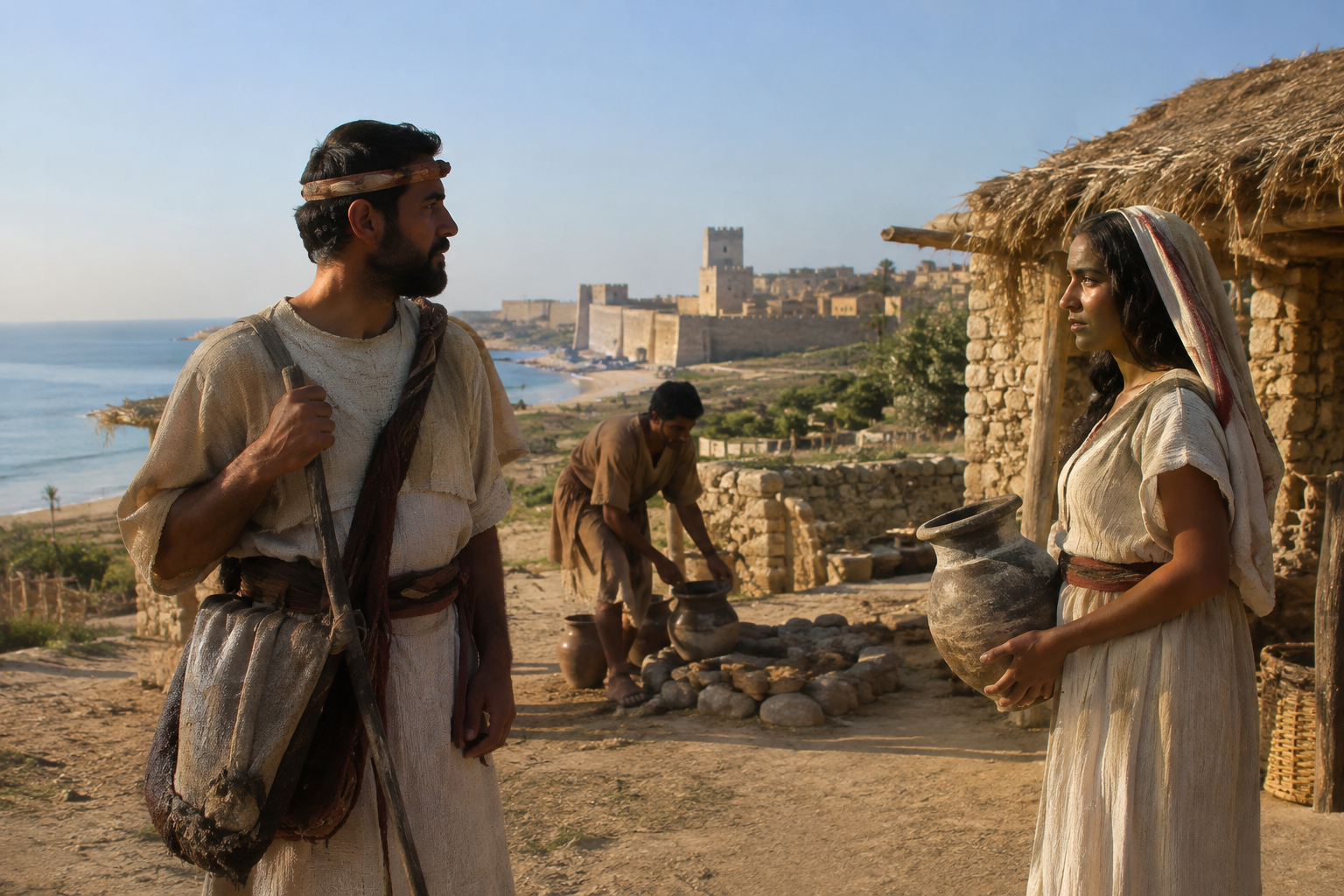
At Ashkelon on the southern Levantine coast, one Late Bronze to early Iron Age burial has become unexpectedly important for the history of Y-DNA haplogroup L1. The individual known as ASH087_ASH_IA2, dated here to around 1250 BC and identified as a Canaanite from Ashkelon, anchors this article in a real place at a real historical moment: a port city standing between Egypt, the inland Levant, and the wider Mediterranean.
That matters because Ashkelon was never an isolated town. It was one of those coastal places where people, goods, languages, and family lines met. If a paternal lineage associated with L1 appears here, it does not give us a simple label for one "people." What it does give us is a glimpse of one direct male line present in a famously connected Canaanite population on the eve of major upheavals in the eastern Mediterranean.
Ashkelon in the later second millennium BC was a major urban center in Canaan. It belonged to that world of fortified cities, maritime exchange, and regional diplomacy that linked the Levant to Cyprus, Anatolia, Egypt, and Mesopotamia. By around 1250 BC, this was a society already deeply entangled with long-distance movement, even before the political crises that transformed the eastern Mediterranean a century later.
The sample ASH087_ASH_IA2 is therefore interesting not because it can single-handedly define Ashkelon, but because it places haplogroup L1 within an archaeological setting that is both local and international at once. In plain terms, Y-DNA follows one direct paternal line only. It is a sharp tool for tracing one strand of ancestry, but it is never the whole ancestry of a person or a city.
A widely discussed ancient DNA study of Ashkelon and its surrounding periods drew attention to the population history of this coastal center and the shifts seen there across the Bronze and Iron Ages. For readers who want the research context behind the site, that work can be found here: https://advances.sciencemag.org/content/5/7/eaax0061.
Earlier burials in ancient Israel
The designation in this article is L1, and it is worth being careful here. Haplogroup names can refer either to broad parent branches or to narrower downstream lines, and the deeper history of a whole parent haplogroup should not be lazily pasted onto every one of its sub-branches. With ancient DNA, the level of resolution can vary depending on preservation and sequencing quality.
So the safest reading is this: an ancient man from Canaanite Ashkelon has been reported in association with L1. That tells us that a paternal line of this kind was present in the southern Levant during the Late Bronze Age or very early Iron Age. It does not by itself prove a recent migration from any one region, nor does it turn L1 into a specifically "Canaanite" haplogroup in any exclusive sense.
Still, presence matters. Ancient port cities are often where lineages appear in combinations that later historians find surprising. Not because the ancients were confused about identity, but because real populations were much messier than neat textbook categories. Ashkelon, with its trading connections and strategic location, is exactly the sort of place where a paternal lineage could arrive generations earlier, become local, and then simply be part of the city's ordinary human fabric.
One of the most useful ways to think about ASH087_ASH_IA2 is not as an isolated genetic curiosity, but as evidence for the kind of social world Canaanite cities inhabited. Ashkelon was a coastal node. Ships came and went; inland routes tied the city to other Levantine centers; imperial powers took a keen interest in the region. In such a setting, paternal lineages could persist locally while the wider population absorbed influences from several directions.
This is why ancient DNA from Ashkelon has had such impact. It helps move discussion away from old habits of imagining sharply bounded ancient peoples. A Canaanite burial from around 1250 BC carrying a lineage linked here to L1 reminds us that ancestry in the Bronze Age Levant was already the product of long histories of contact.
That broader eastern Mediterranean pattern also helps explain why later periods in the region so often show mixed biological and cultural backgrounds. Ports, garrison towns, and market centers repeatedly drew in newcomers while preserving deep local continuity. Ashkelon belongs to that long tradition.
Anatolia and Mediterranean DNA movement
There is only one ancient individual listed here: ASH087_ASH_IA2. Normally, that is a reason for restraint rather than grand conclusions. But a single well-placed sample can still be historically valuable when it comes from an important site and a sensitive period.
The date attached to this individual falls close to the end of the Late Bronze Age, when the old palace-centered world of the eastern Mediterranean was under strain. In the generations around 1200 BC, major disruptions affected trade, cities, and political systems from the Aegean to the Levant. An ancestry signal from just before or around that transition is useful because it gives us a baseline for who was already there before later Iron Age developments reshaped coastal society.
So for men researching L1 today, Ashkelon offers something solid if modest: not a myth of founders and conquests, but a documented attestation of this paternal branch in an urban Levantine context more than three thousand years ago. That is the kind of evidence ancient DNA is particularly good at providing when handled carefully.
There is a temptation, whenever a haplogroup appears in an ancient Near Eastern context, to leap straight from genetics to ethnicity, language, or biblical identity. That is usually where the trouble starts. A Y-chromosome lineage is one inherited line among many. It does not tell us what language a man spoke, which deity he favored, what legal status he held, or whether his grandparents came from one town or three.
What it can do is help map the biological diversity within ancient populations we already know from archaeology and history were interconnected. In the Levant, this is especially important. The region sits at a continental hinge: Africa, Asia, and the Mediterranean all meet there. That alone makes the appearance of lineages such as L1 in a Canaanite context historically plausible and worth noting, without any need for melodrama.
Readers interested in how ancient DNA is reshaping our picture of Mesopotamian and neighboring populations may also want to compare work on other Near Eastern settings, such as Ancient DNA from Bakr Awa: Tracing Population Change in Bronze and Iron Age Mesopotamia, where changing populations are likewise studied through excavated human remains rather than legend.
Bronze and Iron Age Mesopotamia
If your paternal line falls within L1, the Ashkelon evidence does not hand you a royal pedigree or a single ethnic badge. It offers something better, if also more demanding: a historically grounded glimpse of this lineage in a Canaanite coastal city at a pivotal moment in eastern Mediterranean history. In other words, L1 was part of the human reality of the ancient Levant, present among people living in one of the region's busiest and most connected urban worlds.
That is the real attraction of ancient DNA when used well. It does not flatten the past into slogans. It restores named sites, dated burials, and actual people to the story of a lineage that still survives today.
Comments