Haplogroup K2b
– 5 min read


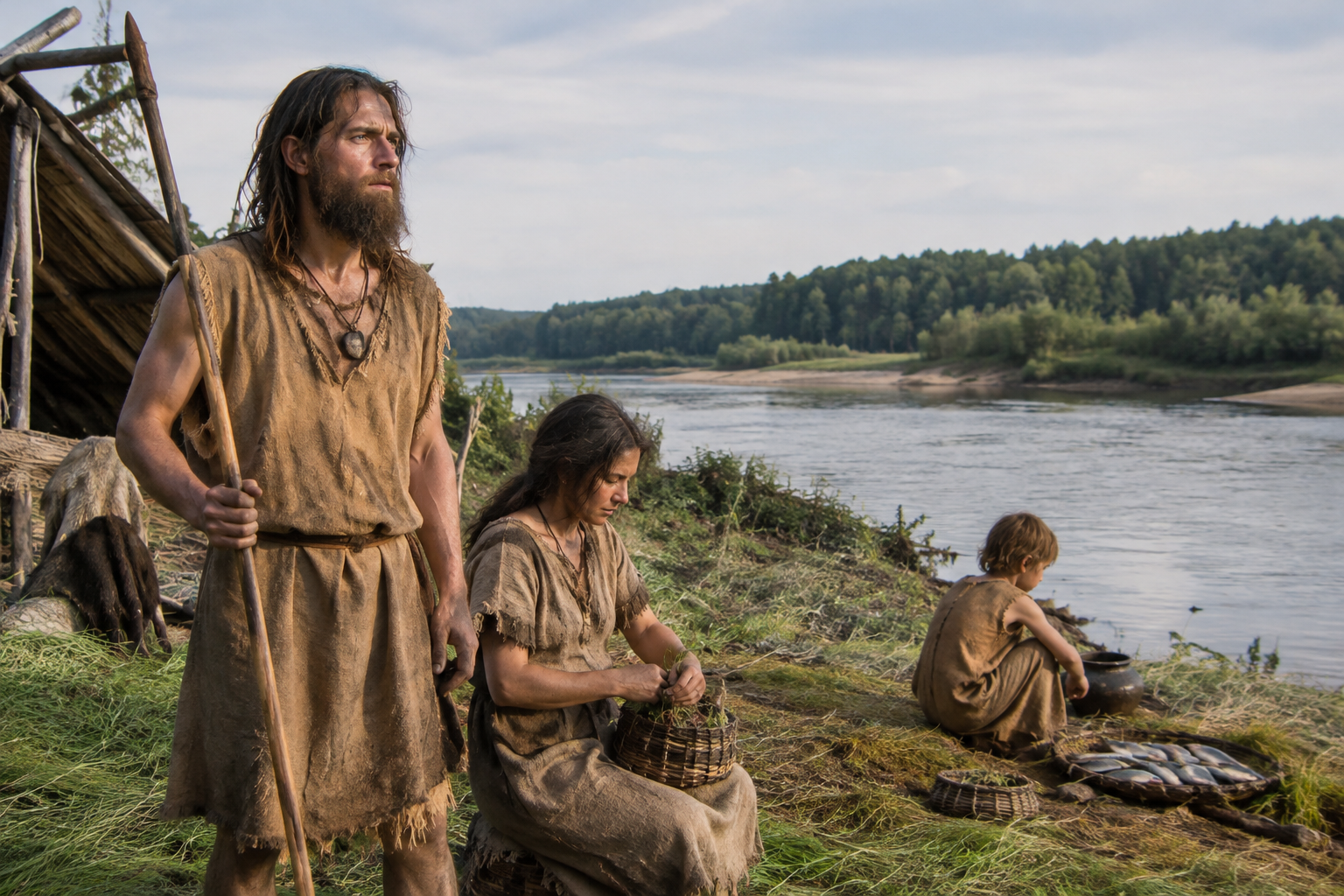
In the forests and river country of western Siberia, one ancient man from Vengerovo has become an unexpectedly useful signpost for a very deep paternal lineage. The individual identified as NEO916, dated to around 3770 BC in ancient Russia, is reported in connection with Y-DNA haplogroup K2b - a branch so old and so consequential in the wider human story that its appearance in an archaeological burial immediately raises a larger question: what, exactly, are we seeing when such an early paternal line turns up in a Neolithic context?
The first thing to say is that K2b is not a cultural label, an ethnicity, or a complete ancestry profile. It is a Y-chromosome lineage, tracing one direct paternal line among thousands of ancestors any individual would have had even in a few generations. But because Y-DNA can sometimes persist for very long periods, a sample like NEO916 matters. It gives us a real ancient person, from a real archaeological setting, attached to a lineage whose deeper branches would later spread very widely across Eurasia, Oceania, and the Americas.
Vengerovo, in the forest-steppe zone of southwestern Siberia, sits in one of the great connective landscapes of northern Eurasia. This was not a sealed-off world. Rivers, wetlands, forests, and open corridors linked communities across large distances, even when their material cultures remained local. A burial dated to the late 4th millennium BC from this region belongs to a period when forager traditions, regional exchange, and new forms of mobility were all interacting in complicated ways.
That is why NEO916 is so interesting. The ancient individual is not famous because he founded a kingdom or left an inscription. He matters because he anchors K2b in an archaeological human being from prehistoric Siberia. In an area that often features in discussions of northern Eurasian population history, this kind of evidence helps show that broad paternal branches associated with very deep Eurasian prehistory were present in real communities on the ground, not just as abstract nodes on a genetic tree.
A genetic study of ancient populations from northern Eurasia and adjacent regions, including material relevant to this wider context, can be found in this Nature research publication. For a reader interested in K2b, the key value is not a dramatic claim about one man, but the way such studies place isolated burials into broader regional population history.
Forest hunter-gatherers of ancient Russia
K2b is a high-level branch, not a fine-grained recent family signature. That distinction matters. When a sample is assigned to a broad lineage like K2b, it tells us that the individual belongs somewhere within a major paternal cluster, but not necessarily which much later descendant branch he would fall into if higher-resolution data were available.
In plain terms, that means we should be careful. We cannot take NEO916 and draw a straight line from one Siberian Neolithic burial to every later population in which descendant branches of K2b became important. What we can say is more modest and more valuable: this lineage, or a branch close to it, was part of the paternal landscape of ancient northern Eurasia long before historic peoples, medieval dynasties, or modern national identities came into being.
This is where ancient DNA often improves the conversation. Rather than treating haplogroups as timeless badges attached to whole populations, it forces us back to individual evidence: one burial, one skeleton, one date, one site, one paternal line. History gets more interesting when it becomes less sweeping and more precise.
There is an old habit in popular history of treating Siberia as a remote edge of the world. Archaeology and archaeogenetics have steadily made that view harder to defend. Prehistoric Siberia was a vast zone of movement, encounter, and local persistence. People there were not merely waiting for events elsewhere to define them. They formed part of the deep background from which later Eurasian histories emerged.
For a lineage such as K2b, that setting is especially important. Some of the most significant descendant branches of ancient Eurasian Y-DNA expanded over enormous distances, but those expansions did not spring from nowhere. They were rooted in earlier populations living across northern Asia, including regions like the Ob-Irtysh and forest-steppe zones where sites such as Vengerovo belong.
That does not mean every bearer of K2b in prehistory shared the same way of life, language, or ancestry profile. Quite the opposite. A broad paternal branch can survive while cultures change around it. Communities may adopt new subsistence patterns, new exchange networks, or new burial customs without replacing every paternal line. The archaeology of Siberia repeatedly shows continuity mixed with movement rather than one tidy story of replacement.
Ancient DNA of northern Eurasia
With only a single named ancient sample here, it would be irresponsible to inflate NEO916 into a population-wide emblem. One burial cannot stand in for all of Neolithic Siberia. Nor can a broad K2b assignment, by itself, tell us whether this man's nearer paternal relatives were local over many generations or connected to movement across longer distances.
Yet single samples can still be revealing. They show that ancient paternal diversity was often deeper than modern readers expect. They also remind us that the Y-chromosome record is uneven: some lineages become common in later datasets because of demographic expansion, social advantage, or sheer chance, while other early branches remain archaeologically rare simply because few suitable burials have been tested.
In that sense, NEO916 is useful precisely because he is not a celebrity burial. He helps restore proportion. Ancient DNA is at its best when it draws attention not only to kings, warriors, and dynasties, but to ordinary prehistoric individuals whose remains preserve evidence of much older human histories.
Readers who want more on broad population shifts across the steppe and adjacent northern zones may find a useful comparison in work on the northern Black Sea region, where ancient DNA also complicates any simple model of migration and identity.
Migrations in the northern Black Sea
Why does a deep branch like K2b attract so much attention? Because it sits high in the paternal tree above lineages that later became historically significant in very different parts of the world. That does not make K2b itself a neat ethnic marker. It makes it a reminder that many later populations, now separated by language and geography, can share ancestry far back along one paternal line.
Seen from this angle, the Vengerovo burial offers a glimpse of a stage before those later divergences had become the familiar map of recorded history. Long before empires, tribes named in texts, or medieval family lines, there were communities in northern Eurasia carrying paternal branches that would eventually have far-reaching descendants. Ancient DNA does not turn that into a simple migration arrow. It turns it into a testable historical problem.
That approach is increasingly central to archaeogenetics as a field. If you want a broader introduction to how ancient genomes are changing the study of the human past, MyTrueAncestry has also explored that bigger picture in its overview of the rise of archaeogenetics.
If your paternal line falls within K2b, the most defensible takeaway is not a claim to one ancient tribe or one dramatic migration. It is something subtler and, in truth, more impressive: your direct paternal ancestry belongs to a very old branch of the human family tree, one already present in prehistoric northern Eurasia in individuals such as NEO916 of Vengerovo around 3770 BC. That does not tell your whole ancestry, but it does place one line of it in a deep and important chapter of Eurasian prehistory.
Comments