Haplogroup J2b2b2

– 4 min read


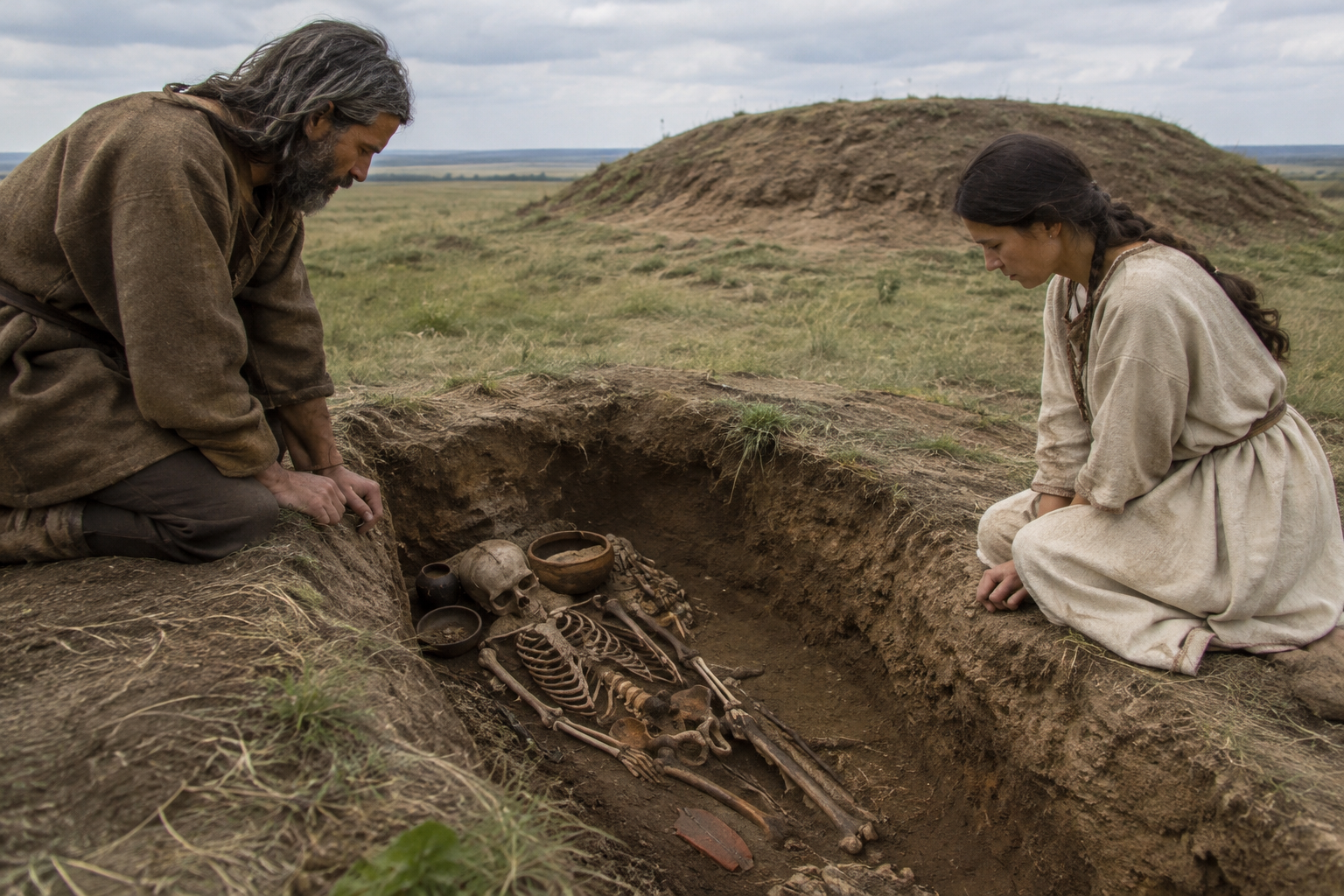
At Bursuceni in present-day Moldova, one burial from a kurgan cemetery pushes the story of J2b2b2 deep into the Eneolithic steppe frontier. The individual known as I17973, dated to around 3228 BC and described as Proto Yamnaya, comes from Kurgan 1, Burial 21. That is an arresting combination: not a late Bronze Age traveler or a classical-era migrant, but a man placed in the world out of which the Yamnaya horizon was beginning to form.
For anyone tracing a paternal line, that matters because Y-DNA follows one direct male line only. It does not describe a person's whole ancestry, language, or identity. But when a branch like J2b2b2 appears in an early steppe-context burial on the northwestern Black Sea margins, it gives us a solid archaeological anchor for thinking about where at least one line of fathers stood during a period of enormous social change.
The label Proto Yamnaya is useful precisely because it is cautious. It points to communities living before or alongside the consolidation of the classic Yamnaya pattern, in a zone where burial customs, mobility, and ancestry were being reshaped across the western steppe. Bursuceni sits in that broad contact region between the Prut-Dniester lands and the steppe corridor, where influences from farming worlds and pastoral worlds met repeatedly.
Sample I17973 is therefore interesting not because one burial can stand for an entire people, but because it shows that a lineage associated here with J2b2b2 was present in this formative setting. A recent ancient DNA study of the North Pontic region, covering the long span from the sixth to the third millennium BC, is the right scholarly backdrop for understanding why such finds matter: the region was not genetically static, and steppe populations were assembled out of multiple earlier streams rather than springing fully formed from a single source. That broader context is discussed in research on genomic ancestry and migrations in the North Pontic region.
Readers who know the headline version of steppe genetics may expect lineages more commonly discussed in connection with later Yamnaya and post-Yamnaya expansions. That is exactly why I17973 stands out. Haplogroup J, in its wider sense, is often associated in public discussion with regions farther south, especially the Caucasus, Anatolia, and the Near East. But public shorthand is a poor guide to ancient reality.
The narrower branch in this article is J2b2b2, not all of J, and certainly not every branch of J2. One ancient male in Eneolithic Moldova does not let us assign a neat origin story to the entire subclade. What it does show is that paternal lines ultimately belonging to this branch could already be embedded in populations on the northwestern steppe frontier during the fourth millennium BC.
That fits a wider archaeological picture in which the steppe was never sealed off from its neighbors. Goods, people, marriage networks, and seasonal movement linked the grasslands to river valleys and to farming societies to the west and south. A paternal lineage from J2b2b2 in this setting is a reminder that the making of steppe populations was a contact story as much as a mobility story.
Bursuceni's significance also lies in geography. Moldova was not some quiet cul-de-sac on the edge of prehistory. It sat close to one of Europe's great transition zones, where forest-steppe, open steppe, and agricultural landscapes overlapped. Communities here could be drawn into exchanges stretching toward the lower Danube, the Black Sea, and the Pontic interior.
In such regions, burial mounds are not just monuments to individuals; they are clues to changing social forms. The appearance of kurgan burial traditions in the westward steppe sphere has long been central to debates about hierarchy, herding, and movement. A man from this milieu carrying J2b2b2 does not prove a migration route all by himself, but he does place this paternal branch within one of the most discussed archaeological transformations in Eurasia.
That is especially important for genealogy-minded readers because modern distributions can be misleading. A lineage found today in the Balkans, eastern Mediterranean, or farther afield may have passed through very different social worlds thousands of years earlier. Ancient DNA keeps forcing that point home: the places where lineages are common now are not always the places where their ancient carriers are first glimpsed in the record.
It is tempting to turn every steppe-associated burial into a grand statement about conquest, horsemen, or the spread of languages. Archaeology is usually less tidy than that. The term Proto Yamnaya marks an early phase in a developing horizon, and the people in it need not have shared one uniform biological profile or one paternal signature.
That is why a sample like I17973 is valuable. It complicates the easy cartoon. Instead of imagining the Eneolithic steppe as dominated by a single paternal lineage from the start, we can see a more mixed and still-forming landscape. Some lines would later flourish, some would fade, and others survive in scattered descendants. J2b2b2 belongs to that more interesting, more humanly messy picture.
This also helps explain why one should be careful with historical labels. Calling I17973 Proto Yamnaya situates him archaeologically; it does not tell us what language he spoke, how he identified himself, or whether his paternal descendants remained in the same region. Genetic lineages travel through adoption, alliance, family turnover, and demographic luck as much as through dramatic migrations.
With only one ancient sample provided here, the responsible approach is modest but still meaningful. J2b2b2 is documented at Bursuceni in Eneolithic Moldova in a Proto Yamnaya context through sample I17973. That puts this paternal branch, or at least a lineage reported within it, in the northwestern Black Sea world before the Bronze Age was fully underway.
For a modern tester, the main takeaway is not a fantasy of descent from one famous tribe or one mounted patriarch. It is that this line was already present in a frontier zone where steppe and neighboring populations were interacting intensely. If your paternal ancestry falls within J2b2b2, one plausible deep background for part of that story includes the contact-rich landscapes of the North Pontic and Moldovan Eneolithic, where communities were being remade long before written history.
So the most distinctive thing about this haplogroup, on present evidence, is not royal glamour or a tidy migration legend. It is that a direct paternal line tied to J2b2b2 appears in a very early mound burial at the threshold of the Yamnaya world. That is a small piece of evidence, certainly, but an unusually evocative one: a father's line already standing in one of prehistoric Europe's great crossroads.
Comments