Haplogroup J2b2a1b~

– 5 min read


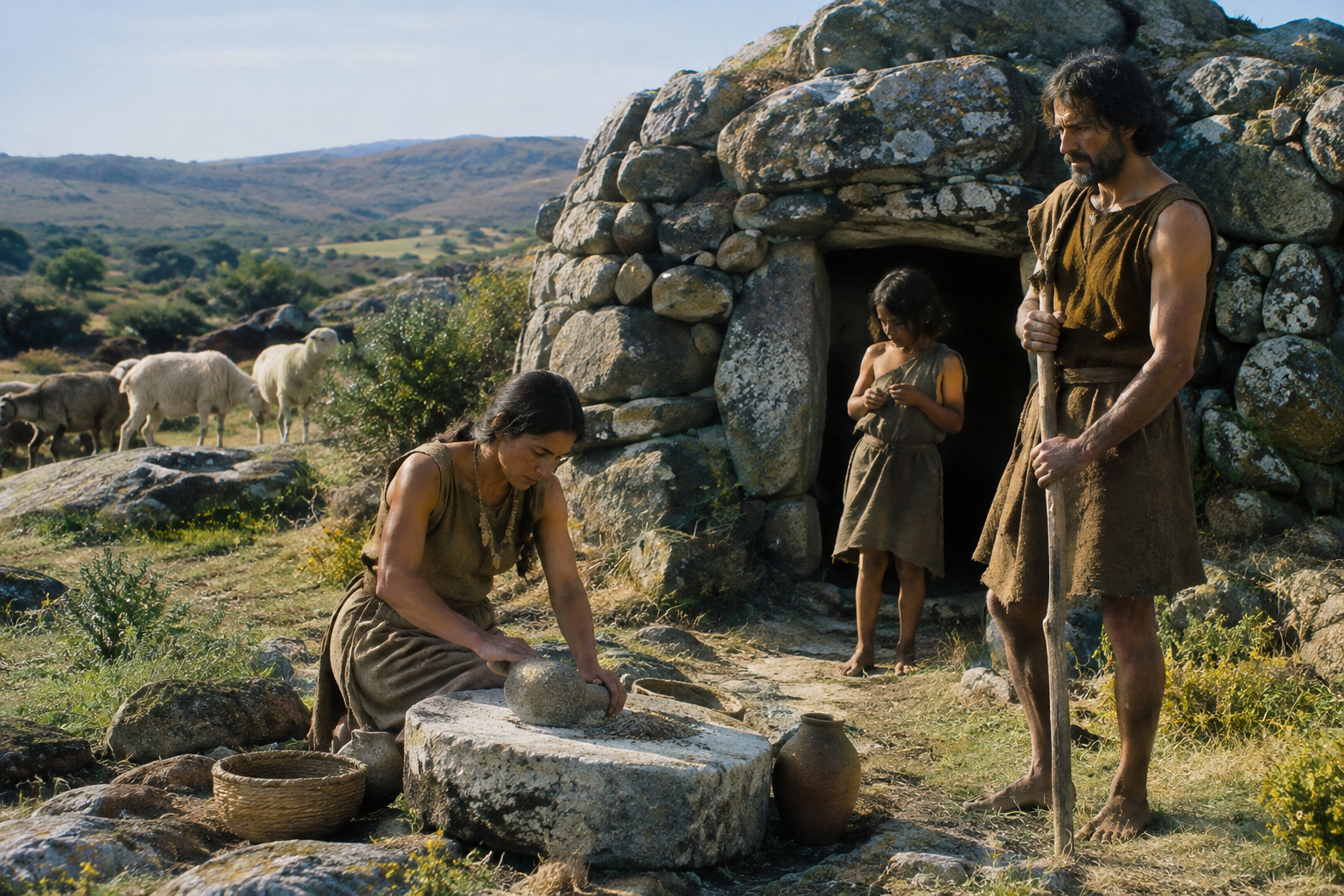
At first glance, ORC007 is a modest label: one ancient individual from interior Sardinia, dated to around 1140 BC and classified as Nuragic. But that is precisely why the sample is so useful. Instead of arriving wrapped in later Greek, Roman, or medieval history, ORC007 belongs to the island in the Late Bronze Age, when Sardinia was dominated by the communities that built the great stone nuraghi and left behind one of the Mediterranean's most distinctive archaeological landscapes. In this case, the paternal line reported in association with the sample is J2b2a1b~.
That tilde matters. It signals caution: not a neat, fully pinned-down modern terminal twig, but an association with a branch in that neighborhood of the Y-chromosome tree. Y-DNA traces one direct paternal line only, not a person's whole ancestry, language, or identity. Even so, when a branch linked with wider Mediterranean and Balkan histories appears in a Nuragic individual from inland Sardinia, it raises an excellent historical question: what does a paternal lineage like this look like when seen not in abstract maps, but in one real island community of the Late Bronze Age?
ORC007 comes from interior Sardinia rather than one of the island's famous coastal contact zones. That alone is important. Sardinia in the second millennium BC was no backwater. It sat in the middle of maritime networks that connected the western and central Mediterranean, yet its interior also maintained strong local traditions, above all the construction and use of nuraghi, those massive stone towers that still dominate the landscape.
So ORC007 is best understood not as a romantic "traveller from elsewhere," but first as a member of a Nuragic population. The interesting point is that a Y-line reported as J2b2a1b~ appears within that setting. This does not prove a recent migration for this individual, and it certainly does not reduce Nuragic society to a single paternal marker. It does, however, show that the paternal diversity of Bronze Age Sardinia included lineages often discussed in relation to broader Mediterranean population history.
An ancient DNA study of Sardinia and the surrounding islands helped bring such individuals into focus, showing how island populations can preserve long local continuity while still participating in larger regional currents of movement and mixture. The relevant research history around these island genomes is reflected in a genetic study of ancient Italian island populations, which has been part of the discussion about long-term population change in Sardinia.
The broader haplogroup background here is worth sketching carefully. J lineages as a whole have a long history in western Eurasia, and various branches of J2 appear repeatedly in archaeological and modern populations around the eastern Mediterranean, the Aegean, parts of the Balkans, and Italy. But the article haplogroup is not "J2 in general." It is J2b2a1b~, a much narrower label, and the current evidence from this article gives us only one ancient Sardinian example to work with.
That means we should resist the temptation to turn ORC007 into a mascot for a single grand migration story. Still, a branch in the J2b family appearing in Bronze Age Sardinia fits something archaeologists have been saying for years by other means: the island was connected, but on its own terms. Goods, ideas, and sometimes people moved across the sea. The paternal record shows one small part of that human traffic.
There is also a geographical subtlety here. Because ORC007 is inland, the sample reminds us that whatever lineages arrived in Sardinia through older or newer contacts did not remain confined to ports. By the Late Bronze Age, such paternal lines could be woven into communities far from the shoreline. That is a very different historical picture from imagining islands as mere stepping stones for foreign sailors.
It is easy to flatten Nuragic Sardinia into a postcard of towers and bronzes. In reality, it was a complex society of villages, ritual spaces, fortified sites, and regional variation. By around 1140 BC, the island had already seen centuries of social development. Some communities were deeply tied to local landscapes, while others were more visibly entangled in exchange systems linking Sardinia to peninsular Italy, Iberia, and the eastern Mediterranean.
That is the proper backdrop for ORC007. A paternal lineage such as J2b2a1b~ does not tell us whether this man spoke one language or another, or whether his father's fathers arrived on the island centuries earlier or were part of more recent movement. What it does say is that by the Late Bronze Age, the male-line diversity of Sardinia was not sealed off. The archaeology and the genetics point in the same broad direction: insular continuity with selective openness.
For Sardinia specifically, that balance between continuity and connection has become a recurring theme in genetic work. Modern discussions of the island often overemphasize isolation, but ancient evidence repeatedly shows that isolation was never absolute. Bronze Age and later Sardinians could be both rooted and connected at once.
With only ORC007 named here, the sensible approach is to treat this as a sharp but narrow window. It is sharp because the sample is archaeologically placed: interior Sardinia, Nuragic context, around 1140 BC. It is narrow because one Y-chromosome result cannot define the island, the culture, or even the whole community around the burial.
Yet single samples can still be historically revealing when they sit in the right place. ORC007 is informative because inland Nuragic Sardinia is exactly where one might expect long local history to be strongest. Finding a J2b-associated paternal line there shows that Mediterranean-connected male ancestry was not a superficial coastal veneer. It had become part of the island's lived demographic fabric.
This matters beyond Sardinia too. Across the Mediterranean, ancient DNA keeps complicating old oppositions between "native" and "incoming." Communities were often mixtures not because they were unstable or uprooted, but because exchange, marriage, seasonal mobility, and regional interaction were normal features of life over many centuries. Sardinia fits that pattern rather well.
Mediterranean continuity and change
By the later second millennium BC, the Mediterranean was full of linked but varied societies: Mycenaean palaces in the Aegean, communities in peninsular Italy experimenting with new forms of hierarchy and exchange, and western island societies like Nuragic Sardinia pursuing their own trajectories. When a lineage associated here with J2b2a1b~ appears in that world, it sits comfortably within the broader human geography of the sea, without needing a melodramatic migration tale attached to it.
That is perhaps the most interesting thing about ORC007. He represents neither a timeless isolated islander nor an obvious colonial outsider. He belongs to a Bronze Age Sardinia that had already absorbed centuries of contact and made them local. The genetics do not overwrite the archaeology; they deepen it.
Readers interested in how ancient DNA is reshaping the story of Mediterranean populations may also find it useful to compare island evidence with later Italian and Iberian cases, where mobility, continuity, and social change often sit side by side rather than replacing one another.
Ancient Italy population change
For someone researching a present-day paternal line under J2b2a1b~, ORC007 offers a careful kind of connection: not a promise of descent from a named dynasty, but evidence that this branch, or a closely related one, was present in Nuragic interior Sardinia around 1140 BC. The larger lesson is that such a lineage can belong to deeply local island history as well as to wider Mediterranean patterns of contact. In other words, this is a branch best understood not as belonging to one modern nation or one ancient people, but as part of the old, complicated human traffic of the Bronze Age sea.
Comments