Haplogroup J2b2a1a1a1a1a1a1e

– 6 min read


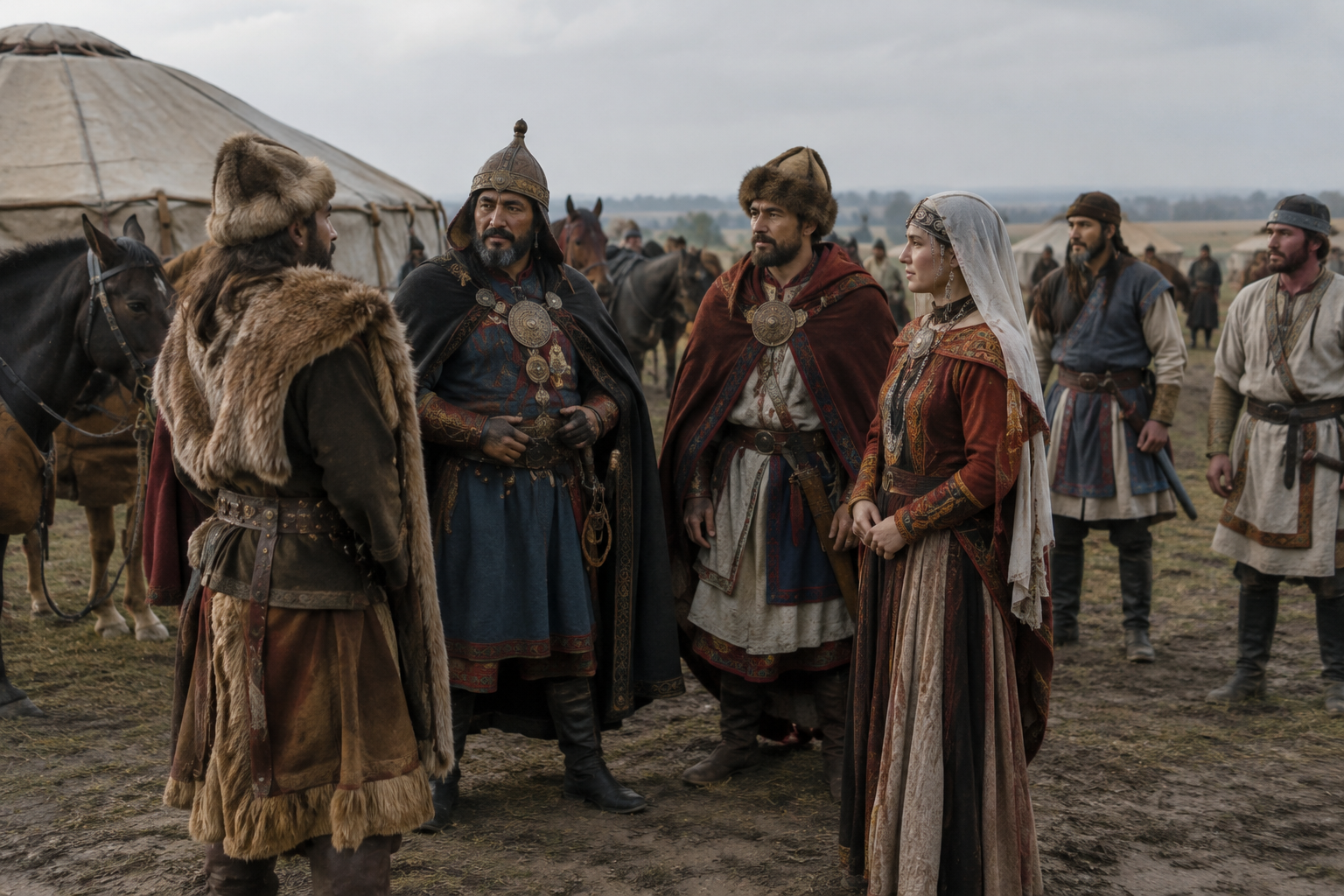
Some Y-DNA haplogroups turn up here and there, in scattered finds, like a half-heard rumor from the past. Others appear in ways that force us to stop and think about movement, status, and the very untidy business of how peoples and polities formed. Haplogroup J2b2a1a1a1a1a1a1e belongs to that second category, not because this very narrow branch can be given a grand sweeping history all on its own, but because its wider paternal family, J2, has long been associated with populations moving across the eastern Mediterranean, the Balkans, and into central and southeastern Europe.
That needs a note of caution straight away. A Y-DNA haplogroup tracks one direct paternal line only: father to father to father. It is not the same thing as a person's whole ancestry, identity, language, or culture. And with a very specific branch such as J2b2a1a1a1a1a1a1e, we must be especially careful not to dump the whole history of broad haplogroup J2 onto one tiny twig of the tree. Still, the ancient DNA evidence supplied here gives us something unusually vivid: a cluster of men from the Carpathian Basin and the eastern Adriatic world in the centuries after Rome, when empires had cracked, new elites had arrived, and old populations had not simply vanished.
Broadly speaking, J2 is part of a larger Y-chromosome family with deep roots in western Eurasia. Its branches are often discussed in connection with ancient movements around the Near East, the Aegean, and southeastern Europe. Within that broader picture, J2b is one of the branches that has attracted attention for its presence in parts of the Balkans and neighboring regions. That does not mean every bearer of J2b belonged to one people, one migration, or one civilization. Quite the reverse: haplogroups often outlast kingdoms, languages, and ethnic labels.
What makes this narrow lineage interesting is that the sample set places it not in abstract prehistory but in a very specific historical zone: post-Roman and Avar-period Hungary, with a later appearance in early medieval Croatia. This is exactly the kind of evidence that reminds us how the Carpathian Basin worked in Late Antiquity and the early Middle Ages. It was not a sealed box. It was a corridor, a frontier, a prize, and sometimes a graveyard of empires.
Explore Ancient DNA and Archaeogenetics
The most striking feature in the supplied evidence is how many individuals come from Rakoczifalva in Hungary, mostly dated to around 650 AD. They include both individuals labeled Migration Period Hungary Rakoczifalva and others labeled Avar Elite Hungary Rakoczifalva. Among them are samples such as RKF031, RKF029, RKF198, RKF142, RKF213, RKF015, RKF160, RKF046, RKF157, RKF170, RKF141, RKF127, RKF032, RKF218, RKF010, RKF012, RKF016, RKF041, and RKF231, alongside elite-associated burials including RKC026, RKC046, RKC047, RKC050, RKC011, RKC038, RKC035, RKC002, RKC028, RKC039, RKC043, RKC042, RKC020, RKC031, and RKC030. The inclusion of RKF047, RKF020, and RKF019 under Avar elite descriptions only adds to the sense that this paternal line appears in socially important contexts.
Now, one must not leap from this to the claim that haplogroup J2b2a1a1a1a1a1a1e was "the Avar elite haplogroup." That would be nonsense. Avar-period populations were genetically mixed, and elite status did not rest on a single paternal line. But the repeated appearance of this lineage in Rakoczifalva does suggest that one paternal branch was present among men living within, and in some cases buried with, the political and social structures of the Avar world in the middle Danube.
That matters because the Avar Khaganate sat at a crossroads between steppe traditions, Byzantine diplomacy, local post-Roman populations, and the many groups caught up in migration-period realignments. A paternal line found in multiple burials here may reflect kin groups, retained local lineages, incoming men absorbed into elite networks, or several of these processes at once. Ancient DNA gives us the outline, but not a simple slogan.
One earlier sample helps frame the story: GHD019, from Post Roman Period Pannonia Arrabona Gyirmot Barbaricum Hungary, dated to 550 AD. This is important because it sits before the main 650 AD Rakoczifalva cluster and places the lineage in the broader post-Roman landscape of Pannonia. In other words, by the time the Avar order was established, this paternal branch was already present in the region or nearby.
The later samples help show that the story did not end in one cemetery. RKF210, from Avar Period Hungary Rakoczifalva Szolnok, dated to 775 AD, and RKF219, from the Byzantine/Avar Borderlands Hungary Rakoczifalva Szolnok, dated to 770 AD, suggest continuity or recurrence into the later 8th century. The label "Byzantine/Avar Borderlands" is especially evocative. It points us to a world where political frontiers were unstable, loyalties layered, and populations deeply entangled.
Then we move southwest to the eastern Adriatic. Two early medieval Croatian samples, VEM033 and VEM025, both from Velim-Velistak and dated to 775 AD, show the same broader paternal presence beyond the middle Danube. Again, this is not proof of one neat migration event. It does, however, fit a historically plausible pattern in which lineages connected to southeastern and central European population networks appear across the late antique and early medieval Balkans.
This is where archaeology and history work best together. The 6th to 8th centuries were not a sequence of tidy ethnic handovers. Roman provincial communities survived in altered forms. New powers imposed themselves unevenly. Soldiers, clients, local farmers, captives, traders, and aristocrats all moved through the same landscapes. A Y-line such as this one may persist through that churn, sometimes in local communities, sometimes in warrior circles, sometimes in households that left no written record at all.
Explore Early Medieval Croatia DNA
The supplied field for associated noble families and castles is effectively empty here, which is in a way rather refreshing. Too often there is a temptation to leap from an ancient burial to a medieval dynasty and then on to a castle with battlements and a gift shop. But genetics does not work like heraldry. Without explicit family data, the responsible thing is to say so plainly: we cannot connect these ancient men directly to a later noble house.
What we can say is something more historically useful. The regions involved, especially Hungary and Croatia, later became landscapes of castles, frontier lordships, and dynastic competition. The paternal lines present in late antique and early medieval cemeteries formed part of the human raw material from which those later societies emerged. By the time medieval noble families were building their strongholds, they were doing so atop populations shaped by centuries of Roman rule, post-Roman survival, steppe political power, and Balkan mobility.
So if a reader hopes for a dramatic claim that one of the men from Rakoczifalva was the ancestor of some named count or clan chief, the honest answer is no. But if the question is whether ancient DNA can illuminate the deep background of the very regions where medieval lordship later flourished, then yes, absolutely.
Discover Hungary's Royal Arpad Dynasty
What haplogroup J2b2a1a1a1a1a1a1e reveals, at least from the evidence here, is not a single people marching across a map. It reveals persistence through upheaval. It appears in GHD019 in post-Roman Pannonia around 550 AD. It appears repeatedly in Rakoczifalva around 650 AD, including among individuals identified with Avar Elite. It remains visible in later 8th-century Hungarian contexts such as RKF210 and RKF219. And it is also present across the Adriatic-facing early medieval world at Velim-Velistak in Croatia in VEM033 and VEM025.
That is a pattern worth lingering over. It suggests that this paternal branch belonged to men living in some of the most politically charged landscapes of early medieval Europe. Not necessarily conquerors, not necessarily locals in the narrow sense, and certainly not members of one timeless ethnicity. But participants in the making of the post-Roman Balkans and Carpathian Basin.
If you want a wider comparative backdrop for that restless age of movement and mixed communities, the MyTrueAncestry article on the European Huns is well worth a look, especially for the larger steppe context into which the Avar world later fits.
Explore the Origins of the European Huns
For modern testers, a match to a branch like J2b2a1a1a1a1a1a1e is best understood as a clue to one paternal thread, not a complete personal history. It may place your direct male line somewhere within a long and complicated story touching southeastern Europe, the Balkans, and the post-Roman world of the Carpathian Basin. It does not prove descent from an Avar elite burial, from a Croatian early medieval man, or from any later noble lineage.
But this is exactly why ancient DNA is so compelling. It lets us see real men, buried in real places, carrying paternal lines that survived political collapse, migration, and reordering. They are not legends. They are data with dirt still on them.
If you want to explore whether your own DNA shows connections to ancient individuals like those from Rakoczifalva, Pannonia, or Velim-Velistak, MyTrueAncestry can help you compare your results with the ancient past. Those comparisons can open remarkable historical perspectives, even when they do not amount to a documented family tree.
Comments