Haplogroup J2b2a1a1a1a1a1a1e

– 5 min read


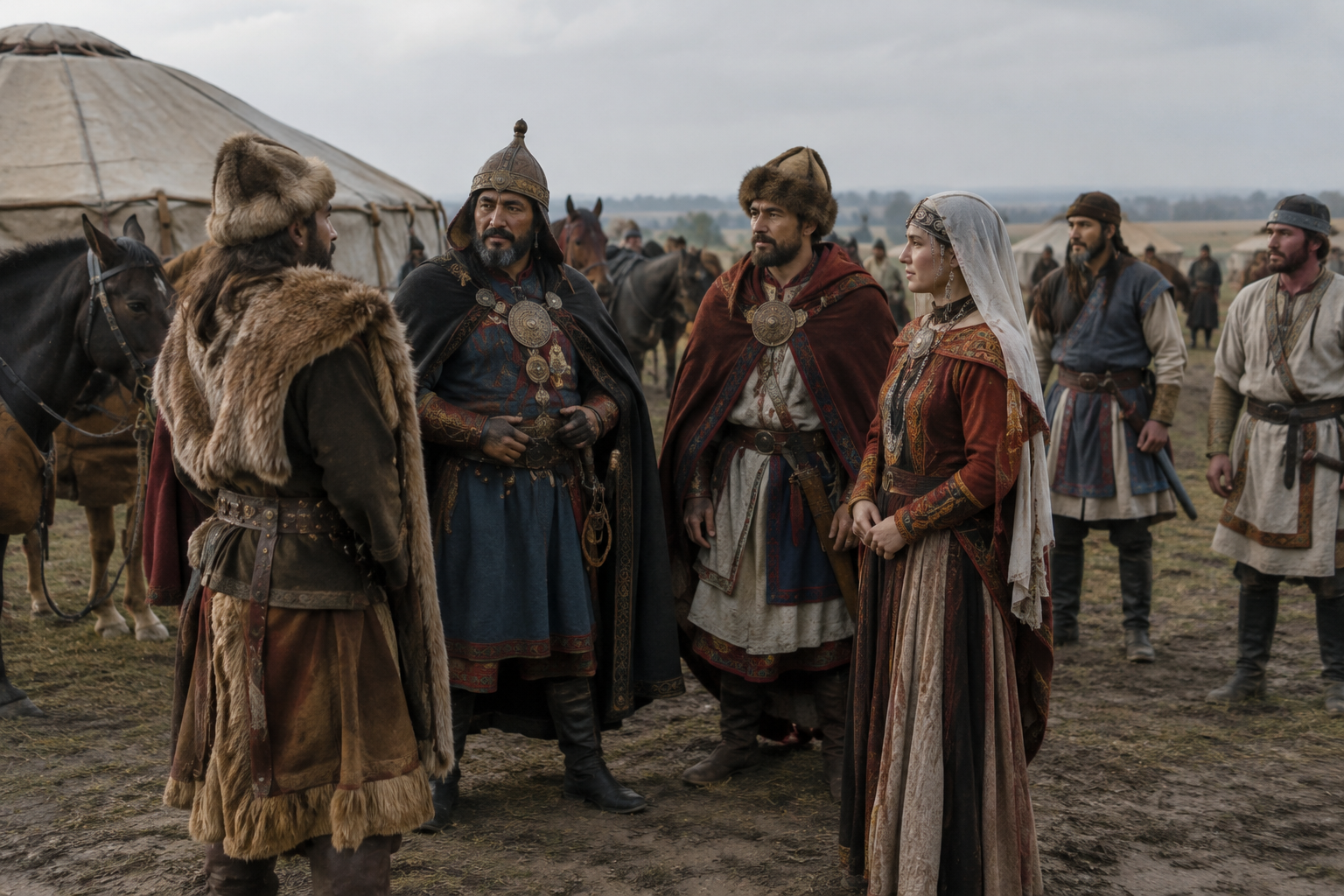
At Rakoczifalva on the Great Hungarian Plain, a striking pattern appears in the ancient DNA record. A cluster of men dated mainly to around AD 650, some described as Avar elite and others more broadly as Migration Period individuals, are associated here with the same very narrow Y-chromosome branch: J2b2a1a1a1a1a1a1e. Even before one asks where that paternal line first formed, the immediate historical point is clear enough: this was not an isolated occurrence, but a lineage turning up again and again in one of the most politically charged landscapes of early medieval Europe.
That matters because Rakoczifalva was part of a frontier world shaped by the collapse of Roman authority in Pannonia, the arrival of steppe powers, and constant movement across the Carpathian Basin. Y-DNA traces one direct male line only, not a person's whole ancestry, but when the same branch appears repeatedly at one site and then also turns up in neighboring regions such as early medieval Croatia, it gives us a useful thread through a famously mixed and mobile age.
The densest evidence for this branch comes from Rakoczifalva in Hungary, where many individuals dated to about AD 650 are linked to it. Among them are samples labeled as Avar elite, including RKC026, RKC046, RKC047, RKC050, RKC011, RKC038, RKC035, RKC002, RKC028, RKC039, RKC043, RKC042, RKC020, RKC031, RKC030, and RKC045. Alongside them stand individuals labeled more broadly as Migration Period Hungary, such as RKF031, RKF029, RKF198, RKF142, RKF213, RKF015, RKF160, RKF046, RKF157, RKF170, RKF141, RKF127, RKF032, RKF218, RKF010, RKF012, RKF016, RKF041, and RKF231.
This is exactly the sort of evidence that makes archaeogenetics so useful and so awkward in equal measure. The labels "Avar elite" and "Migration Period" are archaeological and historical categories, not genetic ones. A repeated Y-line at the same site does not by itself tell us whether every one of these men was close kin, nor does it reduce the Avar world to a single origin. What it does suggest is that one paternal branch had a notable presence within the social landscape of Rakoczifalva during the 7th century.
A genetic study of populations from this broader region and period has helped show just how varied the Carpathian Basin could be after Rome, with local continuities mixing with newcomers from several directions; one useful overview for that wider setting is this ancient DNA research on post-Roman and early medieval population change. The recurrence of J2b2a1a1a1a1a1a1e fits that larger picture rather well: a specific paternal line embedded in a society that was anything but simple.
The haplogroup in question sits deep within the wider J2 family, a major West Eurasian Y-chromosome lineage with a long and complicated history. But it is important not to smuggle in the entire biography of J2 when discussing the much narrower branch J2b2a1a1a1a1a1a1e. The Rakoczifalva pattern tells us that this exact paternal line, or men reported as belonging to it, was present in early medieval communities in and around the Avar sphere. It does not, on its own, prove where that sub-branch first emerged or which language its bearers spoke.
That may sound dry, but in fact it is where the history gets interesting. Early medieval Europe was full of people moving under political labels that were broader than family, broader than tribe, and much broader than Y-DNA. The Avar Khaganate brought together steppe-derived ruling traditions, people from former Roman provinces, and communities already rooted in the basin. A lineage like this could therefore appear in elite and non-elite contexts without needing a single neat ethnic story.
The Rakoczifalva evidence does not stop in the middle of the 7th century. Two later samples from the same wider area, RKF210 dated to about AD 775 and described as Avar Period Hungary Rakoczifalva Szolnok, and RKF219 dated to about AD 770 and described as Byzantine/Avar Borderlands Hungary Rakoczifalva Szolnok, show that this was a durable landscape of interaction. By the later 8th century, the Avar world was under pressure, and the frontier between Avar and Byzantine interests was one of the liveliest contact zones in Europe.
That phrase "Byzantine/Avar Borderlands" is especially revealing. It reminds us that eastern Hungary was not a sealed steppe enclave but part of a connected zone running toward the Balkans and the eastern Mediterranean. If J2b2a1a1a1a1a1a1e appears in that setting, the sensible reading is not to assign it mechanically to one power bloc, but to recognize a paternal line surviving within communities shaped by diplomacy, warfare, trade, and migration.
One earlier comparison point also deserves notice: GHD019, dated to about AD 550 from Arrabona-Gyirmot Barbaricum in post-Roman Pannonia. This sample sits closer to the immediate aftermath of imperial collapse in the region. Put beside the later Rakoczifalva cluster, it hints that the paternal background represented by this branch was already part of the basin's post-Roman population mix before the mature Avar horizon seen around AD 650.
The branch is not confined to Hungary. Two later individuals from Velim-Velistak in Croatia, VEM033 and VEM025, both dated to about AD 775, place it in an early medieval Adriatic hinterland as well. That is valuable because Croatia in this period sat in another contact zone, where Roman provincial legacies, Slavic-speaking communities, Byzantine influence, and regional power politics overlapped.
Here again, the important thing is the pattern rather than a melodramatic claim of conquest by one clan. A paternal line seen in the Carpathian Basin and also in Dalmatian Croatia during the same broad centuries suggests connectivity across the northern Balkans and adjacent plains. Whether that connectivity came through military service, local continuity, marriage networks, shifting frontier loyalties, or a combination of all of them, the ancient DNA is pointing us toward a shared early medieval world rather than neatly separated peoples.
Research on ancient genomes from southeastern and east-central Europe has increasingly stressed precisely this sort of mixture and mobility; for the broader medieval setting, see this scientific study on genomes from medieval Hungary's elite and their steppe-era connections. It does not need to prove every detail of this specific subclade to help frame the historical landscape in which such a lineage appears.
If you belong to J2b2a1a1a1a1a1a1e, the ancient evidence here does not hand you a ready-made badge saying "Avar," "Croat," or "Byzantine." What it does offer is something more historically serious: your direct paternal line appears in a cluster of early medieval burials concentrated in the Carpathian Basin, especially at Rakoczifalva, and also in related borderland settings stretching into Croatia. In other words, this branch is associated, in the current ancient record, with the mixed societies that grew out of Rome's end and the frontier politics of the 6th to 8th centuries.
That is a rather good story to have. Not because it is tidy, but because it is real: a paternal lineage visible in the crowded, argumentative middle ground between empire, steppe, and Balkans.

Comments