Haplogroup J2b2a1a1a1a1a1a1d
– 5 min read


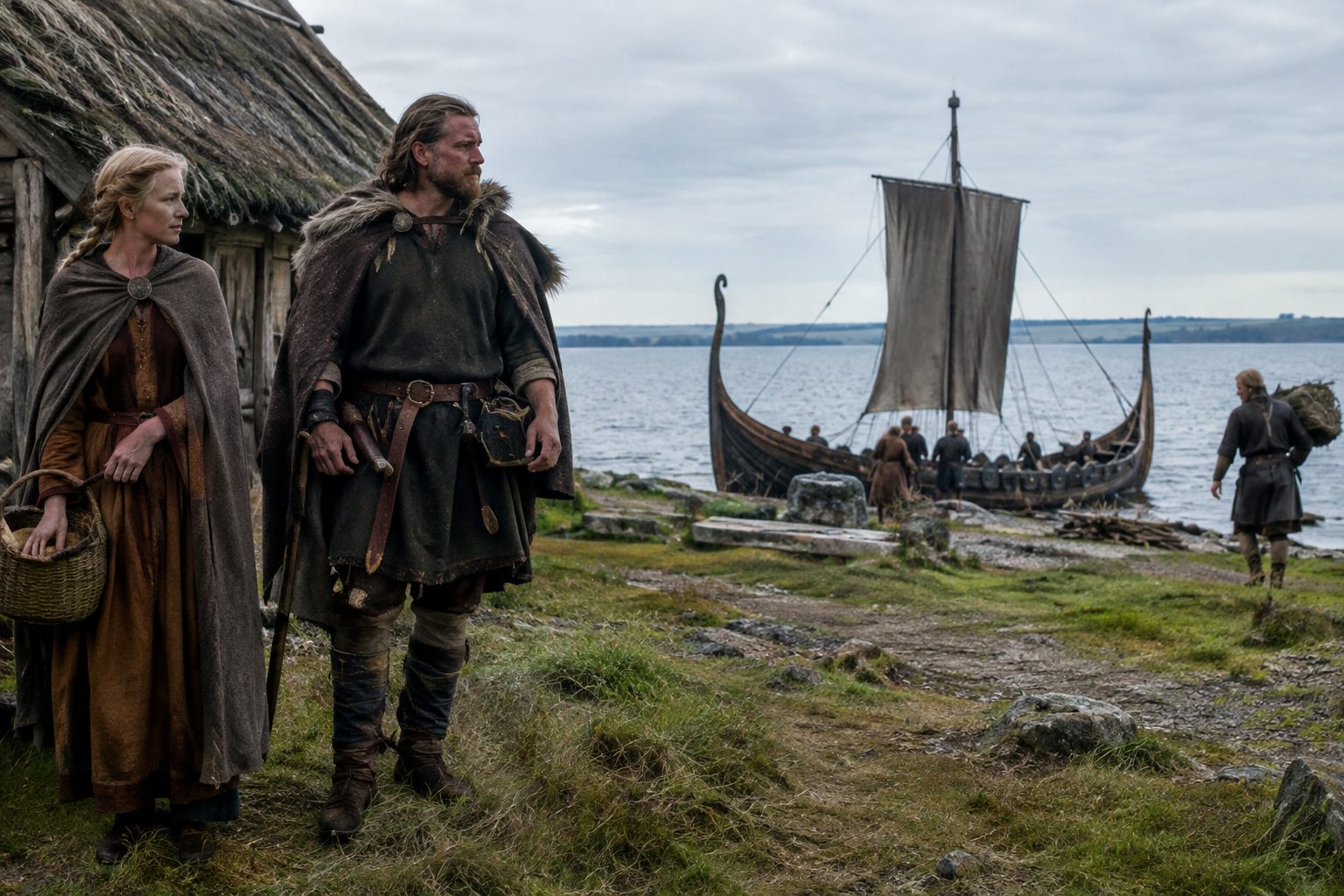
On Oland in Sweden, a Viking Age man identified as VK346 has been associated with the Y-DNA haplogroup J2b2a1a1a1a1a1a1d. The date attached to him, around AD 950, places him in a world that modern readers often imagine as straightforwardly "Norse" in blood as well as culture. Ancient DNA has been wonderfully unhelpful to that old fantasy. Again and again, Viking Age Scandinavia turns out to have been tied into a far wider world of movement, marriage, trade, raiding, service, and settlement than nationalist storybooks once allowed.
That matters here because J2b2a1a1a1a1a1a1d is not a label for an ethnicity, a language, or a ready-made saga identity. It is a very narrow branch on the Y-chromosome, tracing one direct paternal line only. Still, even a single paternal line can be historically revealing when it appears in a precisely dated ancient individual such as VK346. It tells us that one strand of male ancestry present on Viking Age Oland belonged to a lineage whose deeper roots are usually discussed in the wider context of southeastern Europe, the Balkans, and parts of the eastern Mediterranean rather than Scandinavia alone.
Oland is a splendid place to find a surprising lineage, because it was never an isolated backwater. Stretching along the Baltic coast of Sweden, the island sat close to major sea routes that linked Scandinavia to Gotland, the eastern Baltic, the rivers of what are now Russia and Ukraine, and beyond them the Black Sea and the Islamic world. By the 10th century, silver, slaves, textiles, walrus ivory, furs, weapons, and ideas were moving through these networks. People moved too.
So when a paternal lineage like J2b2a1a1a1a1a1a1d appears in a Viking Age burial context, the sensible response is not shock but curiosity. Was this the mark of a recently arrived man? Of an older family line already folded into Scandinavian society? Of mobility across the Baltic, or farther south and east? With one sample alone, archaeology cannot answer all of that. But it can firmly say that Viking Age communities on Swedish islands included paternal diversity that refuses neat ethnic boxes.
The exact branch in this article, J2b2a1a1a1a1a1a1d, is extremely specific. That is both useful and slightly treacherous. Useful, because it gives paternal genealogy enthusiasts a fine-grained marker. Treacherous, because the deeper history of the broader J2 family cannot simply be pasted wholesale onto this one terminal twig without direct evidence.
In broad terms, haplogroup J2 has long been discussed in connection with populations around the Near East, the Mediterranean, and southeastern Europe, and its various sub-branches appear in many different historical settings. But a narrow terminal branch such as J2b2a1a1a1a1a1a1d does not come with a little stamped passport saying "Greek", "Illyrian", "Roman", or anything of the kind. What VK346 gives us is something more modest and more interesting: proof that this paternal line, or a very close ancestral branch, was present in Viking Age Sweden by around AD 950.
That alone is historically significant. It reminds us that Scandinavian identity in the Viking Age was cultural and political as well as biological. A man could be fully part of that world while carrying a paternal lineage whose older history lay elsewhere.
To understand why VK346 matters, it helps to stop imagining the Viking world as a northern cul-de-sac. The Baltic was one of medieval Europe's great connective seas. Swedish voyagers travelled east toward Ladoga, Novgorod, and the river routes leading south. Merchants and mercenaries moved between Scandinavia and the Byzantine sphere. Contacts with Slavic, Finnic, Baltic, and steppe populations were not exotic exceptions; they were part of the texture of life.
A genetic study of Viking Age populations, available here as a research preprint, helped popularize this broader picture: Viking Age people were genetically varied, and their communities often included ancestry from beyond the places where they were buried. Without overclaiming what that paper says about VK346 specifically, it sits squarely within the wider interpretive frame for this Oland individual. The old idea of the Viking Age as a sealed northern gene pool is simply not tenable.
That does not mean every unusual lineage in Scandinavia must reflect some dramatic one-generation voyage from the Mediterranean. Family histories can be older, messier, and more local than that. A paternal line may have arrived generations earlier through the Baltic, through continental Europe, through Roman-period movements, or by other routes entirely. Ancient DNA is often very good at showing that a connection exists, and much less good at narrating the exact trip.
There is a temptation, when dealing with haplogroups, to value only great clusters and big statistical patterns. But archaeology is also built from stubborn particulars. One excavated individual, placed in time and landscape, can force historians to tidy up their assumptions. VK346 is one of those awkwardly useful people.
He shows that a paternal line assigned here to J2b2a1a1a1a1a1a1d had reached a Swedish island community in the late Viking Age. That is not merely a curiosity for lineage charts. It belongs to a much bigger historical shift in how we understand medieval Scandinavia: not as a pristine ancestral homeland, but as an active participant in long-distance exchange zones linking the North Sea, the Baltic, the forest zones of the east, and the older centres of the Roman and Byzantine worlds.
Oland itself is particularly apt for this sort of evidence. Islands tend to be romanticized as isolated, yet historically they are often crossroads. Their harbours, seasonal markets, and coastal settlements attract traffic. Their communities absorb strangers, relatives-by-marriage, fosterlings, traders, crewmen, and returnees. A lineage that looks geographically surprising on a modern frequency map may have seemed entirely unremarkable in a port-facing island society a thousand years ago.
The larger lesson of finds like VK346 is that genetic ancestry and historical identity do not line up in tidy one-to-one fashion. Viking Age burial, material culture, and social belonging were not reserved for one Y-chromosome profile. The archaeological record from Scandinavia increasingly shows communities made through contact as much as continuity.
This broader point also fits with other work on the region, including studies of nearby islands and Scandinavian population change across earlier and later periods. Oland was part of a Baltic world in constant conversation with places beyond itself, just as Gotland and other Scandinavian hubs were. If you want a useful companion piece on that wider island setting, the MyTrueAncestry discussion of Gotland's long genetic history is a good reminder that Scandinavian islands had deep and complicated population histories long before the Viking Age.
If your own paternal line falls under J2b2a1a1a1a1a1a1d, the most responsible historical takeaway is not a fantasy of instant Viking prestige, nor a simplistic leap to one ancient homeland. What VK346 offers is something better: a real ancient anchor showing that this lineage, or one extremely close to it, was present in Viking Age Sweden around AD 950. In other words, this branch was already woven into the human traffic of the Baltic world.
That is the charm of ancient DNA when used properly. It does not hand out costumes. It gives you a dated, excavated human connection. In this case, that connection points to a Viking Age island society whose paternal ancestry was broader than old stereotypes ever admitted.
Comments