Haplogroup J2b2a1a1
– 5 min read


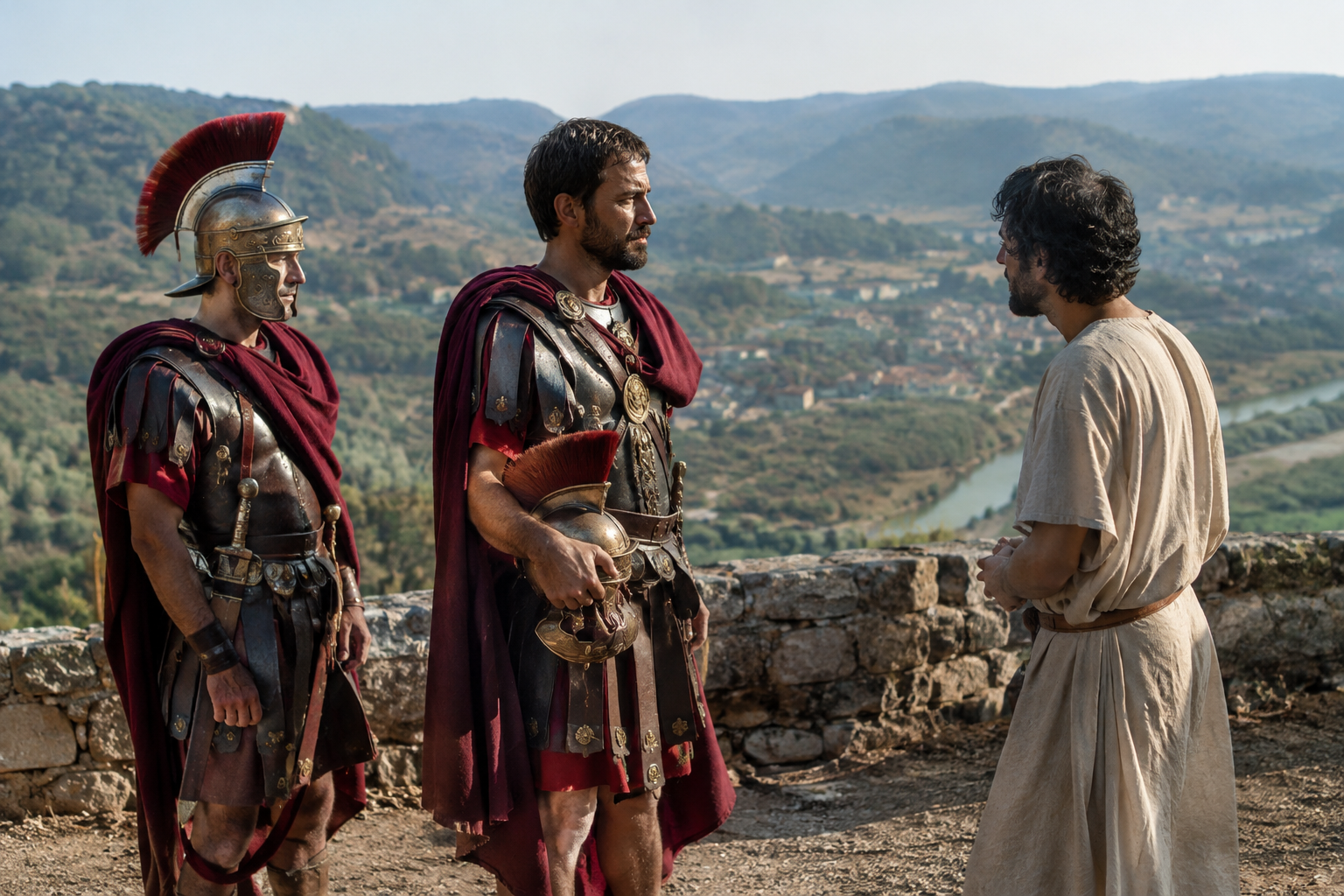
At Svilos Krusevlje in present-day Serbia, one man from the Imperial Roman period, dated around AD 236 and identified as R6693, offers a small but telling glimpse into the paternal history carried by haplogroup J2b2a1a1. There is no need to dress him up as a general, merchant, or settler from some neatly labelled migration. The interest lies in something quieter and more archaeological: this lineage appears in a Roman-era burial from the Balkans, a region where empire, local continuity, and long-distance movement constantly overlapped.
That matters because Y-DNA tracks one direct paternal line only - father to son across many generations - rather than a person's whole ancestry. Even a single securely dated ancient male can therefore be useful. In this case, J2b2a1a1 places a very specific paternal branch into the lived world of the Roman Danube frontier and its hinterland, where soldiers, farmers, artisans, officials, and families all moved through the same political landscape.
The sample R6693 comes from Imperial Roman Serbia, with an estimated date around the mid-3rd century AD. That was hardly a calm moment in Roman history. The Balkans were deeply tied into the empire's military and administrative systems, yet they were also places of striking local persistence, where older communities continued under Roman rule while new people arrived through service, trade, and resettlement.
So when a paternal lineage such as J2b2a1a1 turns up here, the sensible historical reading is not a grand single-origin story but a picture of embedded complexity. A Roman-period burial in Serbia could belong to someone from a family long rooted in the peninsula, or to descendants of movement from elsewhere in southeastern Europe or the eastern Mediterranean, or to people whose family history combined both. The Roman Empire was very good at mixing populations without erasing local identities.
A genetic study investigating populations in this wider region is linked here: https://www.biorxiv.org/content/10.1101/2022.05.15.491973v2.full. What we can say confidently from the evidence at hand is modest but important: a man associated with J2b2a1a1 was living and dying within the Roman world of the central Balkans in the 3rd century AD.
The wider J2 family is often discussed in connection with the eastern Mediterranean, the Aegean, and parts of the Near East, but that broader background should not be lazily pasted onto every downstream branch. J2b2a1a1 is not the same thing as all of J2. The narrower the branch, the more careful we have to be. What an ancient sample like R6693 does is pin one specific paternal line to one specific place and period.
In the Balkans, that is especially useful. This peninsula has seen repeated layers of settlement and cultural change: Neolithic farming expansions, Bronze Age networks, Iron Age communities, Roman conquest, Late Antique reorganization, and medieval population shifts. A Roman-era J2b2a1a1 lineage in Serbia does not solve that whole puzzle, but it does show that this branch belonged within that historical mix before the medieval and modern periods.
That is an important corrective to the old habit of imagining ancient populations as tidy blocks. Roman Balkan communities were not simple ethnic containers. They were made up of people whose paternal, maternal, and autosomal ancestries could each tell slightly different stories.
The date around AD 236 is worth pausing over. This was the age just before the Roman Empire's famous 3rd-century political crises deepened: pressure on frontiers, rapid changes in leadership, military strain, and shifting local loyalties. The Balkans sat close to some of the empire's most important land routes and troop corridors. In practice, that meant movement - but not movement of one type only.
Some people moved because armies moved. Others moved because market towns grew, estates changed hands, or provincial households followed opportunity. Many did not move far at all. The value of R6693 is that he belongs to this exact historical world, not to an abstract map of haplogroup distributions.
When readers encounter J2b2a1a1 in their own results, the temptation is often to ask, "Was this Roman? Greek? Balkan? Near Eastern?" Ancient DNA rarely rewards such blunt questions. A better question is: in what kinds of communities do we actually find this lineage? Here, one firm answer is the Roman Balkans.
Roman-era Serbia was no remote edge. It belonged to a heavily connected zone linking the Danube basin, the interior Balkans, and routes south toward Macedonia and the Aegean. That matters for Y-DNA interpretation because lineages do not travel by themselves; they move through families, and families move through real political and economic structures.
The appearance of J2b2a1a1 in this setting fits a wider archaeological truth about the region: continuity and connectivity existed together. Local populations were not simply replaced by incoming Romans, and "Roman" itself was never a biological category. Imperial rule created frameworks - roads, garrisons, taxation, towns, law - within which many ancestries could coexist.
In that sense, the Roman label attached to R6693 is historically significant but genetically limited. It tells us about his archaeological period and imperial context, not his language, legal status, or complete family background. Yet that context is enough to make the sample valuable. It places this paternal branch in a documented society that was both provincial and cosmopolitan.
Readers interested in how Roman rule left long-lived biological traces in provincial populations may also want to compare evidence from the western empire.
With only one named ancient individual here, caution is not just good manners; it is the whole method. We should not claim that J2b2a1a1 was common in all Roman Serbia, nor that R6693 founded a local dynasty, nor that every modern carrier of this haplogroup descends from a Roman provincial family in the Balkans. Ancient DNA works best when each sample is allowed to speak at the scale it genuinely supports.
Still, one sample can do real work. It can show presence. It can anchor chronology. It can stop us from assuming that a modern paternal line appeared in a region only recently. And in the case of J2b2a1a1, R6693 gives that anchor in a historically important zone where Europe and the Mediterranean met under Roman administration.
There is also a broader interpretive point. The Balkans are often treated as a corridor through which peoples passed. Archaeology keeps reminding us that they were also a place where people stayed, married, adapted, and became local. A lineage found in Roman Serbia belongs to that settled human reality as much as to any story of movement.
Croatia's Shifting Paternal Lines
For members of MyTrueAncestry with haplogroup J2b2a1a1, the strongest evidence here is refreshingly concrete: this paternal branch is represented by at least one documented male, R6693, living in Imperial Roman Serbia around AD 236. That does not turn the haplogroup into a badge of one ethnicity or one migration. What it does suggest is that this line formed part of the human landscape of the Roman Balkans, where imperial systems, regional roots, and family histories were constantly entwined.
Comments