Haplogroup J2b2a1a

– 5 min read


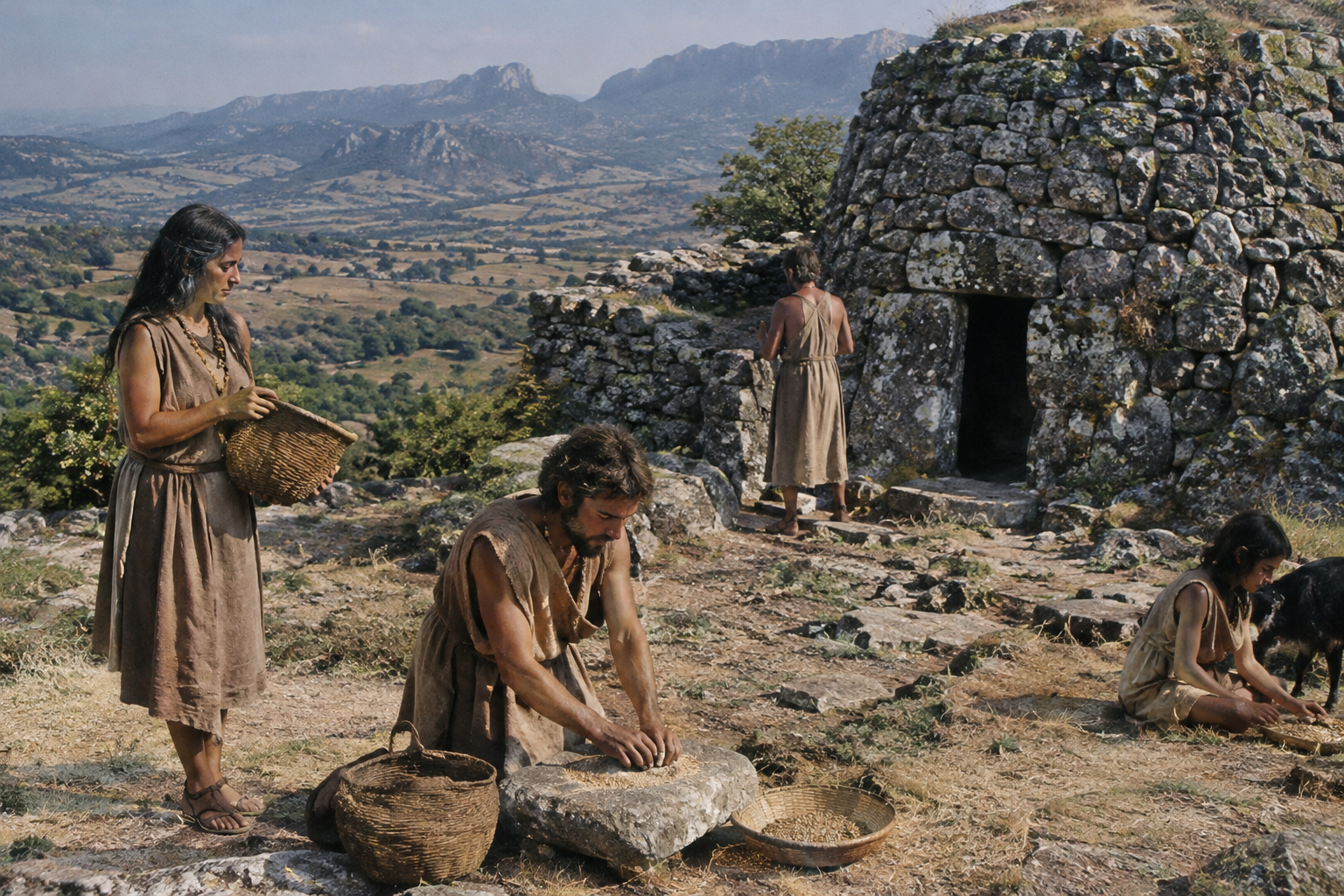
At first glance, ORC008 is a very small trace: one ancient man from interior Sardinia, dated to around 1000 BC and classified as Nuragic. Yet that is exactly why he matters. A lineage like J2b2a1a can easily be talked about in sweeping terms, but archaeology is usually at its best when it stays stubbornly local. Here, the local setting is the island world of the Nuragic period, and the question is simple: what does it mean to find this paternal line in inland Sardinia during the Late Bronze Age or early Iron Age?
That question is more interesting than it may sound. Y-DNA follows one direct paternal line only, not the sum total of a person's ancestry, but in the right archaeological setting it can show how male lines were present, persisted, or moved within communities. In the case of ORC008, the value lies not in turning one man into a grand historical mascot, but in placing J2b2a1a inside one of the Mediterranean's most distinctive prehistoric societies.
The label "Nuragic Interior Sardinia" places ORC008 in a landscape famous for its stone towers, clustered settlements, and long-lived local traditions. By around 1000 BC, Sardinia was no backwater. It sat in the middle of Mediterranean exchange networks, with contacts that could connect the island to the Italian peninsula, Iberia, and the wider central and eastern Mediterranean. But those contacts did not erase local identities. Nuragic communities remained recognizably Sardinian in material culture and settlement pattern.
That makes ORC008 especially useful. He is not presented here as a foreign trader, a dynast, or a conqueror. He is simply an ancient individual from inland Sardinia whose paternal line has been associated with J2b2a1a. In historical storytelling, there is always a temptation to make every J-lineage into an eastern seafaring tale. The evidence for this man is much more disciplined than that. What it shows, at minimum, is that a branch within the broader J2 family was present among people living in Sardinia's Nuragic world by about 1000 BC.
A genetic study of ancient island populations, circulated here as research on the paleogenomics of ancient Italian islands, has helped frame exactly this kind of question: not whether Sardinia was "purely isolated" or "wholly imported," but how continuity and contact worked together over long periods. ORC008 fits that larger archaeological problem very neatly.
J2 is a broad Y-chromosome family with deep roots in the wider Near East and Mediterranean-connected worlds, but the narrower label in this article is J2b2a1a, not J2 in general. That distinction matters. One of the common mistakes in popular DNA history is to take the entire backstory of a major haplogroup and pin it onto a much smaller branch without enough evidence. For ORC008, the secure historical point is presence in Nuragic Sardinia, not a fully mapped migration route.
Still, presence matters. Sardinia is often discussed in genetics as a place of remarkable continuity, especially from early farming populations onward. Yet continuity never meant stillness. The island saw contacts, arrivals, marriages, and exchanges over centuries. A paternal lineage like J2b2a1a appearing in an inland Nuragic individual suggests that outside-linked male lines were not confined to coastal enclaves or one-off visitors. By this date, at least one such line had become part of the lived demographic reality of the island's interior.
That is a useful corrective to simplistic pictures of prehistoric islands. Archaeology has long shown that islands can be both conservative and connected at once. ORC008 belongs squarely in that middle ground.
To understand the historical weight of ORC008, it helps to remember what Nuragic Sardinia looked like in this period. The great era of nuraghi construction had already shaped the island's landscape. Communities lived among monumental stone towers, village compounds, ritual sites, and regional networks of exchange. These were not anonymous prehistoric people drifting outside history; they were participants in a highly structured island society.
By the end of the second millennium BC, Sardinia had clear links with other Mediterranean peoples. Archaeologists have long traced exchanges in metals, ceramics, and prestige goods. Later contacts with Phoenician spheres would become more visible, but even before formal colonial settlements, the island was part of a sea of movement. In that context, a paternal branch such as J2b2a1a does not need a melodramatic backstory to be significant. It fits a Mediterranean in which men, families, and lineages could move, settle, and be absorbed into local communities over generations.
The important point is chronology. ORC008 belongs to a period before the classical empires that often dominate Mediterranean history writing. This is not yet Roman Sardinia, nor medieval Sardinia, nor the later documentary world where identities are named in texts. The value of the DNA is that it lets us glimpse male-line diversity in an era when archaeology must do almost all the talking.
Another point worth pausing over is the phrase "interior Sardinia." Histories of Mediterranean mobility often hug the coastline, as though everything important happened at harbors. But inland communities mattered enormously. Goods moved inland. People moved inland. Marriage networks and kin groups extended beyond ports and anchorages. If ORC008 had only been found in an obviously coastal trading setting, one could too easily imagine a temporary outsider. An inland context encourages a different possibility: incorporation into a settled local society.
That does not prove where his paternal ancestors had come from centuries earlier, nor does it tell us what language he spoke or how he identified himself. What it does suggest is that by around 1000 BC, this branch was not incompatible with being fully embedded in Nuragic Sardinia. For anyone carrying J2b2a1a today, that is a much more interesting message than a cartoon migration arrow. Ancient DNA is at its most revealing when it shows belonging as well as movement.
This also sits well beside broader MyTrueAncestry work on Mediterranean population change. Roman and post-Roman studies often reveal how connected the sea could be, but ORC008 reminds us that the foundations of that connected world were older. Long before Roman Hispania or medieval Sicily, island populations were already shaped by selective, uneven, human-scale mixing.
One sample is never the whole island. ORC008 cannot stand in for every Nuragic man, and he certainly cannot define Sardinia by himself. But single individuals can still matter a great deal when they appear in the right archaeological frame. Here the frame is a famous island population often described through continuity, and the finding adds texture to that continuity rather than overturning it.
The larger historical lesson is that paternal lines in the ancient Mediterranean were often more mixed than older national or regional myths liked to imagine. A Nuragic individual linked to J2b2a1a does not make Sardinia "eastern," any more than another lineage would make it "purely western." It shows a real human population with inherited lines crossing older boundaries while local culture remained recognizably its own.
That pattern has parallels elsewhere in the Mediterranean, where archaeology and genetics increasingly show local societies absorbing newcomers without losing their regional character. Sardinia is especially valuable in this discussion because its long-term continuity makes each signal of connection easier to place in context rather than treating every difference as a dramatic rupture.
For a modern tester with Y-DNA haplogroup J2b2a1a, ORC008 offers a grounded and rather elegant kind of connection: this branch, or a reported association with it, appears in an ancient man from inland Nuragic Sardinia around 1000 BC. That does not create a neat family tree stretching back to one named islander. It does, however, place your paternal line within the kind of Mediterranean world where continuity, seaborne contact, and local belonging all coexisted. In other words, J2b2a1a is not just a label on a phylogenetic tree here; it is a line already present in one of prehistoric Europe's most distinctive island societies.
Comments