Haplogroup J2b1b1
– 5 min read


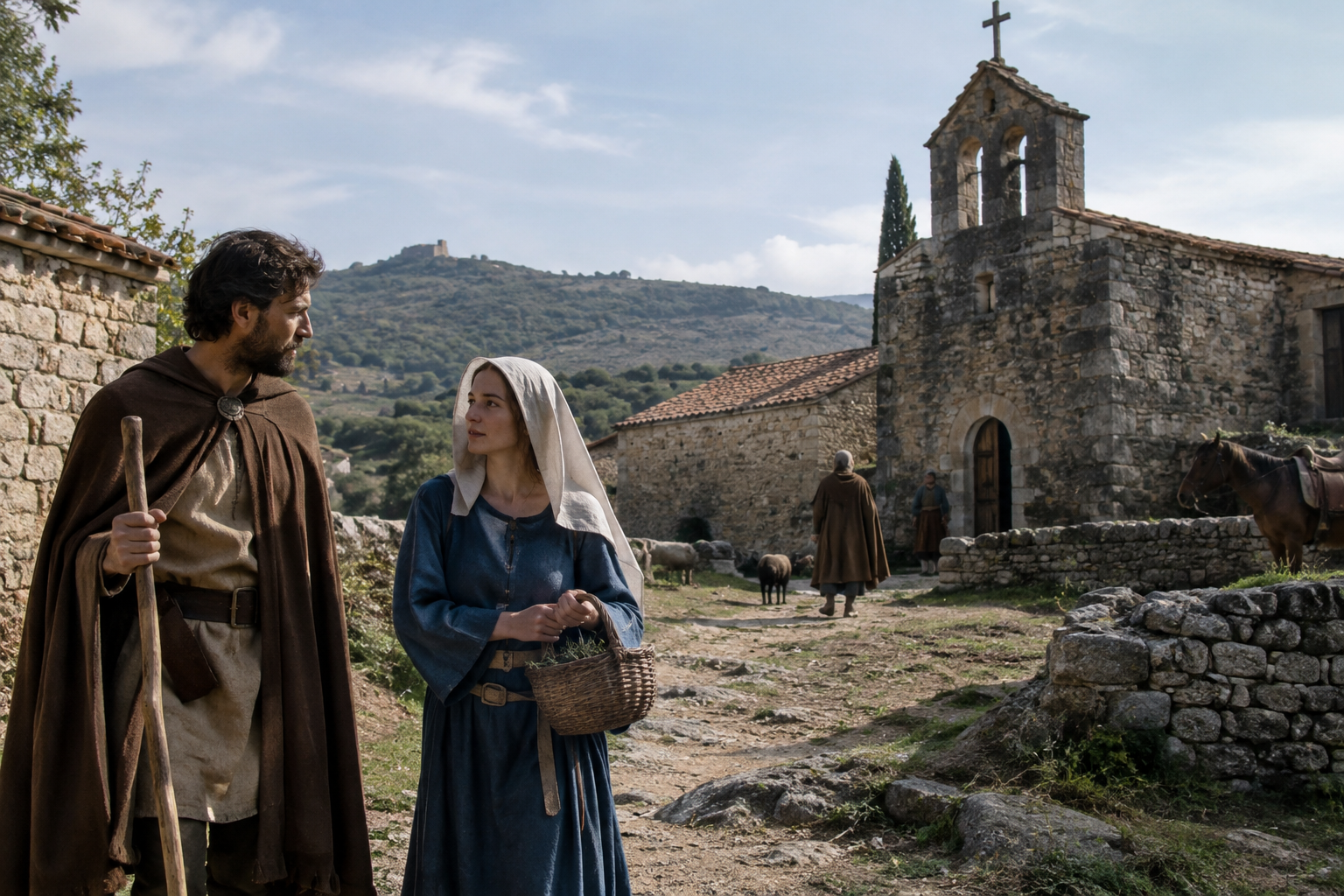
At Sao Miguel de Odrinhas, near Sintra in Portugal, two men buried around AD 1350 stand out for a very specific reason. Their sample IDs, LP114_5 and LP114_3, have both been associated with the Y-DNA haplogroup J2b1b1. That is not, by itself, a dramatic tale of kings and conquests. But archaeologically it is something better: a small, solid glimpse of one paternal line present in a medieval Christian community on the western edge of Europe.
The interest of J2b1b1 here lies in context. Y-DNA follows one direct paternal line only, not a person's whole ancestry or identity, and medieval Portugal was never genetically simple. By the 14th century this was a land shaped by deep Iberian roots, Roman rule, late antique change, Islamic centuries, and Christian kingdoms. Finding J2b1b1 in Odrinhas places that branch within this long and complicated history rather than in any tidy origin story.
The two men come from the Kingdom of Portugal at Sao Miguel de Odrinhas, dated here to about AD 1350. Even with sparse sample-level detail, the pairing matters. Two individuals from the same site and period associated with J2b1b1 suggest that this paternal line was not an isolated curiosity in medieval Estremadura, but part of the living male population of the region.
Odrinhas itself sits in a landscape thick with older history. The Sintra area is one of those Iberian places where Roman, late antique, and medieval layers lie almost on top of one another. That makes any medieval genetic finding especially interesting, because it belongs to a population formed not in one founding event but through centuries of settlement, continuity, conversion, mobility, and local marriage networks.
A broader ancient DNA study of Portugal and its population history is the best frame for reading finds like these, even when the article-level evidence here is limited to site, date, and IDs. Research on the region published in Genome Biology helps place medieval Portuguese individuals within the peninsula's long-term genetic development.
J2b1b1 is a narrow paternal branch, and that distinction matters. It would be careless to load onto this one subclade every broad statement ever made about haplogroup J2, which is a much larger family with a long history across parts of the Mediterranean, Balkans, and western Asia. The evidence here is more modest and more useful: by the 14th century, one branch within that wider paternal family was present in western Iberia.
That may sound restrained, but restraint is exactly what makes archaeogenetics valuable. Medieval burial grounds are full of people whose surnames are lost, whose biographies are unknowable, and whose communities survive only in fragments. A Y-line such as J2b1b1 offers one thread of continuity through that uncertainty. It can show that a paternal branch often associated today with southern and southeastern European patterns was also part of medieval Portuguese society.
It cannot, on its own, tell us whether LP114_5 and LP114_3 were close relatives, recent migrants, or descendants of men whose line had been in Iberia for many centuries. Two shared haplogroups at one site are suggestive, not a ready-made family tree.
If there is one historical mistake to avoid with Iberia, it is imagining each period as a clean replacement of the one before. Portugal in the 1300s was certainly a Christian kingdom, but its people inherited a much older human landscape. Roman towns and roads had long structured movement; late Roman and Visigothic communities had left their mark; and centuries of Islamic rule in parts of the peninsula had introduced new social and demographic layers before Christian political expansion reshaped the map again.
So when J2b1b1 appears at Odrinhas, the sensible question is not, "Which single event brought it there?" More often than not, lineages arrive, persist, fragment, and localize through many episodes rather than one. A paternal branch may pass through Roman-era mobility, late antique survival, medieval resettlement, or ordinary village continuity without leaving a neat written explanation.
This is one reason Iberian ancient DNA has become so illuminating. The peninsula repeatedly shows continuity mixed with newcomers, rather than simple substitution. Medieval men carrying J2b1b1 in Portugal fit that wider picture of accumulated ancestry.
The real strength of the Odrinhas evidence is that there are two individuals, not one. LP114_5 and LP114_3 give us a tiny cluster rather than a lone datapoint. In archaeology, that matters because repeated signals from the same place can hint at a lineage embedded in a community, even if we cannot yet map the exact kinship ties between the buried men.
Church-associated burial grounds in medieval Iberia were not exotic spaces. They were local, familiar, communal. A lineage found there is part of daily life: farming, worship, inheritance, neighborhood, and the ordinary demographic churn of marriage and mortality. That may be less glamorous than a princely tomb, but for understanding how haplogroups actually survived into the present, ordinary cemeteries are often far more revealing.
In other words, J2b1b1 at Sao Miguel de Odrinhas is not evidence of a fleeting visitor on the Atlantic fringe. It is evidence of men buried within a settled medieval society. Whether their paternal line had been in the region for generations or centuries, by AD 1350 it belonged there.
These Portuguese samples also sit comfortably beside a broader pattern seen across Iberia: diversity within medieval populations, sometimes at very local scales. Ancient DNA from Spain has shown how burial grounds can contain people of differing backgrounds without ceasing to be recognizably local communities. Medieval and early medieval Iberia was never sealed off; it was a place of circulation across kingdoms, faiths, and regions.
That broader perspective helps explain why a haplogroup like J2b1b1 should not be treated as surprising simply because Portugal lies so far west. The Atlantic facade was connected to inland Iberia, to the Mediterranean world, and to older imperial networks. Once a paternal branch became established, it could persist for centuries in local male lines.
There is a useful comparison here with other peninsular studies exploring the Muslim-Christian transition and regional mixture. Medieval Iberian genetics repeatedly resists simplistic labels. The westernmost kingdom of Portugal was fully part of that story.
The most distinctive thing about J2b1b1 in this case is not a heroic founder or a named dynasty. It is the quiet fact of medieval presence: this branch is directly attested in two men from Sao Miguel de Odrinhas around AD 1350. For someone researching a modern J2b1b1 paternal line, that offers a historically grounded possibility that such ancestry may have been woven into Iberian populations for a long time, shaped by the same layered history that made Portugal what it was.
That is often how the best ancient DNA evidence works. It does not give you a legend. It gives you real men, in a real place, in a real cemetery, and shows that your paternal branch was already part of the medieval world they inhabited.
Comments