Haplogroup J2a2a1a

– 5 min read


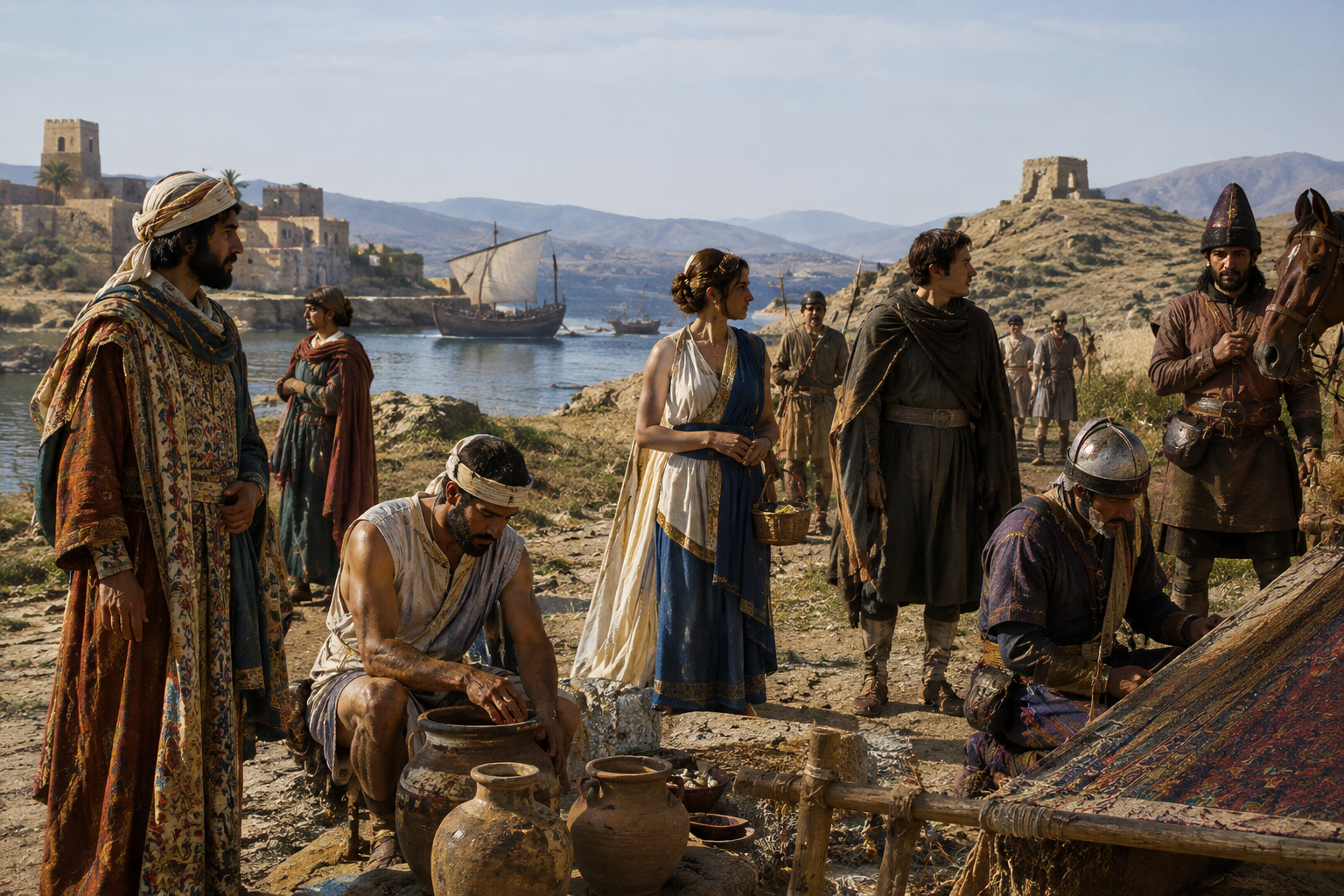
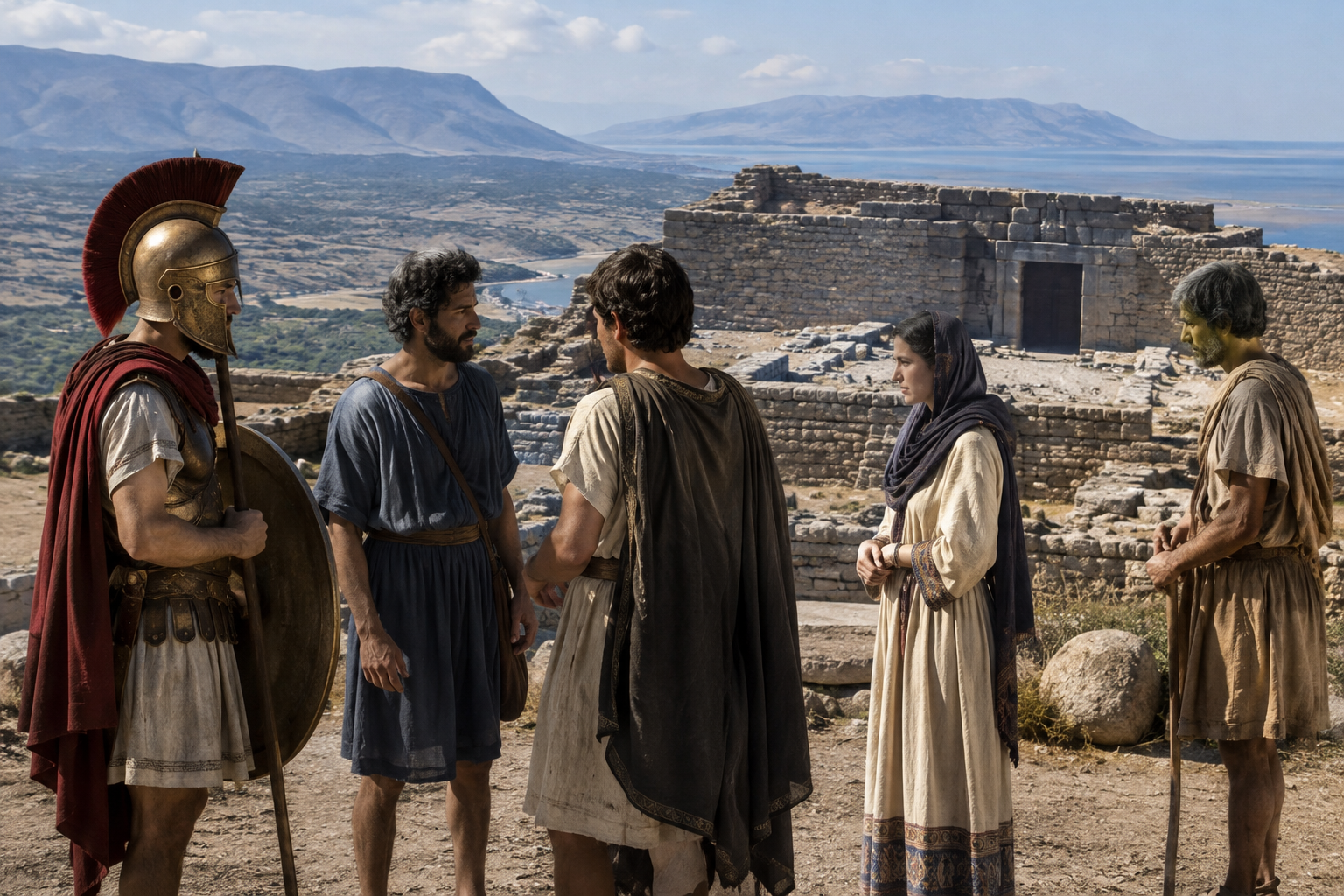
At Aidonia in Corinthia, a Mycenaean-era man identified as AID008 offers one of the oldest signposts in this small trail of evidence for Y-DNA haplogroup J2a2a1a. Dated to around 1500 BC, he belongs to the Bronze Age Aegean world of palaces, fortified settlements, and far-flung exchange. That matters because J2 lineages are often discussed in broad, rather vague terms; here, by contrast, we can watch one branch appear in actual excavated individuals across a connected Mediterranean and Near Eastern landscape.
The samples linked here do not describe a single tribe, dynasty, or ethnic label. They show something more interesting, and more historically realistic: a paternal line associated with places that were busy nodes of movement, trade, and empire. Y-DNA traces one direct male line only, not a person's whole ancestry, but for J2a2a1a the archaeological settings are remarkably consistent. They cluster in worlds tied to the Aegean, Anatolia, Sicily, Iberia, and the Gulf.
AID008 from Mycenaean Aidonia is important precisely because it is early and geographically well placed. Corinthia sat close to one of the great hinge-zones of the eastern Mediterranean, linking mainland Greece to sea routes running south and east. A paternal lineage found there in the second millennium BC is not proof of a single migration event, but it does place this branch within the social world that connected the Aegean to Anatolia, Cyprus, and beyond.
For readers with roots in J2a2a1a, this is the first big point to grasp: the branch is not appearing out of nowhere in late antiquity. Its presence in a Mycenaean context suggests depth in the eastern Mediterranean before the classical age. Research on ancient Aegean populations, including work associated with ancient DNA from Bronze and Iron Age Mediterranean settings, has repeatedly shown that the Aegean was never isolated. It was a place where continuity and contact sat side by side.
Another key individual is I4030 from Iron Age Gordion in central Anatolia, dated here to around 175 BC. Gordion is one of those sites that tends to collapse whole centuries into a single famous name, but that would be a mistake. It was not just the legendary seat of King Midas. It remained part of a strategic Anatolian corridor linking inner Asia Minor to the Aegean coast and, through successive empires, to wider Mediterranean systems.
Finding J2a2a1a in this setting fits a pattern of long-term eastern Mediterranean and Anatolian connectivity rather than a narrow local story. By the Hellenistic period, central Anatolia was entangled in a world shaped by Persian rule before Alexander, then by the successor kingdoms, local elites, and increasing Mediterranean exchange. A Y-line appearing in both Bronze Age Greece and later Anatolia does not mean the same family line can be traced directly between the two men. It does mean the branch belongs comfortably inside the historical traffic of these regions.
That makes Gordion especially useful in this article. Aidonia shows early depth; Gordion shows durability in a major inland crossroads. Together they suggest that J2a2a1a should be imagined less as a marker of one people than as part of the demographic furniture of the eastern Mediterranean's urban and post-urban worlds.
The sample I22095, dated to around 660 BC from Hellenic-Carthago Marsala in western Sicily, brings the story west. And western Sicily is exactly where one would want better evidence if one were testing how a paternal line moved across maritime networks. Marsala was a zone where Phoenician and later Punic influence met Greek expansion, local Sicilian communities, and the hard realities of seaborne commerce.
That label, Hellenic-Carthago Marsala, should not be over-interpreted into a neat ethnic box. But it does place the individual in one of the most mixed and contested regions of the first-millennium-BC Mediterranean. J2a2a1a here is striking because it appears not on one side of the sea-lanes, but on both. Sicily was a classic middle ground: never merely Greek, never merely Phoenician, and certainly never genetically uniform.
Recent work on ancient Mediterranean island populations and Punic-era communities has emphasized just that complexity. A study of ancient populations in the region published in Nature helps frame the wider context: islands such as Sicily preserved local continuities while also receiving newcomers from several directions. A paternal branch like J2a2a1a fits very naturally into that sort of world.
The later samples are perhaps the most revealing of all because they show the branch still turning up in very different political landscapes. MH1_LT comes from Sasanian-period Madinat Hamad in Bahrain, dated here to about AD 497. By then, the old Bronze Age and classical worlds had given way to imperial systems centered on Rome and Iran, but Bahrain remained what it had long been: a Gulf entrepot, tied to trade, religion, and mobility across sea and desert routes.
To see J2a2a1a in Bahrain during the Sasanian period is not surprising in a simplistic "Near Eastern" sense; what matters is the historical setting. This is a branch found in a place where Arabia, Mesopotamia, Iran, and Indian Ocean exchange intersected. That makes the lineage's documented range broader than a narrowly Aegean or Anatolian story, while still keeping it within connected zones of the ancient Old World.
Then there is I13575 from Sarria de Ter, Pla de lHorta, near Girona in post-Roman Spain, dated to around AD 550. Here the branch appears at the far western end of the Mediterranean, in a landscape reshaped by the collapse of Roman administration and the emergence of successor kingdoms. But eastern Mediterranean-linked ancestry and lineages did not vanish with Rome. Iberia had already been tied for centuries to soldiers, merchants, settlers, slaves, administrators, and church networks moving through the empire.
So this Spanish sample should not be treated as an exotic intrusion. It is better understood as part of late antique Mediterranean continuity: the Roman world broke politically, but many human connections endured. That broad picture aligns well with MyTrueAncestry's discussions of Roman Hispania’s Lasting Genetic Legacy and related work on post-Roman Iberian diversity.
With only a handful of ancient men, caution is essential. We should not pretend these individuals formed one continuous paternal chain, nor that J2a2a1a can be assigned to a single language, kingdom, or ethnic category. What the evidence does support is a more grounded historical picture: this branch appears in settings shaped by mobility, urban life, imperial contact, and seaborne exchange.
The pattern runs from Mycenaean Corinthia to Iron Age Anatolia, from western Sicily's mixed colonial world to Sasanian Bahrain and post-Roman northeastern Iberia. That is a wide arc, but not a random one. It maps onto some of the most active connective tissue of the ancient Mediterranean and Near East.
For someone exploring paternal ancestry in J2a2a1a, the most responsible takeaway is not a claim to one famous civilization, but a connection to the long-lived crossroads societies of the eastern and central Mediterranean world. The ancient men associated with this branch are found in places where Greeks, Anatolians, Punic communities, Romans, Iranians, and Iberians all lived within larger webs of contact. In other words, J2a2a1a looks less like the signature of a single people than like a durable paternal thread woven through the marketplaces, ports, settlements, and empires that linked three continents.
Comments