Haplogroup J2a1h2

– 5 min read


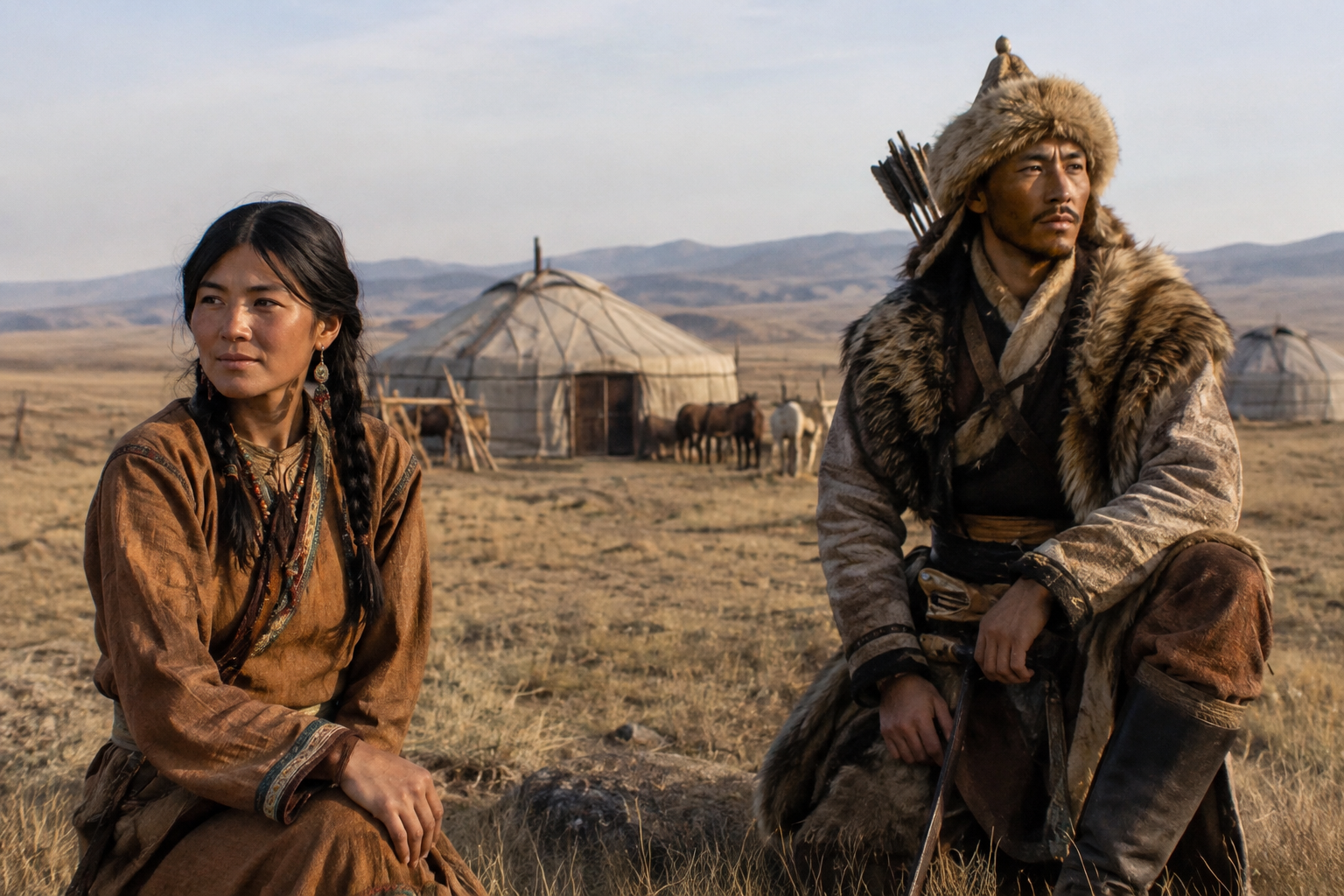
At Konyr Tobe, part of the Otyrar cultural sphere in southern Kazakhstan, one ancient male identified as KNT003 has been associated with the Y-DNA branch J2a1h2 and dated to around AD 300. That is already enough to make him interesting. He appears in a place that sat close to one of Eurasia's great contact zones: the corridors linking oasis towns, river valleys, and steppe routes across Central Asia.
Set beside another man, NAI001 from Naimaa Tolgoi in Mongolia and dated to around AD 50 in a Late Xiongnu context, the picture becomes even more striking. J2a1h2 is a very specific paternal branch within the wider J2a family, and these two finds place it not in a single tidy homeland story, but in the busy world of movement, exchange, and mixed communities across Inner Asia. Y-DNA tracks one direct paternal line only, not a person's whole ancestry, but even one line can tell us a great deal about where men and families turned up in the ancient world.
The broader haplogroup J2 is often discussed in connection with the ancient Near East, the eastern Mediterranean, and later urban and trading networks across West and Central Asia. But that larger history should not simply be pasted onto every downstream branch. J2a1h2 is not a synonym for all J2a. It is a narrower paternal lineage, and with the evidence here, what we can say securely is modest but still revealing: this branch appears in two ancient individuals from historically important zones of interaction in Central and Inner Asia during the first centuries AD.
That matters because the period was anything but static. Empires rose and fell, steppe confederations expanded, oasis settlements flourished, and long-distance exchange tied together places that modern maps often separate too neatly. Research on ancient populations of the Mongolian steppe has repeatedly shown that these societies were genetically varied rather than isolated blocks, a point explored in MyTrueAncestry's discussion of steppe genomes.
The earlier of the two men, NAI001, comes from Naimaa Tolgoi in Mongolia and is dated to about AD 50, in the Late Xiongnu period. That setting is historically important in its own right. The Xiongnu world was not a sealed ethnic container but a large political formation spanning different landscapes and incorporating people with different local backgrounds.
So a J2a1h2 signal here should not be read as an oddity to be explained away, nor as proof of a single dramatic migration event. It is better understood as evidence that paternal lines more commonly associated today with western parts of Eurasia could be present within the social and political world of the eastern steppe. That fits the broader pattern seen in archaeogenetics, where steppe polities often contain individuals of varied ancestry profiles and lineages.
An ancient DNA study examining populations from the eastern steppe is linked here in the supporting research record: https://advances.sciencemag.org/content/7/13/eabe4414. Without overstating any one sample, the larger lesson is plain enough: the Xiongnu horizon included more diversity than older, simpler narratives allowed.
This is exactly the sort of result that helps dismantle the old museum-label habit of treating steppe confederations as if each one were genetically uniform. A burial can be culturally Xiongnu and still carry a paternal line with a deeper history elsewhere. Culture, political identity, ancestry, and Y-chromosome descent do not always march in lockstep.
The second ancient man, KNT003, comes from Konyr Tobe and is dated to around AD 300. This places him in the Otyrar region of southern Kazakhstan, a landscape famous not for remoteness but for connection. The Syr Darya corridor and nearby oasis networks linked Central Asia's settled communities with wider commercial and political systems stretching toward Transoxiana, the steppe, and beyond.
That is an excellent setting in which to find a branch like J2a1h2. Not because one can claim a single origin story for the man himself, but because southern Kazakhstan in late antiquity was precisely the sort of region where paternal lines could circulate through trade, military service, marriage, migration, and the slow accumulation of frontier contacts over generations.
One of the pitfalls in writing about Central Asia is the temptation to divide the past into "settled" and "nomadic" as if they were separate universes. Otyrar and its surrounding settlements remind us that they were deeply entangled. Men moved between these worlds; goods did too; so did lineages. A lineage turning up at Konyr Tobe is therefore not surprising in itself. What is valuable is that ancient DNA lets us pin that presence to a real person, at a real site, in a real historical window.
East-west mixing in Inner Asia
Two ancient examples are not a dynasty, not a tribe, and not a population average. They do, however, show that J2a1h2 had reached both the Mongolian steppe and the southern Kazakh crossroads by the first few centuries AD. That is already historically meaningful. It points to a paternal branch participating in the human traffic of Inner Asia rather than remaining confined to one small corner of the map.
The geographical spread between NAI001 and KNT003 is especially suggestive because the two contexts are different. One belongs to the Late Xiongnu sphere in Mongolia; the other belongs to the Otyrar cultural setting in Kazakhstan several centuries later. The importance lies not in forcing them into one tidy migration arrow, but in seeing that the branch appears in more than one environment linked by wider Eurasian connectivity.
A supplementary research link associated with these ancient materials is also available here: https://www.biorxiv.org/content/10.1101/2020.03.25.008078v1.supplementary-material. In practical terms, such work has helped make it much easier to compare individuals from steppe, oasis, and frontier settings across broad regions.
If there is one historical theme that suits J2a1h2 in these samples, it is not conquest in the narrow heroic sense. It is circulation. The centuries around the turn of the first millennium AD were an age of linked corridors: caravan trade, diplomatic exchange, mobile pastoralism, resettlement, and imperial pressure all helped redistribute people and paternal lines across enormous distances.
That is why these finds sit so comfortably beside other MyTrueAncestry discussions of Central Asian and steppe population history. The branch does not need a romantic legend to be interesting. Its interest lies in its appearance within societies that were already mixtures of local continuity and long-range contact.
There is also a useful comparison with work on Sogdian and Silk Road populations, where archaeology and DNA keep showing that trade routes were carried by communities, not abstractions. Merchants, camp followers, craftsmen, soldiers, farmers, and herders all formed the human texture of exchange.
Sogdians and Silk Road ancestry
For someone researching J2a1h2 today, the most responsible takeaway is not a claim to one empire or one people. It is something subtler, and in its way more interesting: this paternal line is documented in ancient men from two major Inner Asian settings, one in the Late Xiongnu world of Mongolia and another in the Otyrar region of Kazakhstan. In other words, it belonged to the sort of Eurasian past shaped by mobility, contact, and communities that were never as isolated as older histories liked to imagine.
Comments