Haplogroup J2a1a1b1

– 5 min read


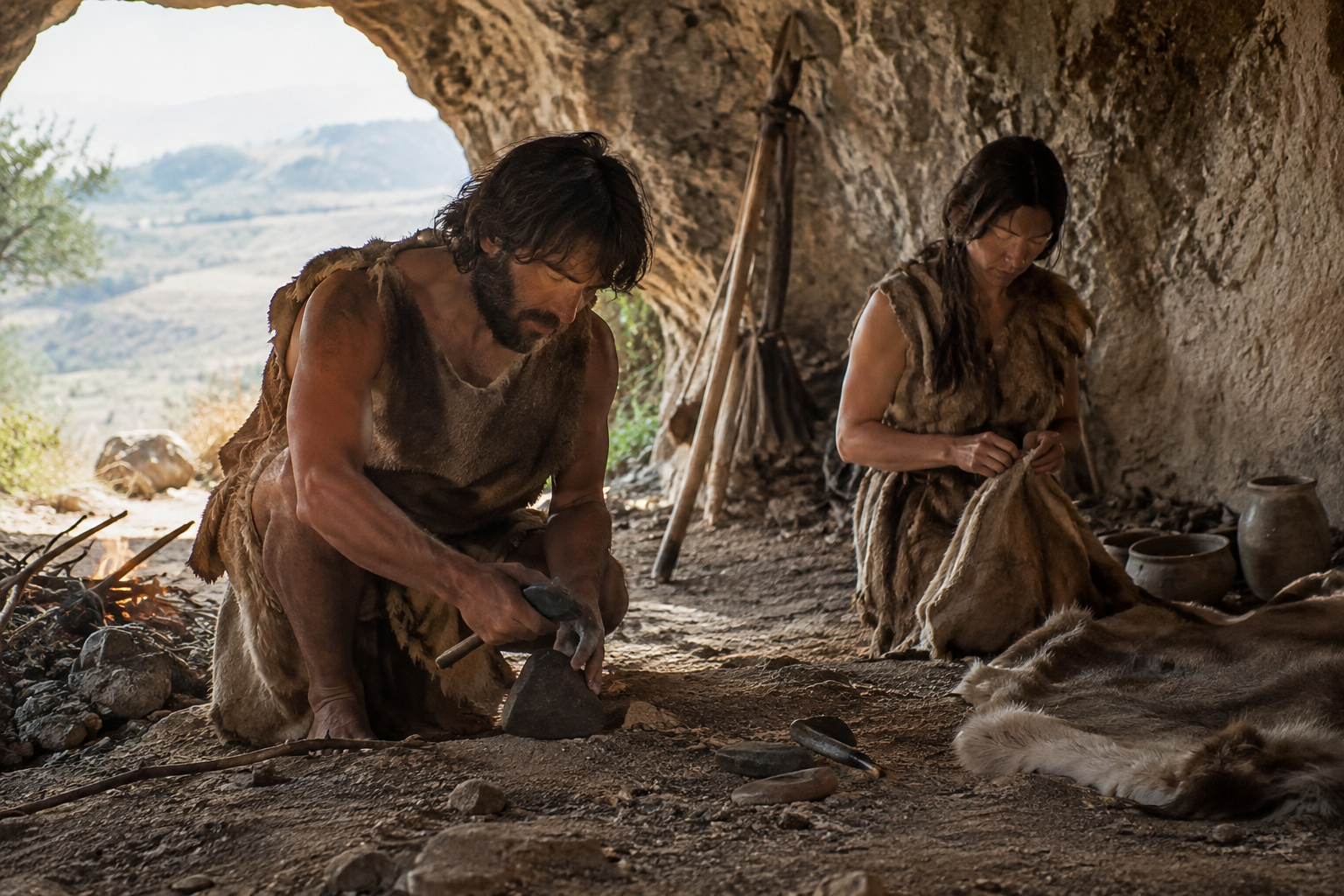
At Grotta La Sassa in central Italy, two men dated to about 3000 BC, sample IDs SC002 and SCA011, bring the Y-DNA haplogroup J2a1a1b1 into unusually sharp archaeological focus. The site is a cave, but not in the romantic storybook sense. It matters because caves in prehistoric Italy were often used in complex ways: for burial, for memory, and sometimes for the careful reworking of the dead across generations.
That makes these two paternal-line findings especially interesting. J2a1a1b1 is a very specific branch within the broader J2 family, a lineage often discussed in connection with the spread of farming and later Mediterranean movement. But the two Grotta La Sassa men remind us to be precise: this article is about one narrow branch, seen here in Copper Age Italy, not about every man ever assigned to J2. Y-DNA follows one direct paternal line only, yet even that thin thread can tell us something valuable when it turns up in a securely dated archaeological setting.
Grotta La Sassa lies in the Monti Ausoni area of Latium, south of Rome, in a landscape of limestone hills, caves, and routes linking the Tyrrhenian side of Italy with inland zones. By the Copper Age, roughly the 4th to 3rd millennium BC, such places were not isolated backwaters. They sat within a changing world of small farming communities, mobile herding, exchange networks, and new social habits tied to metal, stone, and ancestry.
The importance of SC002 and SCA011 is not that they magically identify a tribe or a dynasty. It is that the same paternal branch appears more than once at one prehistoric Italian cave site around the same broad period. That repetition suggests J2a1a1b1 was present among real communities in Copper Age central Italy, not merely as a stray single occurrence. An ancient DNA study on prehistoric Italy and surrounding regions brought new attention to this period of population change and continuity, including cave-associated burials such as these: research on ancient genomes from Copper Age and Bronze Age Italy.
What we should not do is over-polish the evidence. Two men from one cave do not prove a ruling patriline, a local clan structure, or a direct line into every later Italian population. But they do place this branch firmly into a real prehistoric human setting: not an abstract phylogenetic tree, but the burial world of Copper Age Latium.
The wider haplogroup J2 has deep associations with the eastern Mediterranean, Anatolia, and the spread of early farming populations into parts of Europe. Yet broad statements can become misleading when applied to a narrow subclade. J2a1a1b1 is not the whole of J2, and these Grotta La Sassa samples do not by themselves map its ultimate origin, full distribution, or every migration route.
What they do show is that by around 3000 BC, one branch of J2a was present in central Italy during a period when Italian populations were already the product of long Neolithic settlement histories and regional interaction. In other words, this is not necessarily a "first arrival" story. It may instead be a story of persistence, mixing, and local establishment. That is often the more historically interesting possibility, because prehistoric Europe was not a chessboard of clean replacements. It was a messy human landscape in which lineages could endure, spread, contract, or appear in pockets for reasons we cannot reduce to one event.
A cave burial site also changes the kind of history we can tell. Grotta La Sassa was part of a funerary tradition in which the dead were gathered into a place already marked by memory and repeated use. That matters for paternal-line interpretation. If two men at the site belong to J2a1a1b1, the result may reflect a local family pattern, but it may also reflect the selective use of a burial place by part of a wider community.
Archaeologists are always trying to separate those possibilities. A cave can preserve evidence of continuity, but continuity of what exactly? A single household? A broader settlement network? A ritual landscape used by several groups? Without stronger kinship data, we should keep all three in play. Still, the recurrence of the same Y-line there is a strong clue that this branch was woven into the social fabric of the community that used the cave.
This is one reason ancient DNA has transformed prehistoric archaeology. It lets us revisit familiar burial places and ask not just who was buried there, but how biological relationships intersected with ritual practice. MyTrueAncestry readers interested in Italian population history may also want to compare this with later evidence from the peninsula.
It is tempting, when looking at an Italian lineage, to rush forward to Romans, Etruscans, Greeks, or medieval noble houses. Grotta La Sassa belongs to a much earlier chapter. Around 3000 BC, central Italy was still many millennia away from Rome's imperial bureaucracy and from the literary labels that dominate later history. The men represented by SC002 and SCA011 lived in a world known mainly through settlement traces, burials, tools, ceramics, and increasingly, ancient genomes.
That earlier horizon matters because it shows that some paternal diversity in Italy has genuinely deep roots. A lineage found in historic or modern Mediterranean populations may not be the product of a single classical colonization event. Sometimes its presence in the peninsula reaches back into later prehistory, before the familiar names appear in our texts. The cave samples are a small but useful corrective to simplistic ideas about who arrived when.
Central Italy has become especially important in this discussion because genetic studies increasingly show that prehistoric Italian regions were connected, but not identical. Mountain zones, coastal corridors, and cave-using communities could preserve local peculiarities while still participating in broader population shifts.
There is a pleasing austerity to the evidence here. We have two sample IDs, one site, one broad date, and one paternal assignment linked to J2a1a1b1. That is not enough to write a saga, but it is enough to say something responsible. This branch was present in Copper Age Grotta La Sassa, and present in at least two males there: SC002 and SCA011.
That repeated appearance gives the branch more archaeological weight than a lone isolated detection would. It suggests a localized pattern worth noticing, especially in a burial cave context where repeated use may reflect community structure and inherited ties. For people exploring their own paternal ancestry, that is often the real value of ancient DNA: not fantasy genealogy, but glimpses of where a lineage was living, being buried, and participating in society at a particular time.
It also places J2a1a1b1 within a specifically Italian prehistoric setting rather than leaving it floating in generalized maps of the Mediterranean. If your Y-line falls on or near this branch, Grotta La Sassa offers a tangible scene from deep time: central Italy, the Copper Age, and a burial place reused enough for the same paternal signal to appear twice.
The most distinctive thing about haplogroup J2a1a1b1 here is not glamour but context. At Grotta La Sassa, around 3000 BC, it appears in more than one man within a real funerary landscape of Copper Age central Italy. That does not make it the only important lineage there, and it does not turn two burials into a mythic founding family. But it does anchor this paternal branch in prehistoric Italy with unusual clarity. For anyone researching this haplogroup today, that is a solid and meaningful connection: a direct paternal line present among cave-buried communities long before the written history of the peninsula began.
Comments