Haplogroup J2a1a1a2b2a1a1c2

– 5 min read


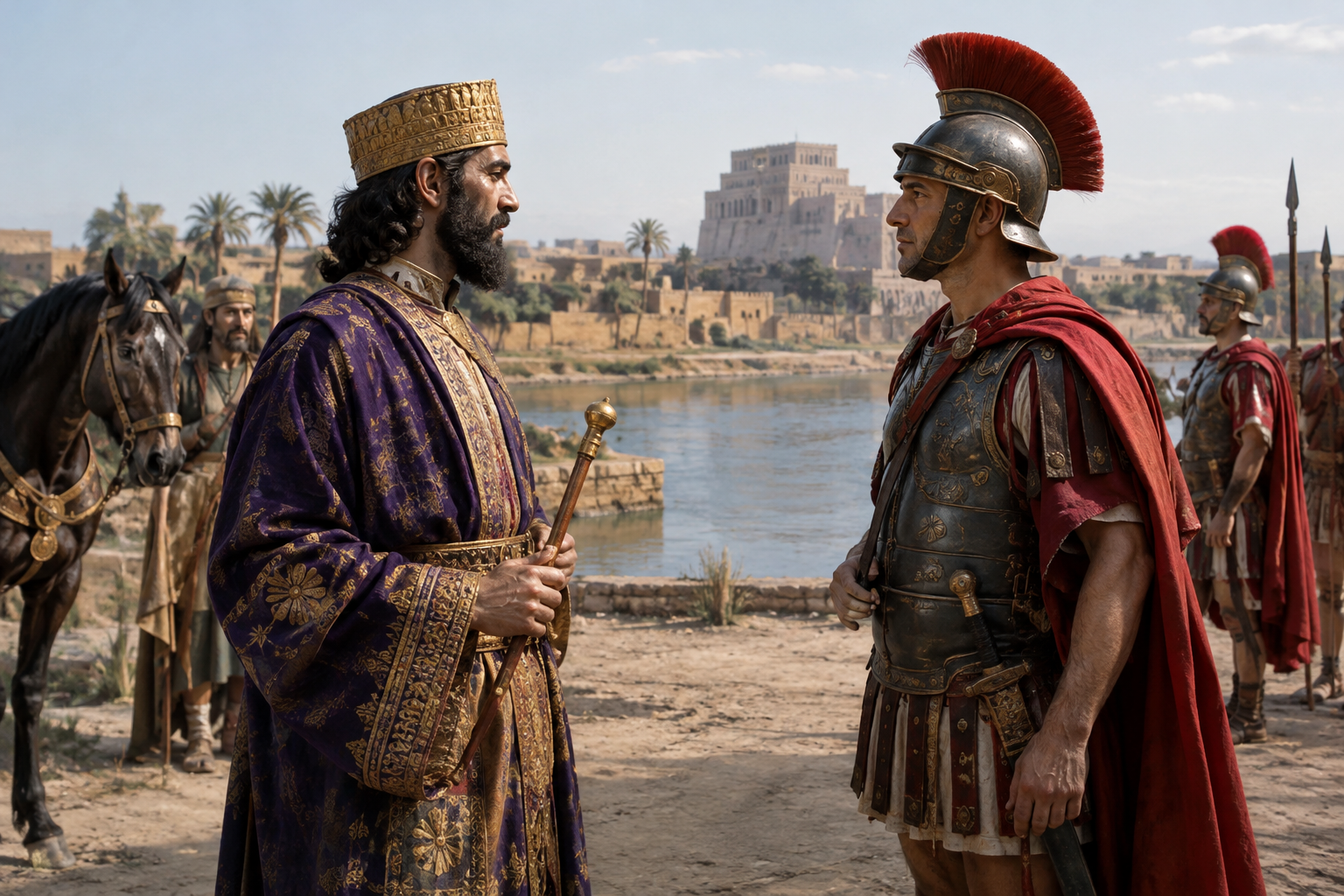
At Bakr Awa in present-day Iraq, one ancient male dated to around 441 BC, sample A22025, offers a precise little window into a very large historical world. He lived in the age of the Achaemenid Empire, when northern Mesopotamia sat inside a political system that stretched from the Aegean to Central Asia. For anyone carrying the Y-DNA haplogroup J2a1a1a2b2a1a1c2, that matters because this is not an abstract branch on a chart: it appears here in a real person from a major imperial-era landscape.
The important point is also the modest one. Y-DNA traces one direct paternal line only, not a person's whole ancestry, language, or identity. But when a branch like J2a1a1a2b2a1a1c2 turns up in ancient Mesopotamia and again in a Hellenic-Roman setting, it begins to suggest a paternal history tied to the connected worlds of the Near East and eastern Mediterranean rather than to a single modern nation or a single ancient people.
Bakr Awa was no backwater. It sits in the Shahrizor plain, a region long exposed to movement between Mesopotamia, the Zagros, and the Iranian plateau. By the 5th century BC, when A22025 lived, this was an imperial borderland in the best sense: taxed, governed, travelled through, and shaped by older local traditions as well as wider Achaemenid structures.
That makes this sample especially useful. A lineage assigned here to J2a1a1a2b2a1a1c2 appears in a setting where local continuity and long-range connections could coexist. One should not force this into a single migration tale. What it does show, quite concretely, is that this paternal branch had reached, or persisted in, an important Mesopotamian population by the later first millennium BC.
A related MyTrueAncestry discussion of the site explores the wider genomic setting of these burials in more detail:
Research connected with these Mesopotamian remains has been released through a genetic study of ancient individuals from the region. Even without overclaiming details beyond the evidence at hand, the larger significance is clear enough: Bakr Awa helps place this paternal line in the human geography of Iron Age Mesopotamia, where empire did not erase local populations but layered new political realities over very old settlement histories.
This long label belongs to the wider Y-DNA family known as J2, a major West Eurasian paternal clade frequently discussed in connection with the Near East, Anatolia, the Caucasus, Iran, and the Mediterranean. But the article's branch is not "J2 in general". It is a much narrower downstream line, and it should be treated that way.
That distinction matters because the broader parent haplogroup has a deep and complicated history, while a fine-grained subclade such as J2a1a1a2b2a1a1c2 may represent only one later twig within that larger tree. So the safest historical reading is not that this branch "founded" whole civilizations, but that it participated in the male-line histories of populations living in the Mesopotamian and eastern Mediterranean worlds documented by these ancient samples.
In practical family-history terms, that can be more interesting than a grand myth. A narrow Y line often points not to one famous ancestor but to a chain of ordinary fathers and sons whose descendants moved through trade routes, military networks, towns, farms, and imperial administrations over many centuries.
The second ancient male listed here, R115, dated to around AD 100, is identified simply as belonging to a Hellenic Roman Empire context. The description is frustratingly brief, but even brevity can be instructive. We are no longer in Achaemenid Iraq, but in a later Mediterranean order shaped by Greek urban culture and Roman power.
That does not prove direct descent from the man at Bakr Awa, of course, nor does it mean every carrier of this lineage belonged to one ethnic bloc moving neatly westward. What it does show is a recurrence of the same paternal branch in another historically connected sphere, one in which eastern Mediterranean and Near Eastern populations were thoroughly entangled through colonization, commerce, slavery, soldiering, and citizenship.
This is where ancient DNA is so good at puncturing tidy textbook maps. The Roman Empire was full of people on the move, but it was also full of long-settled local communities whose paternal lines could persist through changing political labels. A man classified in a Hellenic-Roman context could belong to a family rooted locally for generations, or to one with older ties elsewhere in the eastern empire. The haplogroup alone cannot decide that question, but it does place him within the same broad historical arena as the Bakr Awa individual.
For readers interested in how Roman-period genetics often reveal exactly this sort of mixture and continuity, this related article is a useful comparison:
If one were writing bad history, one could now announce a dramatic march of a clan from Persia to Rome. But the evidence is both better and subtler than that. What these samples really give us is a documented paternal presence in two linked but distinct historical settings: first-millennium-BC Mesopotamia under Achaemenid rule, and a Roman-era Hellenic environment several centuries later.
That pattern fits a region where populations were rarely sealed off. Northern Mesopotamia connected the Iranian plateau to Syria and Anatolia; Greek and then Roman systems connected the Levant, Anatolia, mainland Greece, the islands, and Italy. Men carrying related J2-derived lineages could move through these worlds in many ways: as locals in old cities, as rural families drawn into imperial administrations, as merchants, craftsmen, soldiers, or migrants by marriage and opportunity.
There is a broader historical backdrop here too. Genomic work on ancient Mediterranean populations has repeatedly shown that the Roman and Hellenistic worlds were not biologically neat compartments. One influential ancient DNA study of the imperial city itself, published on ancient Rome and its changing population history, helped demonstrate how strongly the eastern Mediterranean and Near East contributed to Roman-era genetic landscapes. That does not identify R115 by itself, but it provides a fitting frame for why a lineage like this can appear intelligibly in both Mesopotamian and Hellenic-Roman contexts.
Another relevant comparison comes from Iberia, where Roman rule also left complex genetic traces rather than one simple colonial stamp:
The Bakr Awa sample remains the anchor of the story because it is the more clearly placed archaeological context. Mesopotamia is often treated as a stage for kings and empires, but ancient DNA reminds us that it was also a reservoir of families, lineages, and communities whose histories ran underneath the inscriptions. A22025 stands in that quieter register of history.
For carriers of J2a1a1a2b2a1a1c2, the most responsible takeaway is that this paternal line has a documented presence in the zone where Mesopotamian, Iranian, and eastern Mediterranean histories overlap. That does not mean every modern carrier descends from Iraq, or from one named ancient kingdom. It does mean your direct paternal line belongs to a branch that was already present in one of the great connective regions of the ancient world by the 5th century BC.
A useful companion piece on Iranian-region ancient DNA gives further context for how genetics and historical identification can intersect in this broader neighborhood:
The distinctive thing about J2a1a1a2b2a1a1c2 here is not a claim to royal descent or a single heroic migration. It is the quieter, stronger point that this paternal branch appears in both Achaemenid-period Mesopotamia and a later Hellenic-Roman setting. In other words, it belongs to the male-line history of the interconnected Near Eastern and eastern Mediterranean worlds that shaped so much of ancient Eurasia. For someone tracing this haplogroup today, that is a valuable clue: your direct paternal ancestry may be part of a long story of continuity and movement across the old imperial crossroads of Iraq, Iran, Anatolia, and the wider Greek-Roman sphere.
Comments