Haplogroup J2a1a1a2b2a1a1c

– 5 min read


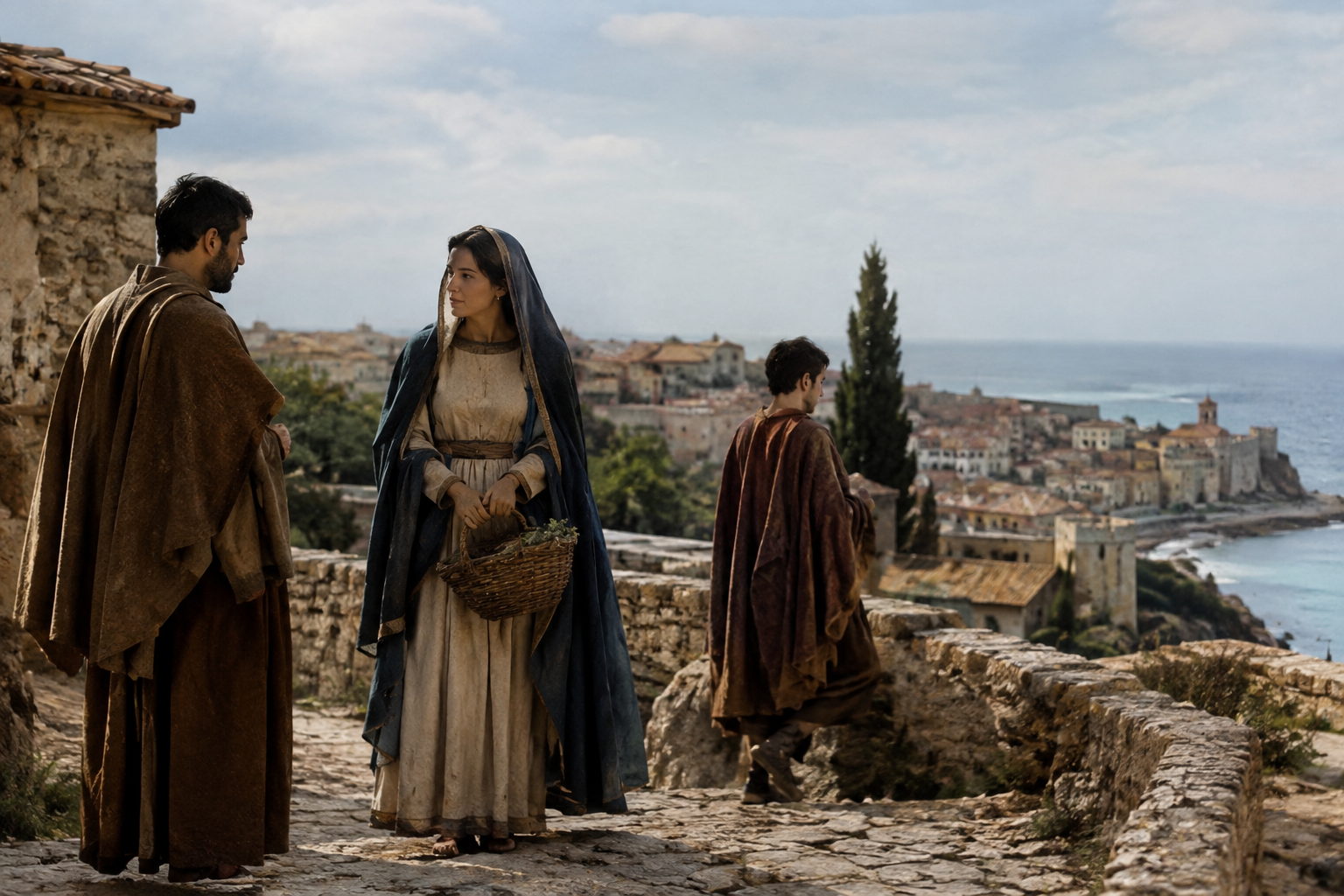
In the later sixth century AD, in the countryside around Tarragona, one man now known simply as I28360 was buried at Vilardida. He belongs to the unsettled world of post-Roman Spain: a landscape where imperial institutions had receded, Visigothic power mattered, Christianity was entrenched, and older local communities still carried on in familiar places. His reported Y-DNA assignment, J2a1a1a2b2a1a1c, is a very narrow paternal branch, and that makes him interesting not because one burial can explain a whole people, but because it fixes one direct male line in a very specific historical setting.
That matters especially in Iberia, where the centuries after Rome were not a simple tale of replacement. Ancient DNA has increasingly shown that the peninsula remained a meeting ground of older Iberian ancestry, Roman-era mobility, Mediterranean connections, and smaller-scale movements during late antiquity. A lineage like J2a1a1a2b2a1a1c sits inside the wider J2 family, a branch often associated in broad terms with the eastern and central Mediterranean, but the precise subclade here should not be stretched beyond the evidence. What we can say securely is that this paternal line was present in northeastern Spain around AD 587.
Vilardida lies in the wider Tarragona region, a place with deep Roman roots. Tarraco had been one of Roman Hispania's great urban centers, connected by roads, trade, administration, and the sea. By the late sixth century, however, the world around it had changed. The Western Roman Empire was long gone, yet the human landscape had hardly become empty or simple. Communities still lived among Roman inheritances while adapting to new political realities.
Sample I28360 is therefore valuable less as an isolated curiosity than as a point of contact between genetics and a period historians used to call the "dark ages" with rather too much confidence. Ancient DNA has helped make that phrase look increasingly clumsy. Even a single male-line result can show that post-Roman communities in Spain were carrying forward paternal lines with wider Mediterranean resonance, rather than fitting a neat story of purely local continuity or purely incoming rule.
A broader genetic study of ancient Iberian populations published by researchers examining long-term population change in the peninsula has helped place such individuals in context: not as caricatures of "Romans," "Goths," or "natives," but as people living in societies already shaped by centuries of movement and mixture.
J2a1a1a2b2a1a1c is not a culture, a language, or a nationality. It is a paternal lineage: one line of fathers, fathers' fathers, and so on, traced through the Y chromosome. That makes it unusually sharp in one sense and very limited in another. It can tell us about a direct male line, but not the whole ancestry of I28360, still less the identity of everyone around him.
The wider haplogroup J2 has long been of interest to archaeogeneticists because it appears across many parts of the Mediterranean and Near East in both ancient and modern populations. But it would be careless to dump all of that history onto this one late antique Spanish burial. A narrow branch like J2a1a1a2b2a1a1c may have reached Iberia generations, centuries, or even millennia before the man at Vilardida lived. The point is not to force a single migration story, but to recognize that such paternal lines fit the well-attested Mediterranean habit of movement: soldiers, merchants, settlers, administrators, laborers, clergy, and families all crossed these connected worlds.
Northeastern Spain is one of the best places to see the long afterlife of Roman connectivity. Tarragona had been tied not only to the rest of Iberia but to Gaul, Italy, North Africa, and the eastern Mediterranean. Even after imperial structures weakened, those older routes and habits did not simply vanish. Ports, roads, church networks, and landholding patterns continued to bind communities together.
So when a post-Roman male from this region carries a branch within J2, the result is historically plausible in several different ways. It may reflect ancestry already embedded in Hispania during the Roman period. It may reflect later movement under late Roman or Visigothic conditions. Or it may represent a line present locally for a much longer span than our current sample coverage can show. The cautious answer is often the most useful one: we are seeing continuity within complexity.
One of the most important lessons from ancient DNA in Iberia is that late antique and early medieval communities were varied. Not every cemetery tells the same story, and not every region was affected in the same way. Some individuals look more continuous with earlier local populations; others show clearer signs of ancestry linked to broader imperial or post-imperial mobility. That is precisely why sample-level evidence matters.
I28360 from Vilardida should be read in that spirit. He is not a mascot for all of Visigothic Spain, nor proof of a single eastern migration. He is one documented man from around AD 587 whose paternal line adds another thread to the population history of the peninsula. The real significance lies in how such finds steadily dismantle tidy textbook categories. "Roman" and "post-Roman" were political labels layered onto people whose family histories could already be mixed, local, and far-traveled at once.
This is also where archaeology and genetics work best together. The burial's date and place situate the lineage in a concrete historical world. Genetics alone would not tell us whether this man lived under Visigothic authority, within a Christian rural community, or in the shadow of Tarragona's Roman legacy. Archaeology alone would not reveal his paternal branch. Together, they give us a firmer, if still modest, piece of the puzzle.
If there is a larger historical lesson in J2a1a1a2b2a1a1c from Vilardida, it is that Iberian paternal history cannot be boxed into a single origin myth. The peninsula absorbed influences from prehistoric farmers, Bronze and Iron Age communities, Phoenician and Greek contacts in some regions, Roman colonization, imperial military service, trade, enslavement, and later migration-period upheavals. Any one Y-DNA branch may have entered that story at many different moments.
That is why narrow haplogroup assignments are most useful when anchored to dated individuals. The branch is not interesting because it sounds exotic, but because it is attached to a man in post-Roman Tarragona. The evidence becomes historical rather than merely taxonomic. For descendants exploring similar paternal lines today, the most responsible conclusion is not a dramatic claim of descent from one ancient people, but a recognition that their direct male ancestry may belong to the long Mediterranean entanglement that shaped Iberia over centuries.
J2a1a1a2b2a1a1c enters the ancient record here not in a palace or a royal pedigree, but in a sixth-century burial from Vilardida. That is exactly the sort of evidence that makes archaeogenetics so useful. It shows a specific paternal line alive in post-Roman northeastern Spain, in a region where Roman legacies, local continuity, and Mediterranean mobility overlapped for generations. For anyone who belongs to this branch today, the strongest insight is not that one ancient burial solves your family history, but that your direct male line already stood inside Iberia's complicated late antique world.
Comments