Haplogroup J2a1a1a2a2a

– 5 min read


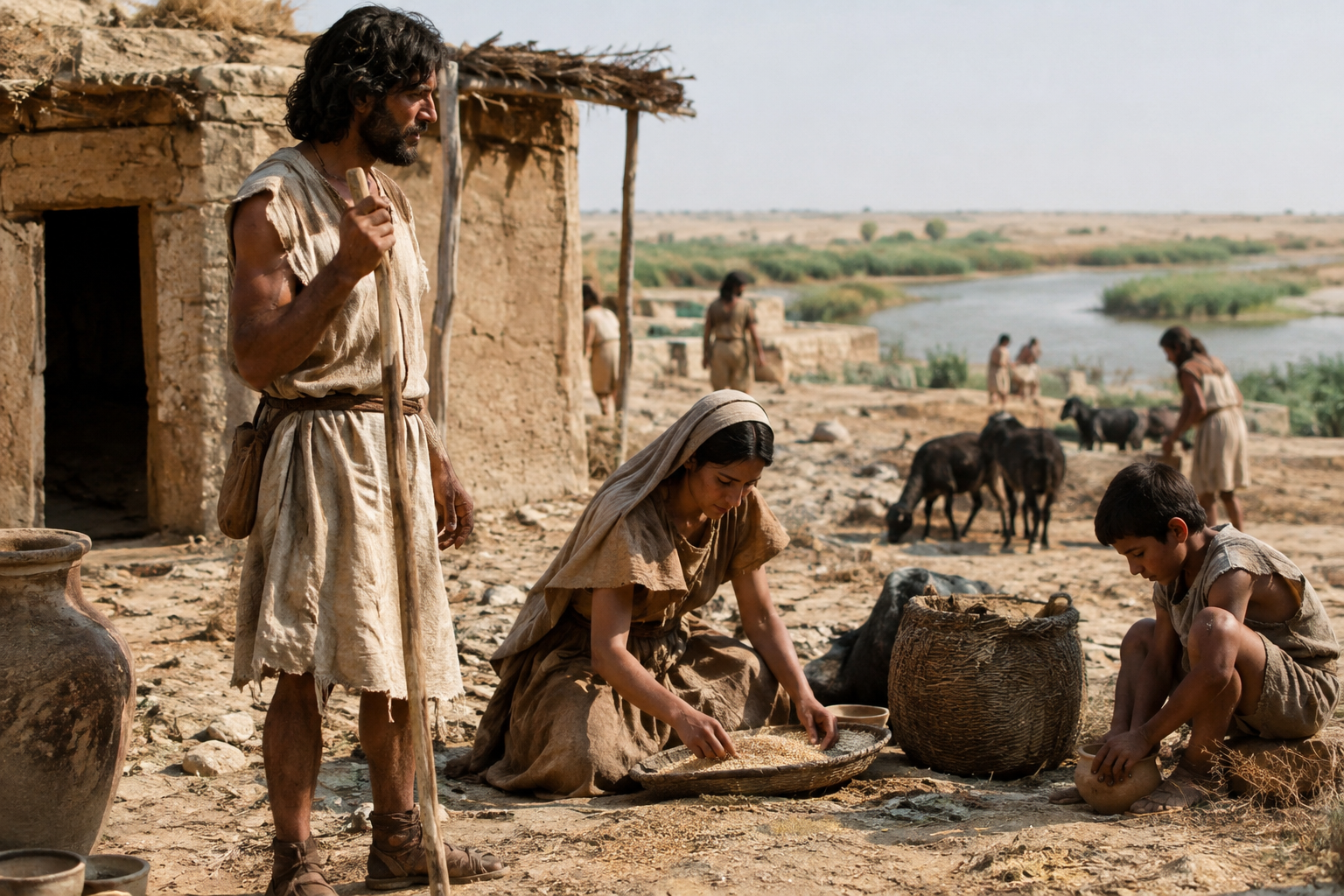
At Bakr Awa in Iraqi Kurdistan, one ancient male dated to around 2000 BC offers a small but telling glimpse into the paternal history of northern Mesopotamia. His identifier, A22041, comes from the Late Early Bronze Age, a period when towns, trade routes, and political worlds in upper Mesopotamia were being reworked again and again. In this one individual, the Y-chromosome branch associated here with J2a1a1a2a2a appears in a landscape that was anything but isolated.
That matters because Bakr Awa is not some romantic outpost at the edge of history. It was a long-lived settlement tied into the wider world of Mesopotamia and the Zagros, exactly the sort of place where archaeologists expect to see continuity, movement, and mixture meeting one another. Y-DNA follows one direct paternal line only, not a person's whole ancestry, but a lineage like J2a1a1a2a2a found in this setting is part of a much larger story about how male lines persisted and shifted across the urban worlds of the ancient Near East.
Bakr Awa sits in a region that has often been treated as a frontier between lowland Mesopotamia and the mountain zones to the east and northeast. In reality, frontiers like this were also corridors. People, animals, goods, and ideas moved through them constantly, and by the early second millennium BC these connections linked local communities to larger systems of exchange and power.
The sample A22041 belongs to that setting. The date given, around 2000 BC, places him at the end of the Early Bronze Age or on the threshold of the Middle Bronze Age in regional historical terms. That is important because northern Mesopotamia at this time was not static: settlement hierarchies changed, older urban traditions were reworked, and populations were shaped by both local continuity and wider contacts.
A MyTrueAncestry article on ancient DNA from Bakr Awa gives useful background on why this site has become so interesting to archaeogenetics: it lets researchers compare different phases of Mesopotamian life at one place rather than relying on scattered single burials from far-flung regions.
The first thing to say is that J2a1a1a2a2a is a very specific downstream branch within the wider J2 paternal family. The broader haplogroup J2 has long been associated, in general terms, with parts of the Near East, the Caucasus, Anatolia, Iran, and the Mediterranean world. But one must be careful: the deeper history of J2 as a whole cannot simply be pasted onto every one of its much narrower sub-branches.
So what can responsibly be said here? The presence of a Bakr Awa male associated with J2a1a1a2a2a suggests that this paternal line, or a very close ancestral branch, was already part of the human landscape of northern Mesopotamia by the Late Early Bronze Age. It does not mean that all men at the site shared that lineage, nor that the branch originated at Bakr Awa, nor that one ancient individual can stand in for an entire people.
Still, the setting is highly suggestive. Paternal branches within J2 often turn up in archaeological regions shaped by early farming, long-distance exchange, and later urban development. Bakr Awa fits precisely that kind of historical world: not a blank spot on the map, but a connected zone between plains and highlands.
If you want to understand why a lineage like this appears here, it helps to think geographically. Northern Iraq in the Bronze Age sat between several kinds of landscape at once: riverine agricultural zones, foothill routes into the Zagros, and lines of communication running west toward Syria and south toward the great Mesopotamian centers. Communities here could be intensely local and stubbornly rooted, yet also open to the movements that make ancient DNA so interesting.
That is one reason Bakr Awa matters more than a bare sample label might suggest. A22041 is not merely "an Iraqi Bronze Age man." He belongs to a settlement world in which political influence, marriage networks, mobility, and trade could all help spread paternal lines over time. A branch like J2a1a1a2a2a may therefore reflect not a single dramatic migration, but the accumulated effect of many generations living in a connected zone.
Another MyTrueAncestry piece, on ancient Iranian DNA, is worth reading alongside Bakr Awa because the Iraqi and Iranian plateau worlds were never neatly sealed off from one another. Archaeology has been telling us that for decades; genetics increasingly shows the same thing, though never in quite such simple ethnic boxes as older histories once imagined.
There is a temptation in ancient DNA writing to prize only big sample sets and sweeping maps. But one securely placed ancient individual can be valuable when he comes from the right context. Bakr Awa is one of those contexts because the site contributes to a growing picture of population history in Bronze and Iron Age Mesopotamia, where textual history is rich but direct genetic evidence has long been comparatively thin.
In that sense, A22041 helps anchor J2a1a1a2a2a in a real archaeological landscape. He gives the haplogroup a date, a place, and a historical environment: upper Mesopotamia around 2000 BC, during a phase of major regional transformation. That is much more useful than treating haplogroups as abstract labels floating free of time and place.
The research infrastructure behind these Mesopotamian genomes can be followed through the project record at https://www.ebi.ac.uk/ena/browser/view/PRJEB111543, which is associated with ancient DNA work on the population history of the region. Even without overclaiming from a single database link, it underlines an important point: Bakr Awa is now part of the serious scientific effort to place Mesopotamian archaeology into the genomic record.
One of the frustrations of public discussions about ancient ancestry is that Mesopotamia is often talked about as if it were obvious, central, and yet strangely invisible. We all know it was one of the great cradles of urban life; we have schools, tablets, kingdoms, and trade. But genetically, the region has been slower to yield clear ancient evidence than Europe. That makes every credible data point from places like Bakr Awa disproportionately useful.
For men whose paternal line today falls under J2a-related branches, this matters because Mesopotamia and its neighboring regions are exactly where archaeology, history, and genetics begin to overlap in particularly complicated ways. There were no tidy peoples marching about with haplogroups pinned to their tunics. There were towns, dynasties, herders, merchants, local families, and newcomers, all contributing in different proportions over time.
Readers who want a wider frame for how ancient DNA is reshaping these historical questions may also enjoy MyTrueAncestry's introduction to the rise of archaeogenetics. It helps explain why a single Y-line from one Mesopotamian site can now be set beside much larger regional patterns.
The most distinctive thing about J2a1a1a2a2a in this case is not a grand imperial claim or a tidy ethnic label. It is that this branch is represented at a real Bronze Age settlement in northern Iraq, at a moment when Mesopotamia's connected worlds were already mature and busy. For someone exploring this paternal line today, that is a sober but genuinely exciting clue: your direct male-line ancestry belongs to a lineage family present in one of the great contact zones of the ancient Near East.
Bakr Awa's A22041 does not tell every story about J2a1a1a2a2a, but he gives the branch historical ground under its feet. He places it in an archaeological world of settlements, regional exchange, and long continuity across the Mesopotamian-Zagros corridor - exactly the kind of place where paternal history becomes human history.
Comments