Haplogroup J2a1a1a2a1a2a2b1

– 4 min read


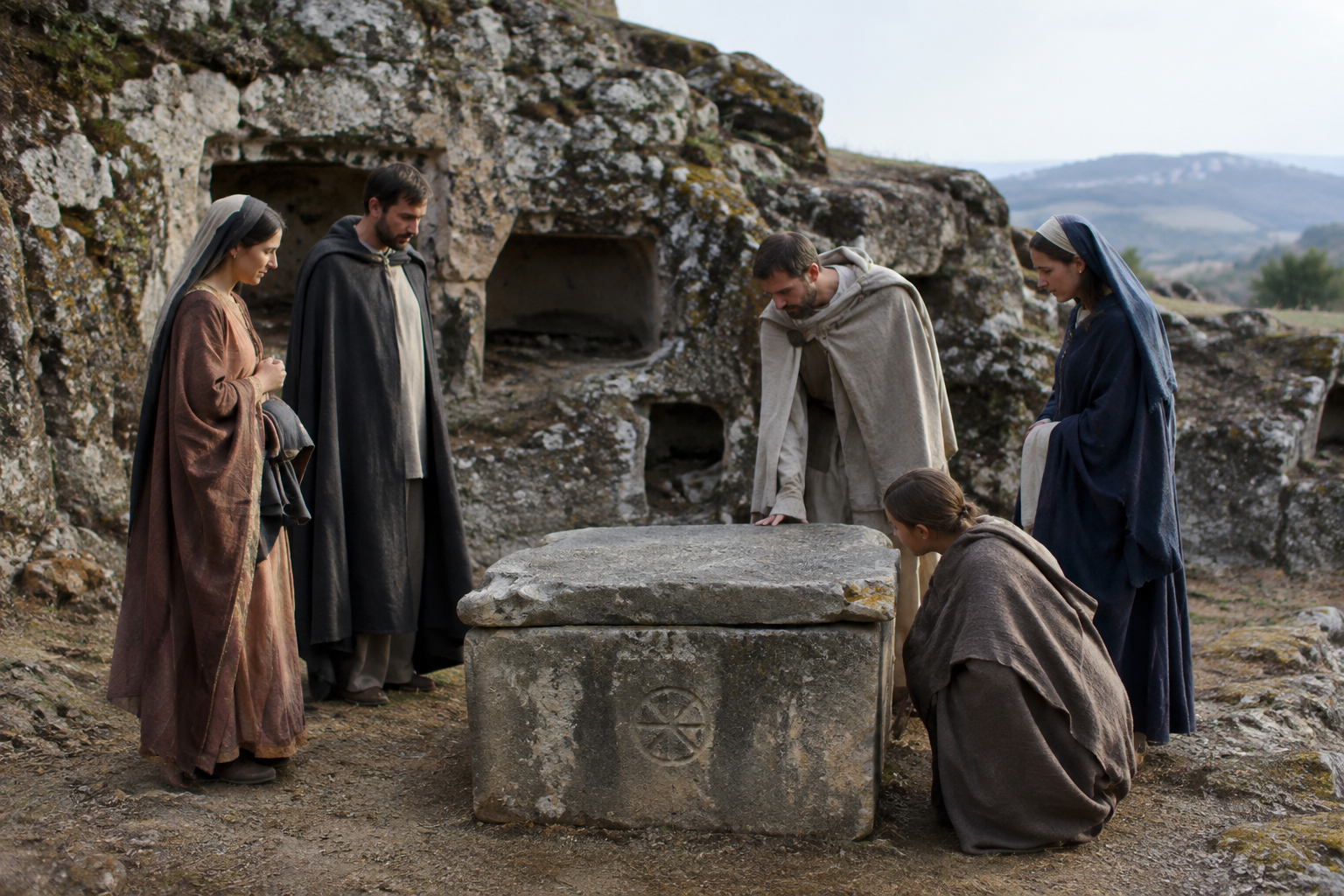
At Castel Sozzio in northern Italy, a small cluster of men buried around AD 600 has given this very narrow Y-chromosome branch, J2a1a1a2a1a2a2b1, an unusually concrete archaeological setting. The sample labels are plain enough - P9883, P9883a, P9883b, P9883d, and P9883h - but the pattern is striking. Instead of one isolated ancient match, we are looking at repeated evidence from the same post-Roman necropolis, at the moment when Italy was adjusting to the end of imperial rule and the arrival of new powers.
That matters because Y-DNA traces one direct paternal line only: father to son, and so on. It does not define a whole person's ancestry, language, or identity. But when the same paternal branch appears several times in one cemetery, it can tell us something valuable about continuity, kin-linked burial communities, and the kinds of male lineages present in early medieval Italy.
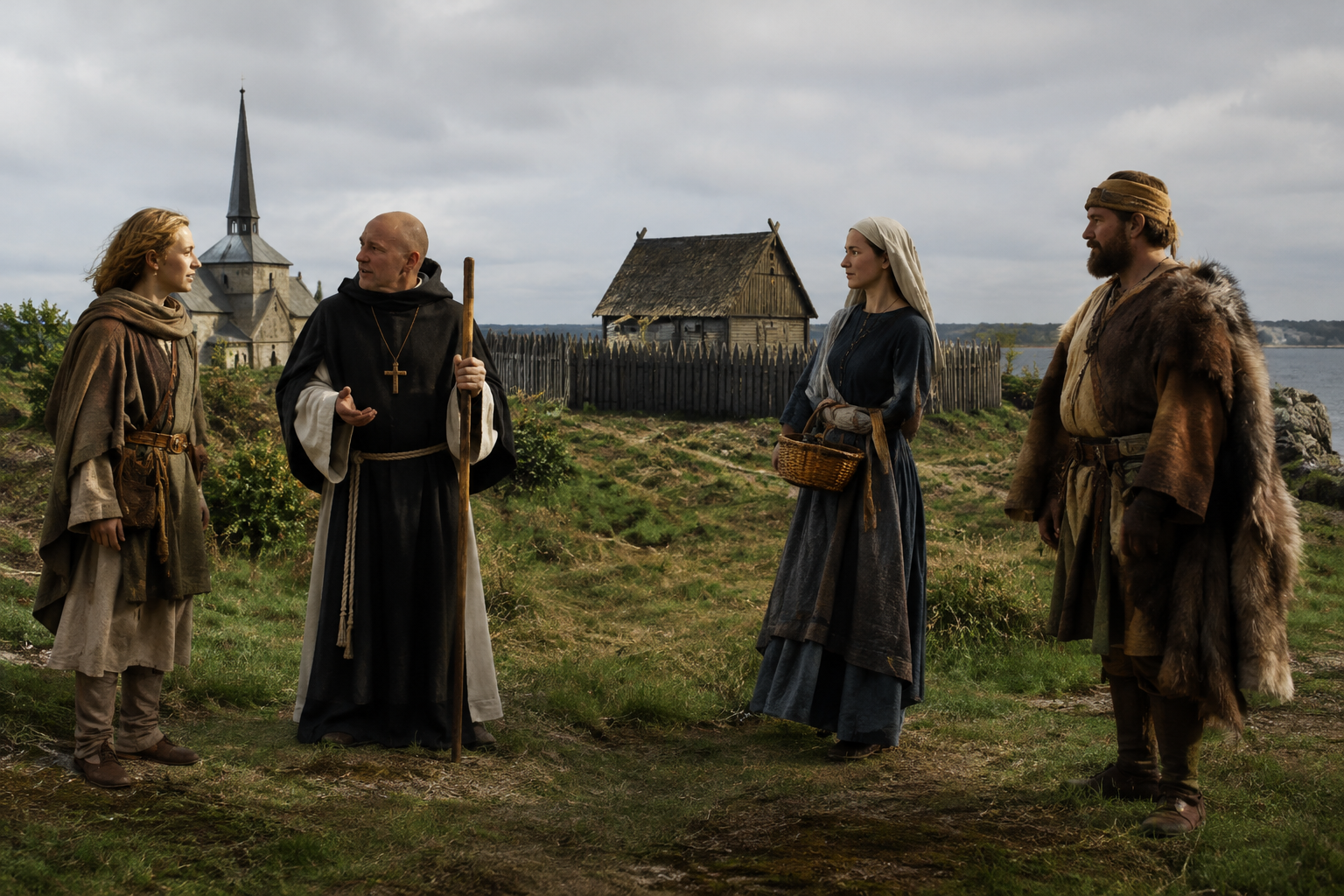
The Castel Sozzio necropolis belongs to a period that historians often describe too neatly as a collapse followed by replacement. Real life was messier. Around AD 600, northern Italy was a landscape of surviving Roman habits, local communities, shifting political loyalties, and new elites operating in territory long shaped by the empire.
The men identified here as P9883, P9883a, P9883b, P9883d, and P9883h all come from that same setting: Post Roman Empire Italy, Castel Sozzio Necropolis. On present evidence, this is the core archaeological context for the haplogroup in this article. That does not automatically mean these individuals were all close relatives, but repeated presence in one burial ground strongly suggests that this paternal line was not a one-off arrival. It was part of the local human landscape.
Castel Sozzio has already attracted attention for what it can reveal about daily life and burial populations in this transitional age.
The broader parent haplogroup J2 is widely associated in ancient DNA research with populations of the Mediterranean, the Aegean, Anatolia, and the Near East, especially in contexts shaped by farming expansions, trade, and later urban civilizations. But one must be careful here. Those broad patterns belong to the larger family tree, not automatically to the precise terminal branch J2a1a1a2a1a2a2b1.
What we can say safely is narrower, and in some ways more interesting. This branch, as represented here, is documented in early medieval northern Italy. That places it inside a region where Roman-period mobility had already mixed people from across the Mediterranean for centuries, and where post-Roman communities continued to inherit that complexity rather than starting from scratch.
In other words, a J2-derived paternal line at Castel Sozzio should not surprise us. Italy had long been entangled with Adriatic, eastern Mediterranean, and imperial networks. The significance lies not in some dramatic single migration tale, but in the persistence of such a lineage into a cemetery used after Rome's western empire had gone.
The most distinctive feature of this evidence is repetition. Five sample labels from the same necropolis - P9883, P9883a, P9883b, P9883d, and P9883h - are associated here with the article's haplogroup. In archaeogenetics, clusters like this are often more informative than glamorous isolated finds, because they let us talk about a burial population rather than a lone man pulled from context.
Even so, restraint matters. A repeated Y-line in one cemetery can reflect relatives, a wider patrilineal kin group, or simply a branch that was locally common enough to appear several times. Without published kinship results for these exact individuals in hand, it would be rash to turn them into a named dynasty or a tidy family tree. The safer conclusion is that this paternal lineage had a real foothold in the community using Castel Sozzio around AD 600.
That is precisely the sort of evidence that helps bridge the false divide between "Roman" and "medieval." People did not wake up one morning with entirely new ancestors. Burial grounds like this show lineages continuing, mixing, and being remembered locally even as political systems changed overhead.
There is another quiet lesson in the Castel Sozzio material: ancient DNA depends as much on preservation and laboratory method as on historical importance. A research study linked to work on ancient DNA recovery from petrous bone highlights the technical side of why some burials can produce usable genetic data while others remain stubbornly silent.
That may sound like laboratory housekeeping, but it is not trivial. Post-Roman cemeteries in Italy are historically rich, yet DNA survival is uneven. Every securely typed male lineage from a site like Castel Sozzio therefore rests on a chain of preservation, sampling, and analysis that deserves notice. The history is human; the evidence is stubbornly material.
The centuries around AD 600 are often narrated through Goths, Byzantines, and Lombards, as if the peninsula were only a stage for named powers marching through. Genetics has been steadily complicating that picture. Ancient DNA from Italy increasingly shows that local communities could be diverse, that ancestry profiles were layered, and that older Mediterranean connections remained visible well into the early medieval period.
That wider Italian context helps make sense of a branch like J2a1a1a2a1a2a2b1 at Castel Sozzio. It fits a peninsula that had absorbed movement for generations: soldiers, traders, settlers, slaves, administrators, and families from many shores of the Roman world. By the post-Roman period, those histories were no longer foreign episodes. They were local ancestry.
Other MyTrueAncestry work on Italian populations points in the same direction: continuity and change coexist. A cemetery may reflect local roots, outside inputs, or both at once, and the only honest way to proceed is site by site.
For someone researching the paternal haplogroup J2a1a1a2a1a2a2b1 today, Castel Sozzio offers a specific and grounded point of contact: this branch, or an assignment associated with it, appears multiple times in a post-Roman cemetery in northern Italy around AD 600. That is not proof of one family story, one ethnicity, or one migration route. It is something better than that: a real archaeological context in which this paternal line was part of a living community.
The value of the evidence is its modesty. Not emperors, not legend, but ordinary burials in an Italy remaking itself after Rome - and a paternal signature that endured there long enough to appear again and again in the same necropolis.
Comments