Haplogroup J2a1a1a2a1

– 5 min read


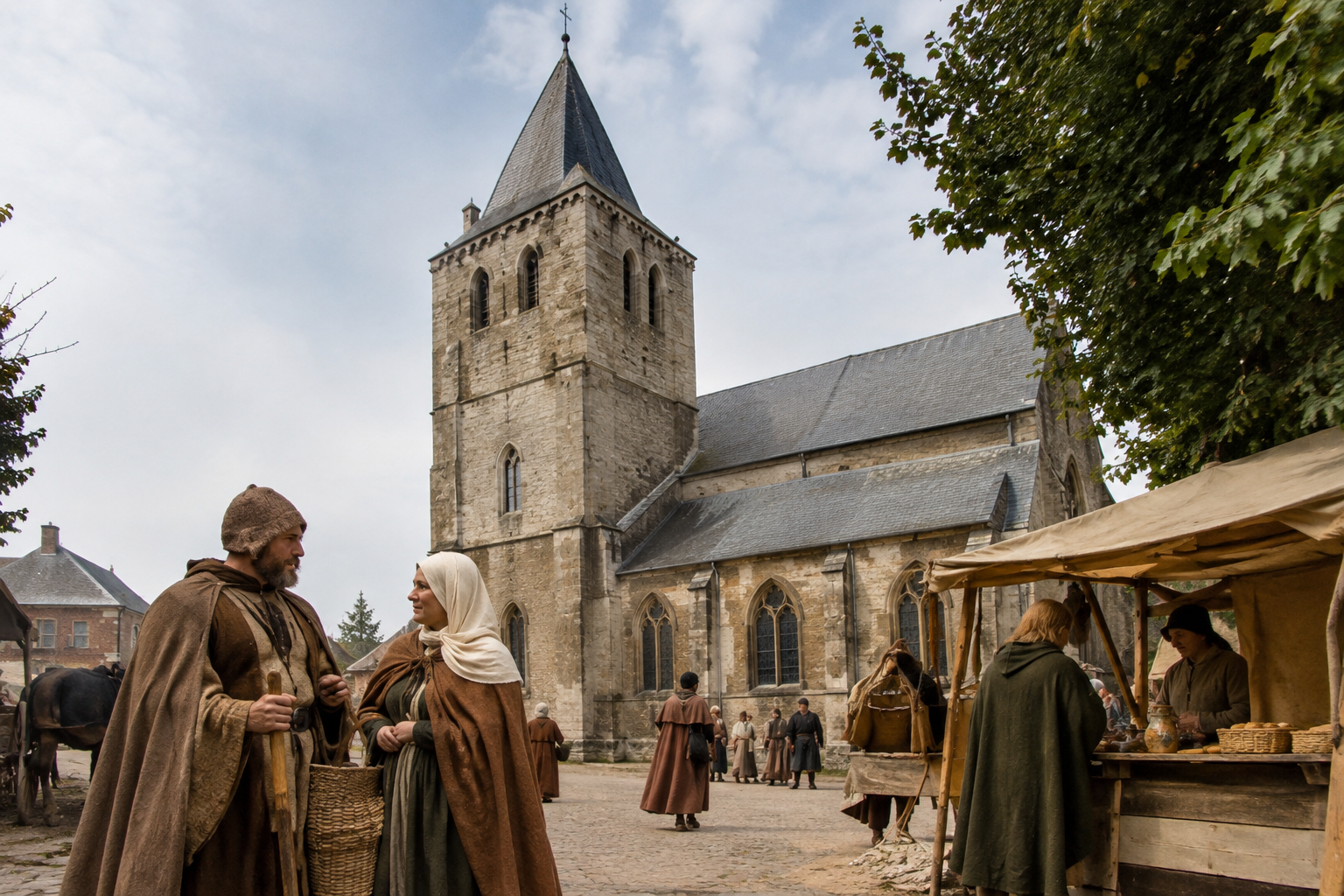
At Sint-Truiden in present-day Belgium, the burials around the Onze-Lieve-Vrouwekerk have begun to tell a rather sharper story about medieval town life than older chronicles ever could. One individual in particular, sample ST0129, dated to around AD 900 and described as an outsider in the cemetery population, is associated here with the Y-DNA haplogroup J2a1a1a2a1. That is a very precise paternal label, but the historical interest lies not in the code itself so much as in what it is doing in an early medieval urban churchyard in the Low Countries.
Sint-Truiden was not some sleepy backwater. It sat in a region shaped by monasteries, markets, political fragmentation, and movement of people across the old Roman northwestern world. A Y-chromosome lineage traces only one direct male line, not a person's whole ancestry or identity, but a find like ST0129 matters because it hints at mobility in a place often imagined as locally rooted and homogeneous.
The label attached to ST0129 is itself revealing. In a medieval cemetery study, calling someone an outsider does not mean a stranger in the melodramatic sense; it usually means that, in genetic terms, this person did not fit neatly within the main local cluster. That makes Sint-Truiden especially useful for thinking about haplogroup J2a1a1a2a1. Instead of beginning in the abstract with maps and migration arrows, we begin with a man buried in a Christian cemetery in the heart of medieval Europe whose paternal line points to wider connections.
Research on the Sint-Truiden material has focused on the relationship between urbanization and population structure, asking whether an expanding medieval town drew in people from beyond its immediate hinterland. In that setting, ST0129 becomes more than a technical designation. He is evidence that early medieval communities in the Meuse region could include men whose paternal ancestry was not simply a continuation of the dominant local lines.
An ancient DNA study examining these burials, published in Genome Biology, places Sint-Truiden within exactly this broader question of how medieval towns formed and how much they homogenized, or failed to homogenize, the people buried there.
J2a1a1a2a1 belongs to the broader J2 family, a paternal branch with a long history in western Eurasia and particularly deep roots in parts of the eastern Mediterranean, Anatolia, the Caucasus, and neighboring regions. But that broad background must be handled carefully. It does not allow us to declare that ST0129 was "Greek," "Syrian," "Roman eastern," or anything similarly tidy.
The narrower branch J2a1a1a2a1 is much more specific than the parent haplogroup, and specific branches can travel in very particular historical ways. Some move with merchants, some with soldiers, some with church networks, some through marriage and household service, and many through ordinary family movement that leaves no written trace at all. In a medieval town, all of those channels are plausible in general, but none should be imposed on one burial without firmer evidence.
That is the crucial point for anyone researching this haplogroup today. The significance of J2a1a1a2a1 in this case is not that it proves a single dramatic migration, but that it fits a world in which early medieval Europe still contained the afterlives of Roman connectivity, long-distance exchange, and constant low-level human movement.
By around AD 900, the old Roman political framework had gone, but the routes it helped organize had not simply vanished. The Meuse basin, the Rhineland, and the wider Carolingian and post-Carolingian world were threaded together by monasteries, episcopal centers, river traffic, seasonal markets, and elite estates. Sint-Truiden itself grew around an important abbey foundation, and such institutions pulled in labor, wealth, tenants, clerics, and visitors.
That background makes ST0129 historically legible. An "outsider" buried in a church context is not an anomaly in the sense of being unbelievable; rather, he belongs to the sort of mobile medieval society that archaeology increasingly reveals. The surprise is only to modern expectations that local burial grounds must represent static village populations.
In that respect, this Belgian sample belongs to a wider pattern seen across post-Roman and early medieval Europe, where ancient DNA keeps uncovering mixed origins in places once described too neatly by language or kingdom. Medieval communities were often less bounded than their later national histories would suggest.
There is an old habit in popular history of treating northwestern Europe as though every unusual lineage must have arrived in one spectacular episode. Real history is usually messier. A lineage such as J2a1a1a2a1 could have reached the Low Countries generations before ST0129 was buried, perhaps through late Roman movements, perhaps through migration within Frankish territories, perhaps through families already established somewhere nearer the Rhine.
That possibility matters because Belgium in the early Middle Ages was heir to several older worlds at once. It inherited Roman roads and settlement zones, Germanic-speaking political elites, Latin Christian institutions, and trade links stretching far beyond the region. In such a landscape, a paternal line with deeper connections to southeastern or Mediterranean-linked populations need not signal a recent arrival from afar. It may instead represent the long memory of earlier mobility embedded in later local society.
This is where the genetics become historically useful without becoming overconfident. ST0129 does not stand for all men in Sint-Truiden, still less for all bearers of J2a1a1a2a1. But he is a good reminder that medieval Europe's paternal landscape was not made up of neatly sealed ethnic blocks.
With only one named ancient individual here, discipline matters. We should not inflate ST0129 into the founder of a community, the representative of a merchant colony, or proof of a named people moving into Belgium. Archaeology is full of dead ends created by overreading isolated finds.
Yet one well-placed sample can still be historically rich. ST0129 comes from a documented medieval burial ground, at a datable moment, in a town whose development itself raises questions about migration and social mixing. The combination of site, period, and "outsider" status makes this a particularly telling appearance of J2a1a1a2a1, because it places the lineage not on the empire's glamorous frontiers but inside an ordinary working medieval community.
That is often where the best evidence lies: not with kings and conquerors, but with burials that show how populations were actually composed. The grand historical processes of the first millennium AD, Roman legacies, Christian institutions, trade, resettlement, and local marriage networks, all end up written quietly into graves like this one.
If your paternal line falls under J2a1a1a2a1, ST0129 offers a useful kind of ancestor to think with. Not a celebrity, not a dynast, and not a tidy ethnic label, but a man buried around AD 900 in medieval Belgium whose direct male line points to broader horizons than the cemetery around him might first suggest. The most responsible historical reading is that this branch could be part of the many layers of mobility that shaped Europe long after Rome and long before modern nations.
For family historians, that is both modest and exciting. It suggests that a paternal line like J2a1a1a2a1 may have been present in northwestern Europe within ordinary medieval communities, carried not necessarily by famous migrants, but by people whose movements became woven into local life and then forgotten by the written record.

Comments