Haplogroup J1b8

– 5 min read


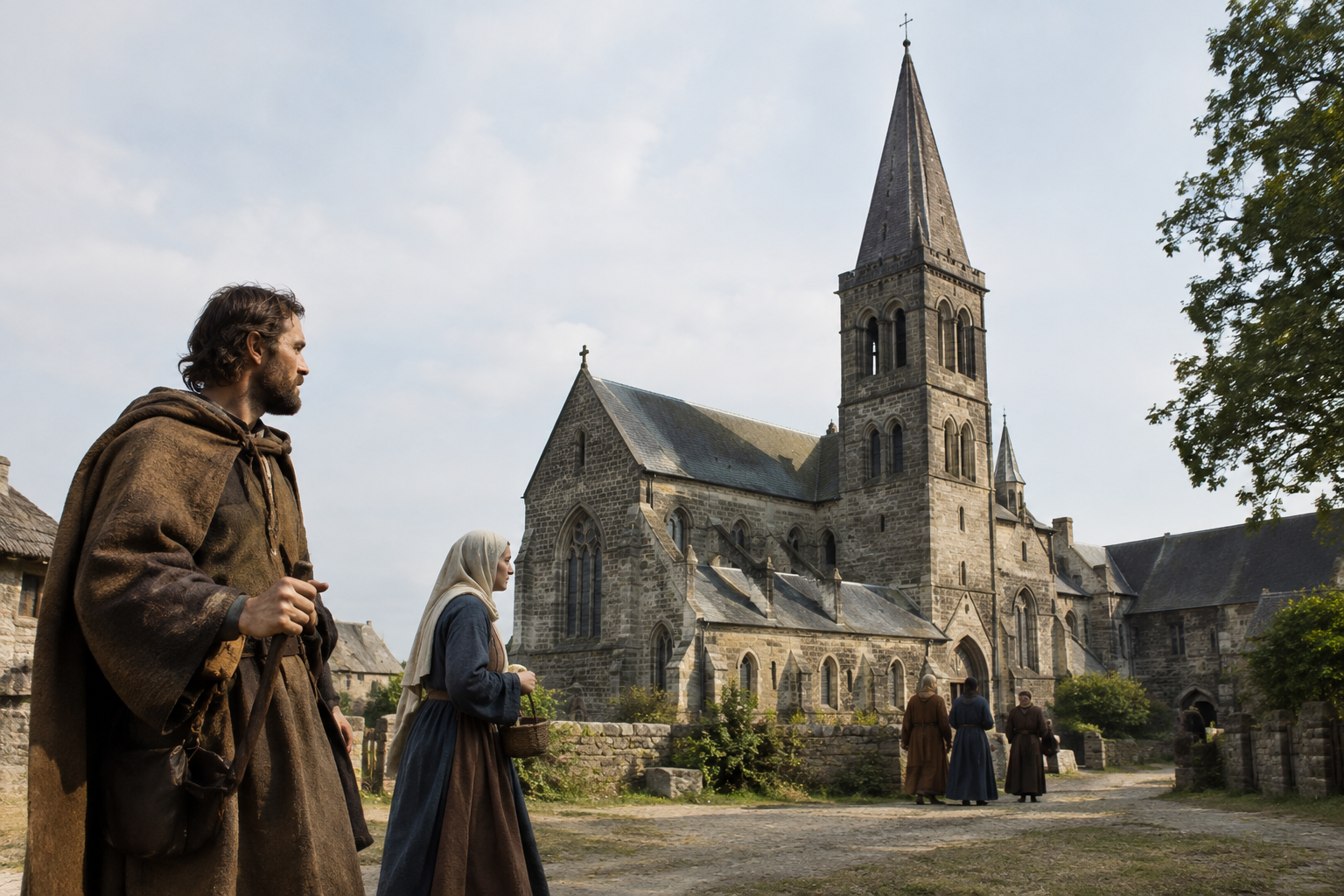
At Sint-Truiden in medieval Belgium, one burial stood out precisely because it did not seem to belong. Sample ST0475, dated to around AD 900 and recovered from the Onze-Lieve-Vrouwekerk, was identified in the study as an “outsider” in a community otherwise notable for local continuity. That makes him an unusually useful starting point for thinking about Y-DNA haplogroup J1b8: not as a grand banner for a whole people, but as a direct paternal line turning up in a place where movement, settlement, and identity were more complicated than tidy ethnic labels suggest.
That is often the real fascination of Y-DNA. It follows one paternal line only, not a person’s whole ancestry, yet in the right archaeological setting it can illuminate how particular male lines appeared within larger populations. In the case of J1b8, the evidence here is modest but quite pointed: a medieval man in the Low Countries whose paternal lineage marked him out within an urbanizing Christian town.
Sint-Truiden was not some remote hamlet at the edge of nowhere. By the early Middle Ages it was part of a lively ecclesiastical and economic landscape in the region that is now Belgium, shaped by monasteries, market exchange, and the afterlives of the Carolingian world. A burial from the Onze-Lieve-Vrouwekerk therefore belongs to a setting where population history is not simply local reproduction from one generation to the next, but also mobility: clerics, traders, dependants, pilgrims, craftsmen, and newcomers of many sorts.
In that context, ST0475 matters because he appears in a study of medieval Sint-Truiden that examined how urbanization could create both continuity and diversity. Research on these burials, published in Genome Biology, framed some individuals as more locally typical and others as more genetically unusual within the sampled community. ST0475 belongs to that second category.
One should be careful here. “Outsider” in an archaeogenetic study does not automatically mean a dramatic foreign arrival fresh off a horse from a far frontier. It means, more soberly, that this individual did not fit the main local genetic pattern as neatly as others in the cemetery. But sober can be interesting. Medieval towns and church sites are exactly where such lives become visible: people whose family histories came from elsewhere, yet whose deaths placed them within the same sacred ground as their neighbours.
The haplogroup in question is J1b8, a specific branch within the broader Y-chromosome haplogroup J. That broader haplogroup has a long and varied history across West Asia, the Mediterranean, and parts of Europe. But it would be careless to pour the entire history of haplogroup J into this one narrower branch, still less into one medieval burial.
What we can say is more measured. A paternal line classed as J1b8 was present in an individual buried in tenth-century-era Sint-Truiden. In a region where many discussions of early medieval ancestry quickly default to “Frankish,” “Germanic,” or “local Gallo-Roman” categories, that is a useful reminder that paternal lineages in medieval Europe were never confined to one simple historical story.
That point matters especially because Y-DNA can tempt people into over-reading. A single branch can travel through marriage, migration, military service, religious networks, slavery, trade, or gradual family movement across generations. The direct paternal line is real and traceable, but the historical mechanism behind its appearance at any one site must be argued from context, not guessed from the label alone.
The more one looks at early medieval Europe, the less persuasive the old picture of neatly bounded populations becomes. Churchyards, towns, ports, frontier zones, and market centres repeatedly produce evidence of mixed origins. Sint-Truiden fits that wider pattern rather well. It sat in a landscape tied to river systems, political lordship, ecclesiastical institutions, and long-distance exchange. Men could arrive there from nearby regions, from the Rhineland, from the former imperial south, or from still wider networks.
That makes ST0475 historically legible even when he remains biographically anonymous. He need not be turned into a merchant, monk, warrior, or pilgrim for his burial to tell us something important. The important thing is that a J1b8 paternal line was present in a medieval community whose cemetery also reveals the sorting and absorbing power of a growing European town.
The Low Countries were particularly exposed to that kind of traffic. Roman roads and institutions had long since altered the region; post-Roman political formations did not erase those routes, but repurposed them. By around AD 900, movement through such landscapes was normal enough that genetic “outsiders” are not surprising. What is valuable is that ancient DNA now lets us detect them where older historical categories would flatten them into the general crowd.
There is only one ancient sample supplied here, and that means this article should not pretend to chart the full ancient distribution of J1b8. Yet a single well-contextualized individual can still be revealing. Archaeology often works like that. One inscription, one skeleton, one pot in the wrong place, and suddenly the historian has to adjust the map.
ST0475 does exactly that on a modest scale. He shows that a J1b8 paternal line was present in medieval Belgium, in a burial context tied to a Christian urban community, and that this line was associated in the study with a genetically atypical individual. That is already enough to complicate simplistic stories of local sameness.
It also helps place personal ancestry questions in a properly historical frame. If a present-day tester belongs to J1b8, the medieval evidence does not prove descent from this individual, of course. But it does show that such a paternal line could be present in northwestern Europe by the early Middle Ages, embedded in ordinary social landscapes rather than only in the regions where broader haplogroup J is more common today.
Early Medieval Britain Genomes
Across the early medieval West, ancient DNA has steadily chipped away at the notion that ancestry, language, and political identity always travelled together. A man buried under a Christian church in Belgium might have had a paternal line with deeper connections far beyond the region, while still living his life entirely within the social world of the Meuse-Rhine zone. That is not an exception to history; it is history.
Comparable studies from other early medieval settings have made much the same point in different ways: communities could be locally rooted and yet genetically varied, especially in male lines linked to movement across trade routes, military systems, or marriage networks. If you want the broader background to how shifting populations and language communities intersect in early medieval Europe, it is worth comparing this case with work on Germanic-language spread in ancient genomics and with evidence for diverse origins in other post-Roman cemeteries.
The most distinctive thing about J1b8 in this evidence is not royal prestige or some overblown migration saga. It is the quiet, concrete fact that this paternal line appears in an early medieval burial from Sint-Truiden, and appears there in a man identified as genetically unusual within his cemetery community. For anyone researching J1b8 today, that is a useful clue: your direct paternal line may have participated in the long, untidy circulation of men through medieval Europe, where local belonging and distant ancestry were often folded together in the same life.

Comments