Haplogroup J1a2b2

– 4 min read


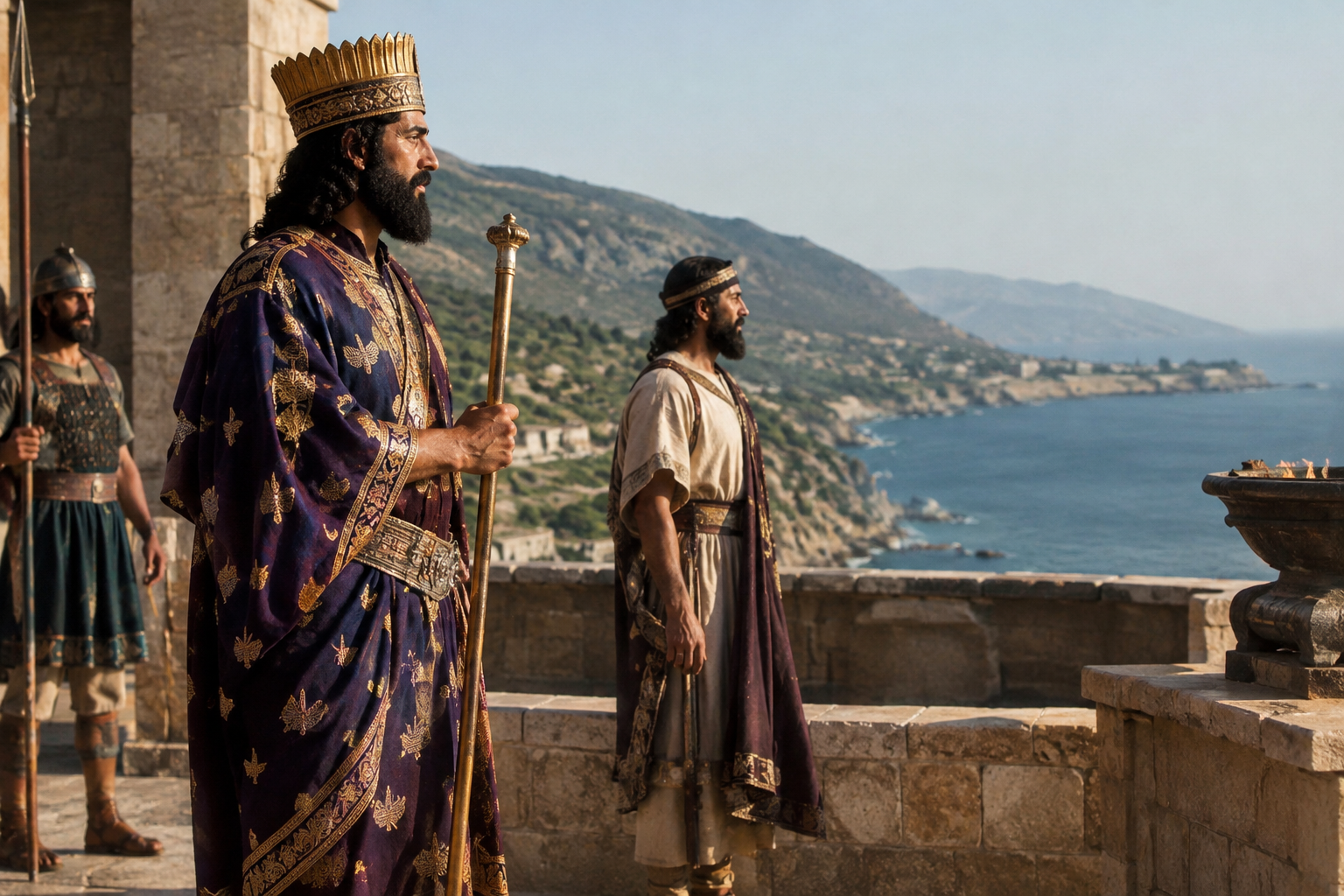
At Saifi in Lebanon, one ancient male dated to around 500 BC has been associated with the Y-DNA haplogroup J1a2b2. The individual, identified as SFI-45, belongs to the world of the Achaemenid Empire, when the eastern Mediterranean was tied into an enormous imperial system stretching from the Levant to Iran and beyond. Even with just a single ancient sample, that is already enough to make this lineage historically interesting: it places a paternal branch of J1 in a coastal Levantine setting during one of antiquity's most interconnected ages.
That matters because Y-DNA tracks one direct paternal line only - father to son across many generations - rather than a person's whole ancestry. So SFI-45 does not stand for all men in Achaemenid Lebanon, still less for all people carrying J1 today. But he does give us a real archaeological foothold: a man from the Levant, living under Persian rule, whose paternal line sits within a branch often discussed in the broader history of Southwest Asia.
Saifi lies in the Beirut area, a place with a very long history of movement, trade, rebuilding, and political change. By the 6th to 5th centuries BC, this coast formed part of the Achaemenid imperial order, but it was hardly a blank slate waiting to be absorbed. It was already a region of old cities, maritime links, and layered local traditions, now operating inside a much larger state.
That is the setting in which SFI-45 becomes useful. A label such as J1a2b2 is not a nationality and not a job description, but it can help show which paternal lines were present in a region at a particular time. In this case, the finding points to the continued presence of a J1-derived paternal line in the Levant during the Persian period, a reminder that imperial history was carried not only by kings and inscriptions, but by ordinary bodies in cemeteries.
A genetic study of ancient Near Eastern populations published in The American Journal of Human Genetics helped demonstrate just how informative such individuals can be for reconstructing long-term regional population history. Even when one sample cannot bear too much interpretive weight on its own, it can still anchor wider patterns in a securely archaeological context.
The broader haplogroup J1 is well known in discussions of the Near East, Arabia, and adjoining regions, but one must be careful here. The article haplogroup is J1a2b2, a narrower branch, and the history of the whole parent lineage cannot simply be poured into one smaller subclade as though the two were identical. Ancient DNA is full of these traps: a broad family tree may be old and widespread, while a particular twig on that tree has a much more specific and sometimes poorly documented history.
So the safest reading is also the most useful one. SFI-45 shows that a paternal line assigned to J1a2b2, or closely associated with it in reporting, was present in Achaemenid-period Lebanon. That ties the branch to a real eastern Mediterranean context in the first millennium BC, without requiring us to invent a precise migration tale, tribal identity, or dynastic pedigree.
It is worth pausing on the date. Around 500 BC, Lebanon was part of an imperial system ruled from the east, yet the Levantine coast retained its own stubbornly local character. Ports, inland routes, temple economies, and multilingual communities all sat within an Achaemenid framework that depended on existing regional strengths rather than erasing them.
In that sense, a paternal lineage like J1a2b2 fits the historical landscape rather well. This was a world in which families could be deeply local and thoroughly entangled with wider imperial networks at the same time. A burial from Saifi does not tell us whether SFI-45's recent ancestors came from a nearby community or from farther afield within the empire, but it does show that the paternal branch had a place in this Levantine setting during the Persian age.
Bronze and Iron Age Mesopotamia
Readers sometimes assume that a single ancient individual is too little to say anything worthwhile. Archaeologically, though, one well-placed sample can be far more revealing than a hundred vague assertions. SFI-45 is fixed to a period, a region, and a historical order that we can describe with confidence: Achaemenid Lebanon, around 500 BC.
That makes him a point of comparison. As more ancient males from the Levant, Syria, Mesopotamia, and Iran are tested, lineages like J1a2b2 can be plotted across time rather than guessed at from modern distribution alone. Ancient DNA often corrects easy stories. Sometimes a lineage turns out to be far more localized than expected; sometimes it appears in surprising cosmopolitan settings long before later historical identities took shape.
This is especially important in the eastern Mediterranean, where modern political and ethnic categories can tempt people into reading the past backwards. A Persian-period burial from Lebanon belongs first to its archaeological setting. Only after that should we ask larger questions about continuity, mobility, and the survival of paternal lines across centuries.
The Saifi sample also belongs to a bigger historical problem: how paternal lines moved, endured, or were reshaped in the crowded societies around the Mediterranean. The Levant was not isolated. It connected Egypt, Cyprus, Anatolia, Mesopotamia, and the Iranian world, and later it would be folded into Hellenistic and Roman systems as well. A branch like J1a2b2 may therefore interest not only those with specifically Lebanese roots, but anyone tracing paternal ancestry through the wider Near Eastern and Mediterranean zone.
That does not mean every later appearance of J1, or every modern carrier of J1a2b2, descends from men exactly like SFI-45 in an obvious documentary chain. It means something subtler and, in many ways, more exciting: the branch is not merely theoretical. It is archaeologically present in a major historical crossroads at a clearly recognizable moment in antiquity.
If your paternal haplogroup is J1a2b2, the most responsible takeaway is not a grand claim of imperial descent, but a real connection to an ancient Near Eastern landscape in which this branch is already visible by the Achaemenid period. SFI-45 from Saifi, Lebanon, shows that this paternal line had a place in the Levant around 500 BC, inside one of the great political systems of the ancient world but rooted in a region with much older local depth. For family historians, that is the value of ancient DNA at its best: not fantasy, but a firmer sense of where one line of ancestry can genuinely be seen in the historical record.


Comments