Haplogroup J1a2a1a2d2b2b2c4a1a1
– 5 min read


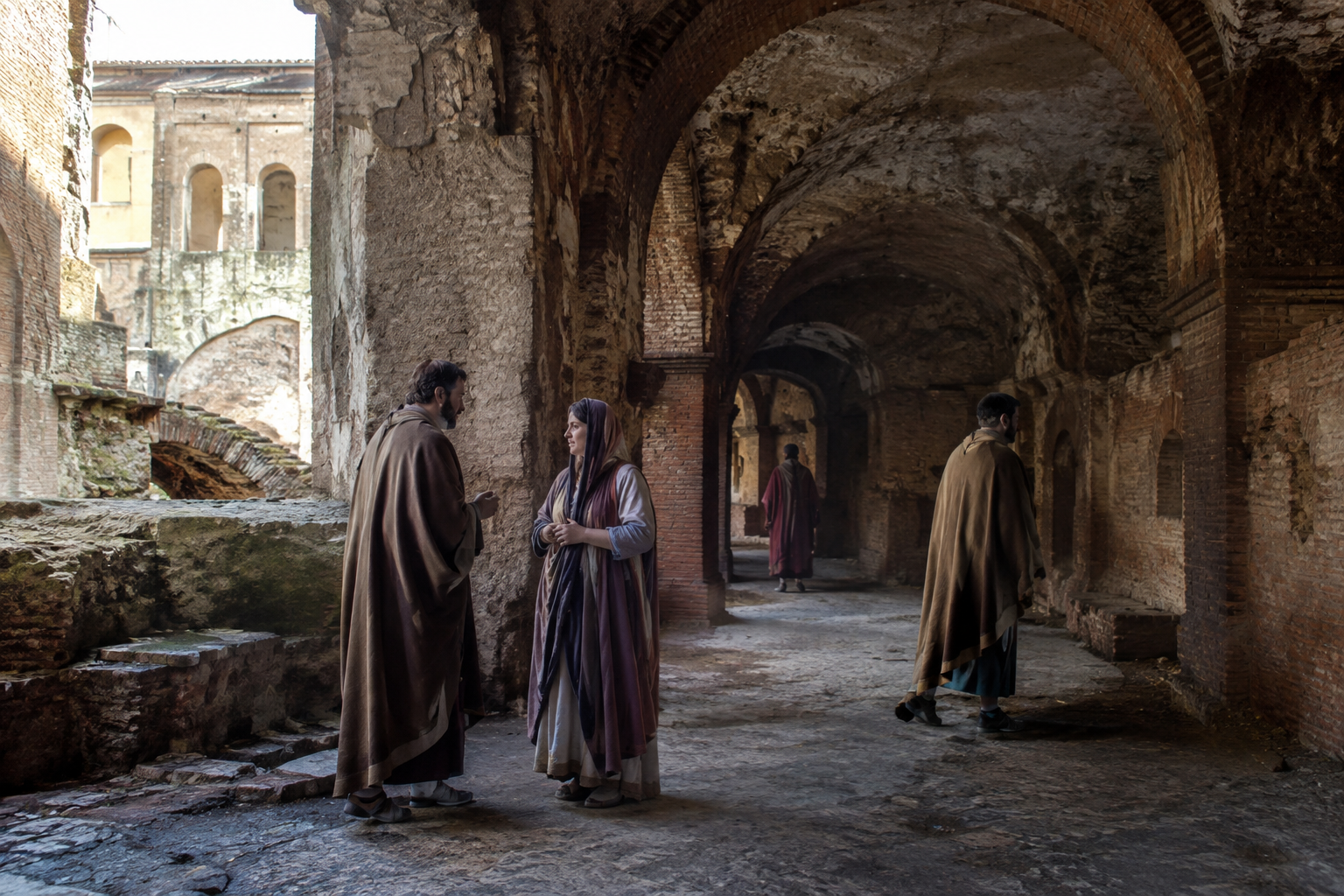
Late Antique Rome was not peopled by a single, tidy "Roman type". One of the clearest reminders comes from sample R105, dated around AD 500 and associated here with the Y-DNA haplogroup J1a2a1a2d2b2b2c4a1a1. He comes from Crypta Balbi, a remarkable urban archaeological complex in the heart of Rome where layers of imperial, late Roman, and early medieval life pile up one upon another. In other words, this is not the edge of empire. It is the old center itself.
That matters because a paternal lineage like J1a2a1a2d2b2b2c4a1a1 is not telling us that one man was "more Roman" or "less Roman" than his neighbors. Y-DNA traces only a direct male line. But when such a lineage appears in a late Roman burial from central Rome, it adds another small, sharp piece of evidence to a bigger historical picture: the city in late antiquity was still a place of movement, mixture, and inherited diversity.
Crypta Balbi is one of those sites archaeologists cherish because it lets us watch a city mutate across centuries. Originally part of a monumental complex in the Campus Martius, the area later became entangled with workshops, dwellings, burials, reused materials, and all the practical improvisations of a capital adjusting to new political and economic realities. By the time of R105, Rome was no longer the unquestioned administrative heart of a unified empire, yet it remained densely connected to the Mediterranean world.
The fascination of R105 lies precisely in that setting. A man buried in Rome around AD 500 belonged to a city that had seen emperors, senators, soldiers, traders, clergy, laborers, migrants, and slaves arrive for generations. A paternal branch like J1a2a1a2d2b2b2c4a1a1 should therefore be read historically, not romantically: not as a badge of ethnic essence, but as evidence that the male lines present in late Roman Rome could be varied, and sometimes unexpectedly so.
A major ancient DNA study of imperial and late antique Rome, published in Science, helped establish just how dramatic that long-term population history was. The broad result is now familiar: Rome's ancestry profile changed markedly over time, especially as the city drew people from across the Mediterranean. R105 sits comfortably within that wider archaeological lesson, even if one Y-chromosome lineage on its own cannot stand in for the whole population.
Rome and eastern Mediterranean ancestry
The full label J1a2a1a2d2b2b2c4a1a1 is an extremely narrow twig on a much larger paternal tree. That is important. People often know that haplogroup J1, in the broadest sense, has a history tied to parts of the Near East and surrounding regions, but one should be very careful not to dump the entire story of that wide parent branch onto one tiny downstream subclade. The article's lineage is much more specific than the parent J1 label, and without a fuller chain of securely documented ancient matches, the sensible thing is to keep the claim narrow.
What can be said with confidence is simpler and more interesting. A direct paternal line associated with this branch appears in late Roman Rome. That makes this lineage part of the documented male diversity present in the city during the centuries when imperial structures were fraying but Mediterranean links had by no means vanished.
It is also a useful reminder that lineages do not map neatly onto language, religion, or legal identity. A man living in Rome around AD 500 might have identified through locality, profession, household, military service, church ties, or inherited citizenship traditions. His Y-DNA is one clue about descent, not a complete biography.
It is tempting to speak of "the fall of Rome" as if the lights simply went out. Archaeology is much less theatrical. Sites like Crypta Balbi show continuity mixed with alteration: old monuments reused, neighborhoods repurposed, urban life reorganized rather than erased. Burials from this world belong to a society in transition, not a vacuum.
That context gives R105 his historical value. If a lineage such as J1a2a1a2d2b2b2c4a1a1 appears in this setting, it fits a Rome shaped by centuries of movement from Italy, the Balkans, North Africa, the Aegean, Anatolia, and the Levant. We do not need to invent a dramatic migration tale for this one man. Rome itself had already done the collecting. The city was the great funnel.
In that sense, the sample is less an outlier than a witness. By AD 500, generations of mobility had already been folded into ordinary urban life. A paternal line that may seem geographically surprising to a modern reader may have been entirely unremarkable in a city that had spent hundreds of years absorbing people from every shore of the inland sea.
Late Roman Italy in ancient DNA
There is, admittedly, only one ancient individual listed here: R105. That means the article cannot honestly claim a local dynasty, a neighborhood clan, or a continuous series of father-to-son burials at Crypta Balbi. But one well-placed sample can still matter when the place is as historically charged as Rome.
A burial from the old capital anchors the haplogroup in a documented archaeological context. It tells us that this paternal branch, or at least a line associated with it, was present in late antique urban Italy. For family historians and DNA testers, that is often the most valuable kind of evidence: not mythic origins, but a real person in a real city at a real moment of historical change.
And Crypta Balbi is exactly the right place for such a discovery. The site has long been central to understanding how classical Rome became medieval Rome. Every individual from there contributes to a bigger argument that the transition was not a simple ethnic replacement or civilizational collapse, but a complicated reshaping of an already mixed population.
At a wider scale, the presence of a J1-related paternal line in Rome should not be treated as exotic decoration. Mediterranean history is full of circulation: merchants, soldiers, captives, administrators, pilgrims, and families moving gradually or abruptly across the sea. The Roman Empire did not merely conquer territory; it also created enduring corridors of movement.
That is why late Roman and early medieval genetic evidence so often refuses our neat national boxes. The same broad region can contain lineages with very different deeper histories, while people sharing a language or political allegiance may have very different paternal origins. Rome is one of the best laboratories for this because its written history already tells us it was crowded with incomers; genetics simply sharpens the picture.
If your paternal line falls under J1a2a1a2d2b2b2c4a1a1, the most defensible historical insight from the evidence here is not a grand claim about one ancient tribe or noble house. It is something both smaller and better: a man associated with this lineage, R105, was living in late antique Rome around AD 500, in a city whose population had been shaped by centuries of Mediterranean contact. That places your haplogroup within the documented human variety of one of history's greatest urban crossroads.
For many people, that is the real pleasure of ancient DNA. Not the fantasy of a single pure origin, but the discovery that even one narrow paternal branch can surface in the thick of Rome's messy, cosmopolitan, very human history.
Comments