Haplogroup J1a2a1a2d2b2a1a

– 5 min read


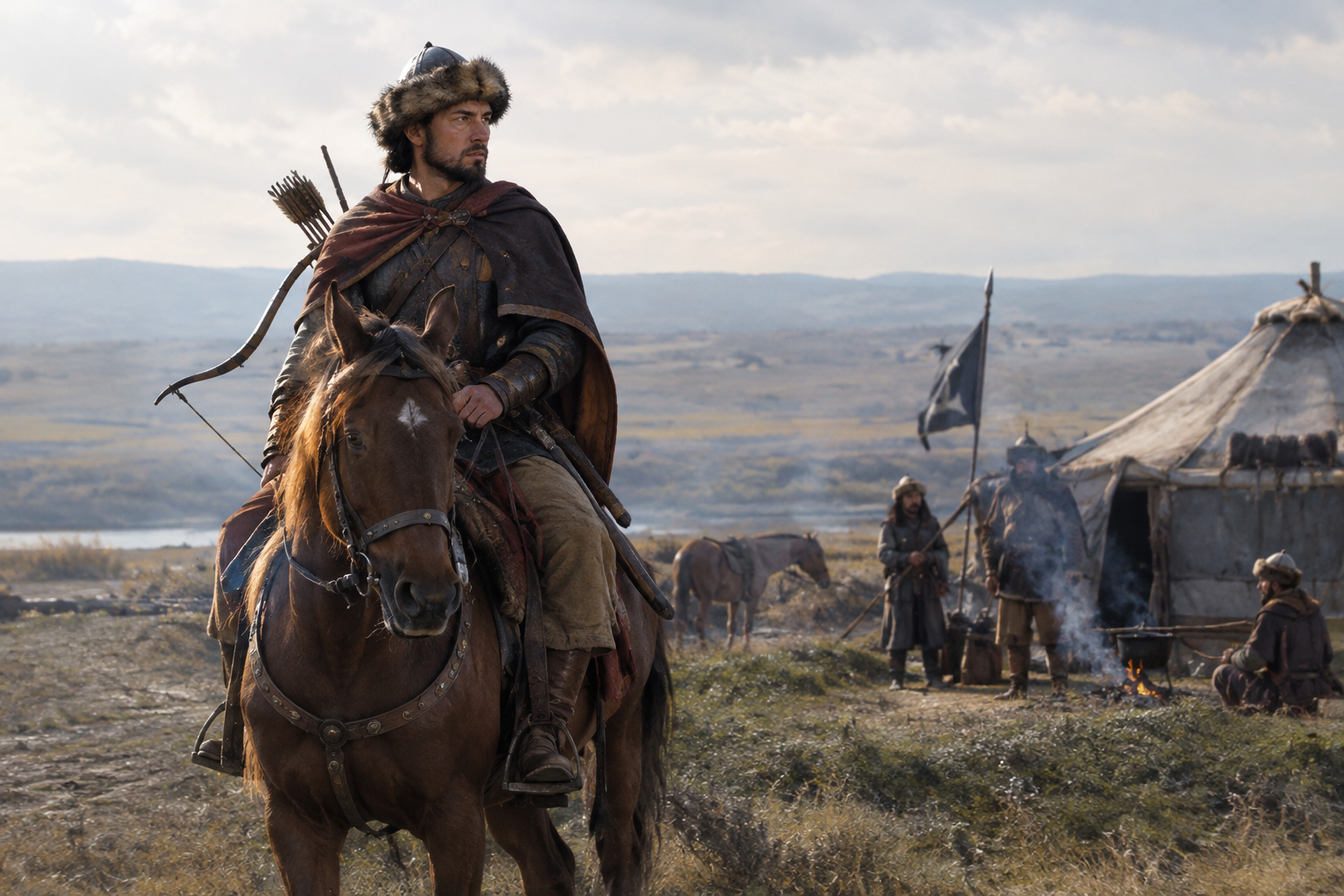
At Eloszallas-Bajcsihegy in present-day Hungary, one man from around AD 650 stands out for what his DNA can tell us about a very unsettled age. The ancient individual identified as AHPS220W, described as a Dark Ages Hungary horseman, belongs on the map of Y-DNA haplogroup J1a2a1a2d2b2a1a. That is a very narrow paternal branch, and the interest here lies not in grand claims about whole peoples, but in the fact that such a lineage appears in the Carpathian Basin during a period when power, mobility, and identity were being renegotiated after Rome and before medieval kingdoms had fully taken shape.
This is exactly the sort of case where ancient DNA sharpens, rather than simplifies, the historical picture. Y-DNA follows one direct paternal line only; it does not tell us a person's whole ancestry, language, or political loyalty. But when a lineage like J1a2a1a2d2b2a1a turns up in an early medieval burial connected with horseback culture, it becomes part of a larger archaeological question: who was moving through the Carpathian Basin in the 6th and 7th centuries, and how mixed were the communities that emerged there?
The sample we have here is unusually evocative even in its brief description. AHPS220W comes from Eloszallas-Bajcsihegy and is dated to about AD 650, squarely within the early medieval centuries often called the Dark Ages in older writing. In the Carpathian Basin, that was a time of overlapping frontiers and layered populations, with local late antique survivors, newcomers from the steppe, and communities shaped by long-distance military and political connections.
The description of the individual as a horseman matters because mounted identity was not a trivial detail in this region. Horses, riding equipment, and equestrian burial associations are among the clearest archaeological signatures of status and cultural affiliation in many 6th- to 8th-century cemeteries of the basin. Even when we do not know every grave detail for this man, the label places him in a recognizable historical world: one in which cavalry, mobility, and elite display were central to power.
An ancient DNA study of post-Roman and early medieval populations in this broader region has helped show just how biologically varied these societies could be, and how poor the old habit was of equating one burial style with one biological origin. That wider context is important for understanding why a lineage like J1a2a1a2d2b2a1a appearing in Hungary is interesting rather than anomalous. Research on the region can be found here: https://www.science.org/doi/10.1126/sciadv.adq5864.
It is worth being careful here. The article haplogroup is J1a2a1a2d2b2a1a, an extremely specific twig on the wider J1 paternal tree. The broader haplogroup J1 has a long and complicated history across parts of the Near East, Caucasus, and surrounding regions, but that does not mean every fine-grained descendant branch shares the same story in the same way or arrived in the same place at the same time.
So the safest historical reading is also the most useful one: this branch shows that at least one direct paternal line found in early medieval Hungary belonged to a lineage with deeper roots outside the standard stereotype of a purely local or purely steppe-derived male population. In other words, the male lines present in the Carpathian Basin by around AD 650 could be strikingly diverse.
That matters because early medieval history in this region is too often flattened into a succession of named groups as if each were genetically uniform. Ancient DNA keeps spoiling that neat picture, and rightly so. Cemeteries, warrior identities, and political confederations could bring together men from quite different paternal backgrounds.
By the 7th century, the Carpathian Basin was one of Europe's great contact zones. It had been shaped by Roman imperial systems, by post-Roman transformations, and by the arrival and consolidation of steppe-oriented powers. Archaeology reveals local continuity in some places, abrupt changes in others, and a landscape threaded together by exchange, warfare, and migration.
That is why a horseman from Eloszallas-Bajcsihegy bearing J1a2a1a2d2b2a1a should be read against the backdrop of mixture rather than isolation. A mounted burial identity may signal status, military culture, or participation in a wider political world, but it does not pin a man to one simplistic ethnic label. The paternal lineage adds another layer: the men buried in these early medieval communities did not all descend along the same male lines.
There is a useful parallel here with work on frontier populations farther east and south around the Black Sea and steppe margins, where archaeology and genetics repeatedly show that cavalry-linked or politically connected groups were often composite. The old habit of imagining a single "tribal" biological core rarely survives contact with actual genomes.
There is only one ancient individual listed here, and that calls for restraint. One sample cannot define the full history of J1a2a1a2d2b2a1a, still less the identity of all early medieval horsemen in Hungary. But single individuals can be historically valuable when they illuminate a broader pattern already visible in archaeology: that the societies of the migration and post-Roman periods were assembled from many strands.
AHPS220W is valuable precisely because he is not a mythic founder or a royal mascot. He is a real excavated person from a real site, dated to a specific historical horizon. His paternal lineage shows that fine-scale J1 diversity had reached, or was present within, the Carpathian Basin's early medieval world.
That, in turn, has implications for family history. If you belong to J1a2a1a2d2b2a1a today, the ancient evidence does not let anyone leap straight to a named tribe, dynasty, or national origin. What it does suggest is that your paternal line belongs to the sort of lineage that could appear in the mixed, mobile, militarized societies of early medieval east-central Europe.
One of the most important lessons of recent archaeogenetics is that post-Roman Europe was not simply a set of populations replacing one another in tidy blocks. In Hungary, as elsewhere, some communities carried local ancestry forward, some included newcomers from long distances, and many were products of repeated admixture. Burial grounds can preserve the material signs of rank or cultural fashion, while DNA reveals that people participating in the same world did not necessarily share the same paternal past.
That is why the Eloszallas-Bajcsihegy horseman is such a useful anchor for this haplogroup. He places J1a2a1a2d2b2a1a in a frontier-rich, cavalry-shaped society where identity was made through politics, mobility, and alliance as much as through descent. His Y-chromosome records one thread of that story: a direct male line present in early medieval Hungary, without pretending to explain everything else about the man.
The distinctive thing about J1a2a1a2d2b2a1a in this evidence is not sheer antiquity or royal glamour, but placement. It appears in an early medieval Hungarian horseman, AHPS220W, from a region where archaeology and genetics both point to intense mixing and movement. For someone tracing this paternal branch today, that is a solid and interesting clue: your direct male line fits into the complicated human traffic of the early medieval Carpathian Basin, where mounted elites and local communities alike were far more diverse than older histories once allowed.
Comments