Haplogroup J1a2a1a2d2b2

– 5 min read


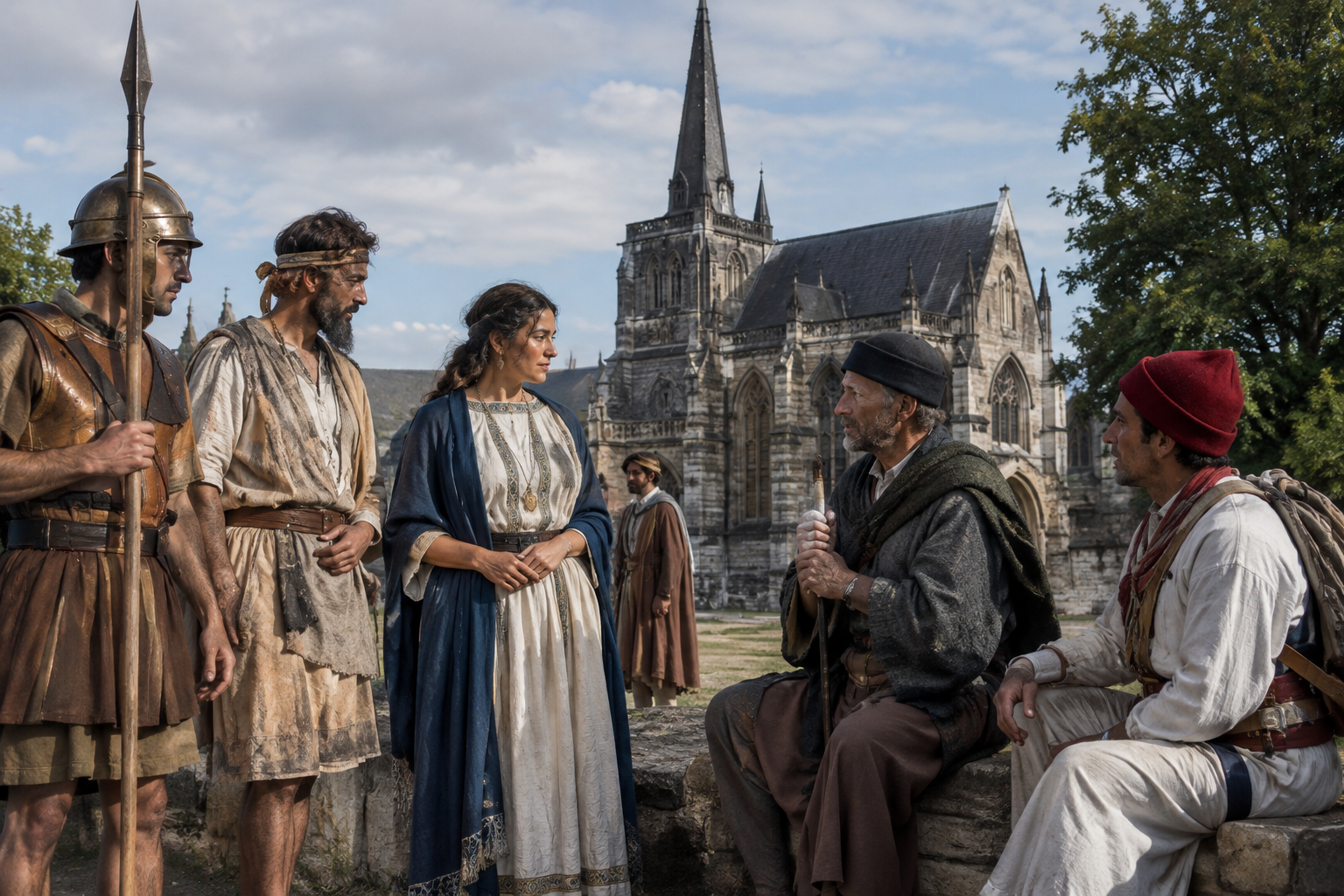
At Sint-Truiden in medieval Belgium, one of the more revealing burials is identified simply as ST2701, dated to around AD 900 at Onze-Lieve-Vrouwekerk. On the face of it, that looks like a very local story: a church burial in the early medieval Low Countries, in a town growing around an important religious foundation. Yet the paternal line associated here with haplogroup J1a2a1a2d2b2 becomes far more interesting when set beside much older finds from the Levant and the central Mediterranean.
That is the real value of a lineage like this one. Y-DNA follows only a direct paternal line, not a person's whole ancestry, but it can still illuminate how male lines moved through historical worlds. In this case, the evidence points not to one isolated people, but to a chain of appearances stretching from Bronze Age cities in the southern Levant to Punic Sardinia, and then into later European settings.
ST2701 comes from Sint-Truiden, a place that mattered in the Carolingian and post-Carolingian world because monasteries and churches were not just religious buildings. They were engines of settlement, landholding, literacy, and burial prestige. A man buried there around AD 900 belonged to a society in which towns were thickening around ecclesiastical institutions and older rural populations were being drawn into new urban frameworks.
That matters because a paternal line such as J1a2a1a2d2b2 appearing in this context should not be read as exotic by default. Medieval towns gathered people from different backgrounds, sometimes over many generations. Research on Sint-Truiden has emphasized how ancient DNA can help clarify urban population structure in the early medieval Low Countries, and this broader setting is reflected in a genetic study of medieval Sint-Truiden examining the community around the site.
So ST2701 is useful not because one burial can tell us everything, but because it shows this paternal branch present in a recognizably medieval northwestern European environment. By AD 900, any such line could already have had a long and complicated history behind it.
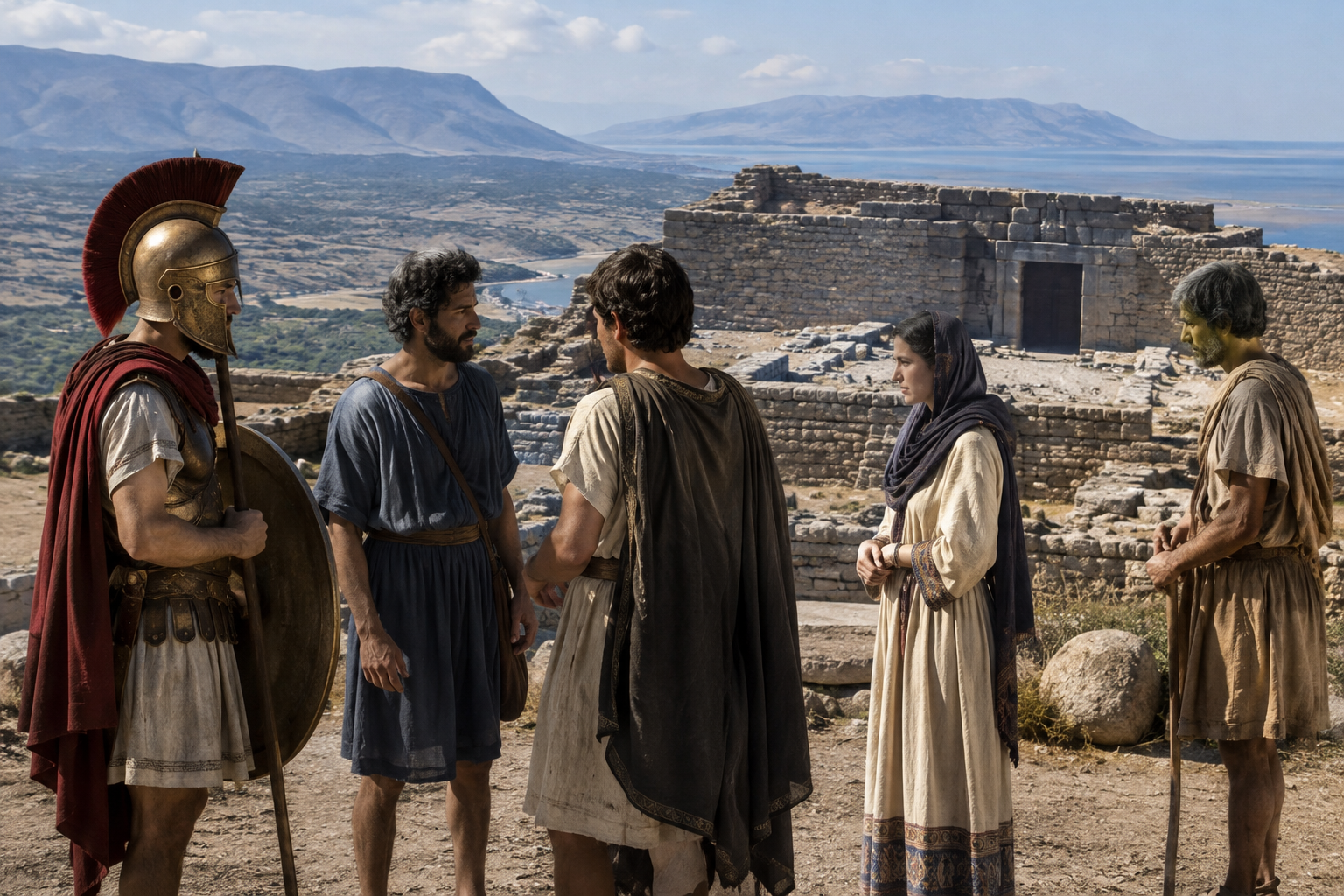
The older anchors for this haplogroup are especially striking. Sample I3965 comes from Bronze Age Hazor in Upper Galilee, dated here to around 1750 BC, while I2198 comes from Megiddo in the Late Bronze Age, around 1470 BC. These are not obscure villages. Hazor and Megiddo were two of the great urban names of the Bronze Age Levant, deeply tied into diplomacy, trade, warfare, and elite exchange.
That does not mean the same paternal line "belonged" to a kingdom or an ethnicity. It means that men carrying a branch associated here with J1a2a1a2d2b2 were present in precisely the sort of urbanized Levantine settings that linked inland Syria-Palestine to Egypt, Anatolia, Cyprus, and Mesopotamia. When you find a lineage in major centers like Hazor and Megiddo, you are looking at a world already full of movement.
For the Levantine side of the story, one of the most relevant research leads is an ancient DNA study on Bronze Age Megiddo and regional population history. Even without claiming more than the evidence allows for any one terminal subclade, the broader point is solid: these cities sat at the crossroads of eastern Mediterranean interaction, and their populations were anything but static.
That is the first big clue to the character of this lineage's history. Not a simple "origin story", but a documented presence in Bronze Age urban networks where ancestry, language, and political allegiance did not map neatly onto one another.
The sample VIL007 from Villamar in Sardinia, dated here to around 250 BC and described as Carthaginian/Punic, adds a very different chapter. Now we are in the western Mediterranean, in the age when Punic culture connected North Africa, island communities, and former Phoenician trading zones. Sardinia was one of those places where imperial reach, commerce, and local society met in a particularly intense way.
This is exactly the sort of context in which a paternal line with earlier eastern Mediterranean appearances might turn up again, though one has to be careful. A Punic-period man in Sardinia is not automatically a recent migrant from the Levant, nor does one Y chromosome make him a spokesman for all Punic ancestry. Still, the appearance of this branch in Punic Sardinia fits a historical world shaped by maritime links between the Levantine and central-western Mediterranean basins.
That wider Punic picture has been explored in MyTrueAncestry's discussion of ancient Punic diversity, which is worth reading alongside this lineage evidence.
In other words, VIL007 does not prove a straight paternal chain from Hazor or Megiddo to Sardinia. What it does show is that this haplogroup appears in another historically plausible corridor of contact: the seaborne world shaped by Phoenician and later Carthaginian expansion.
The most unusual entry in this set is I2869, listed as "Skeleton Lake Traveller - Hellenic" and dated to AD 1805. Whatever the exact route of that individual's paternal ancestry, this is plainly a much later case and belongs to a very different historical problem from Bronze Age Levantine cities or Punic Sardinia.
What makes it interesting is not that it somehow "confirms" a single continuous migration track. Rather, it shows how enduring and mobile paternal lines can be by the early modern period. A branch associated with J1a2a1a2d2b2 appears here in a person connected with a Hellenic identification at a famously unusual mountain-lake context, suggesting once again that this is a lineage encountered in worlds of travel, exchange, and layered identity.
That Mediterranean complexity has clear echoes in other ancient-DNA work on mixed and mobile communities. One useful comparison is medieval Sicily, where genetics likewise reveals populations shaped by repeated movement and overlapping cultural spheres rather than tidy ancestral boxes.
With a very precise label like J1a2a1a2d2b2, it is important not to smuggle in claims that belong only to the much wider parent haplogroup J1. The ancient samples here are valuable because they give this narrower branch a documented archaeological footprint, but not every sample will necessarily have been resolved to the same terminal depth in every study. The safest reading is that these individuals are associated with the branch used for this article, while the strongest historical picture comes from the pattern of places and periods rather than from overconfident phylogenetic storytelling.
And that pattern is rather distinctive. The branch appears in Bronze Age Levantine urban centers, in Punic Sardinia, in medieval Belgium, and in a much later Hellenic-labelled traveller. That is not the profile of a lineage confined to one kingdom, one language, or one migration episode. It is the profile of a paternal line that repeatedly surfaces in connected zones of the eastern and central Mediterranean, and eventually in medieval and later Europe as well.
For someone researching this haplogroup today, the most responsible conclusion is also the most interesting one: J1a2a1a2d2b2 is a reminder that paternal ancestry can preserve traces of very old links across cities, ports, and religious communities without reducing a family's past to a single identity. Its ancient appearances suggest deep roots in historical interaction zones rather than a neat one-place origin story.
Comments