Haplogroup J1a2a1a2d2b

– 6 min read


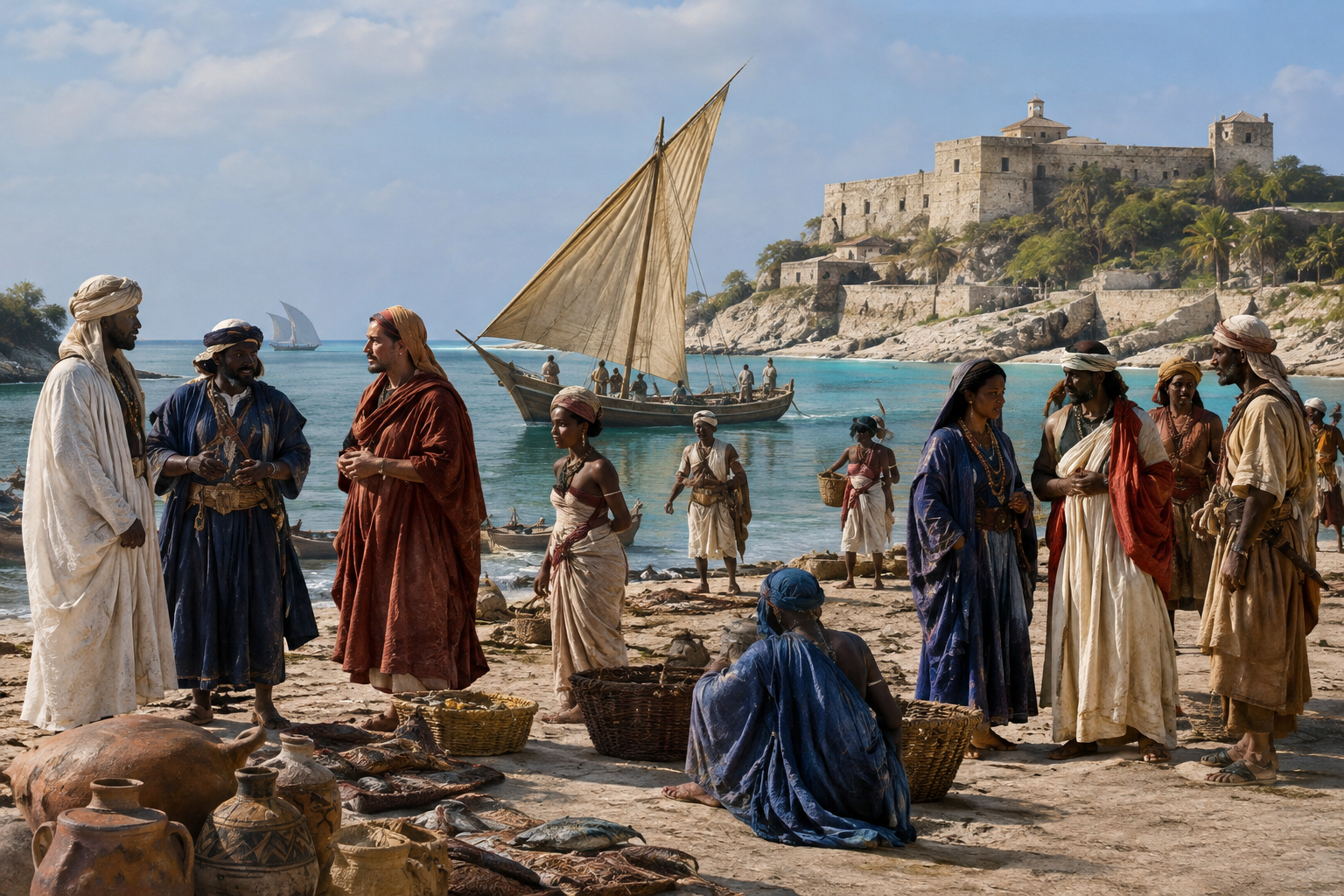
Some Y-DNA haplogroups announce themselves with a neat, tidy story. J1a2a1a2d2b does not. What makes it so interesting is precisely that it appears in places linked by sea lanes, empires, ports, and long-distance exchange: Punic Pantelleria, Roman Pannonia, the Byzantine Aegean, early medieval Iberia, Yemen, and the Swahili coast of Kenya. That is not the pattern of a lineage locked into one valley or one kingdom. It is the pattern of a paternal line that turns up where people, goods, and ideas moved.
As always, a note of caution is essential. Y-DNA traces only one direct paternal line: your father's father's father, and so on. It is not your whole ancestry, not your whole family tree, and certainly not a shortcut to claiming a civilization, dynasty, or noble house. But in historical work it can be wonderfully revealing, because even a very narrow lineage like J1a2a1a2d2b can illuminate the corridors through which men travelled, settled, served, traded, married, and were buried.
Haplogroup J is one of the best-known Y-chromosome lineages of the Near East and eastern Mediterranean. Within that wider family, J1 has often been discussed in connection with Southwest Asia and adjoining regions, but it would be careless to project the entire deep history of broad J1 directly onto a very specific branch such as J1a2a1a2d2b. What we can say responsibly is that this subclade belongs to a paternal family tree whose history is strongly entangled with the Near East, the Mediterranean, and the Red Sea world.
The ancient sample pattern supplied here points less to a single ethnic label than to a zone of interaction. The branch turns up in island contexts, coastal contexts, and imperial settings. That suggests that maritime mobility, military service, commerce, and regional integration may all have helped spread related paternal lines. The geography is telling: Pantelleria between Sicily and North Africa; the Aegean coast under Byzantine influence; Roman Croatia on an imperial frontier; Girona in early medieval Spain; Soqotra off southern Arabia; and Mtwapa on the East African coast.
That is a reminder that lineages do not travel with flags attached. They move with people whose identities changed depending on time and place: Phoenician or Punic settlers, Roman provincials, sailors, merchants, soldiers, islanders, Muslims, Christians, and townsmen in mixed port societies.
One of the most revealing early anchors is I24187, from Carthaginian/Punic Cossyra Pantelleria, dated 550 BC. Pantelleria, ancient Cossyra, sits in the channel between Sicily and North Africa and was a natural staging post in Punic maritime networks. A lineage of this kind appearing there makes excellent historical sense. Punic worlds were not isolated enclaves; they were seaborne systems linking North Africa, Sicily, Iberia, and island communities in between.
Several centuries later we find BBC005 at Imperial Roman Croatia Karlovac Pannonia Savia, dated 275 AD. Here the setting is entirely different: not a Punic island but the inland machinery of the Roman Empire. Yet that is exactly the point. Rome excelled at relocating people. Soldiers, administrators, traders, camp followers, and their descendants could carry paternal lines far beyond their earlier centers of concentration. A branch found both in Punic Pantelleria and Roman Pannonia is not evidence of direct descent between those two individuals, but it does show how the same broader paternal tradition could be present in very different imperial worlds.
Then there is I14824, from Byzantine Era Kera Panagia Aegean Coast, dated 500 AD. Again the setting shifts, this time to the eastern Mediterranean in the age of Byzantium. The Aegean was a maritime hinge connecting Anatolia, the Balkans, the Levant, and the wider Mediterranean. A lineage like this appearing there reinforces the impression of continuity across connected coastal worlds rather than isolation within one population.
Readers interested in the island setting behind Pantelleria may enjoy this related piece on ancient DNA from Mediterranean islands.
Perhaps the most striking sample in the western Mediterranean is I20385, from North African Early Medieval Spain Girona Sarria de Ter Pla de lHorta, dated 689 AD. That description alone tells a fascinating story. Early medieval northeastern Spain was no sealed Christian backwater. It was part of a broader western Mediterranean zone in which late Roman, Visigothic, and North African connections all mattered. A paternal lineage with clear ties to Mediterranean and Near Eastern interaction zones appearing in this context fits the increasingly complex genetic picture emerging from early medieval Iberia.
Far to the southeast, I21109 from Medieval Yemen Soqotra Momi Zaflah, dated 900 AD, places this branch in one of the great crossroads of the Arabian Sea. Soqotra was never merely remote. It stood at the edge of routes linking southern Arabia, East Africa, and the Indian Ocean. If Pantelleria represents the sea roads of the central Mediterranean, Soqotra represents another marine world altogether: monsoon trade, Islamicate exchange, and movement between Arabia and Africa.
That wider maritime picture becomes even clearer in the remarkable cluster from Medieval Coastal Kenya Mtwapa: I19401, I19413, I17409, I17410, I17412 dated 1600 AD, and I19381, I19391, I19408 dated 1585 AD. Mtwapa on the Swahili coast was a trading town in contact with Arabia, Persia, India, and inland Africa. Finding multiple related paternal signatures here is a powerful clue that this was no one-off arrival. It suggests that lineages of this family had become part of the male population in a coastal East African town shaped by centuries of Indian Ocean exchange.
If you want to place the Iberian evidence in a broader peninsula-wide setting, this article is particularly relevant.
The temptation, when faced with a lineage turning up from Spain to Kenya, is to reach for grand declarations: Phoenician, Arab, imperial, mercantile. Better to be more precise. The evidence does not prove that every carrier belonged to the same people in any cultural sense. It does suggest that paternal lines within this branch were at home in connected zones stretching across the Mediterranean and into the Red Sea and Indian Ocean worlds.
That matters historically because written sources often separate our narratives too neatly: Punic here, Roman there, Byzantine elsewhere, Islamic again somewhere else. DNA can reveal a messier and more human truth. Men moved across those political and religious boundaries. Some served empires. Some traded. Some settled in ports. Some married locally and founded lines that continued for centuries in new places.
The cluster at Mtwapa is especially useful in this respect. It shows how a paternal lineage associated with older western and eastern Mediterranean contexts could also be present in a late medieval and early modern African coastal society. Not as a museum relic, but as part of a living population shaped by commerce and mobility.
For readers interested in that North Africa-Iberia connection across later centuries, this is a natural next stop.
Explore Iberian-North African Links
In this case, the supplied field for associated noble families and castles is effectively empty. That absence is worth stating plainly rather than papering over with invention. We therefore cannot responsibly tie J1a2a1a2d2b to a named medieval house, dynastic founder, or ancestral stronghold from the evidence provided here.
And in truth, that is rather refreshing. It reminds us that the most illuminating stories in ancient DNA are not always the ones with coats of arms attached. Sometimes the real drama lies in harbors, islands, garrisons, and market towns: Pantelleria under Punic influence, Pannonia under Rome, the Byzantine Aegean, early medieval Girona, Soqotra in the Arabian Sea, and Mtwapa on the Swahili coast. These were the places where history actually happened in the plural, through encounters rather than pedigrees.
For a broader look at one of the worlds most relevant to this haplogroup's early sample pattern, the Punic context is especially helpful.
So what does this haplogroup reveal? First, that direct paternal ancestry can preserve traces of long-distance historical worlds that are easy to miss in conventional genealogy. Second, that ancient DNA is often at its most interesting when the same lineage appears in very different cultural settings. And third, that shared haplogroups do not prove close kinship, noble descent, or a single ethnic identity.
Still, there is something wonderfully concrete about these sample IDs. I24187, BBC005, I14824, I20385, I21109, and the Mtwapa individuals are not abstractions. They are men who lived in real places at specific moments when seas connected continents and empires remade populations. J1a2a1a2d2b, at least from the evidence here, belongs to that historical geography of connection.
If your own Y-DNA falls on a branch like this, MyTrueAncestry can help place it in context by comparing your results with ancient individuals and historical populations. Those matches may offer remarkable clues about where parts of your paternal story intersect with the ancient world, while still not proving direct descent from any one excavated person or later family line.



Comments