Haplogroup J1a2a1a1b

– 5 min read


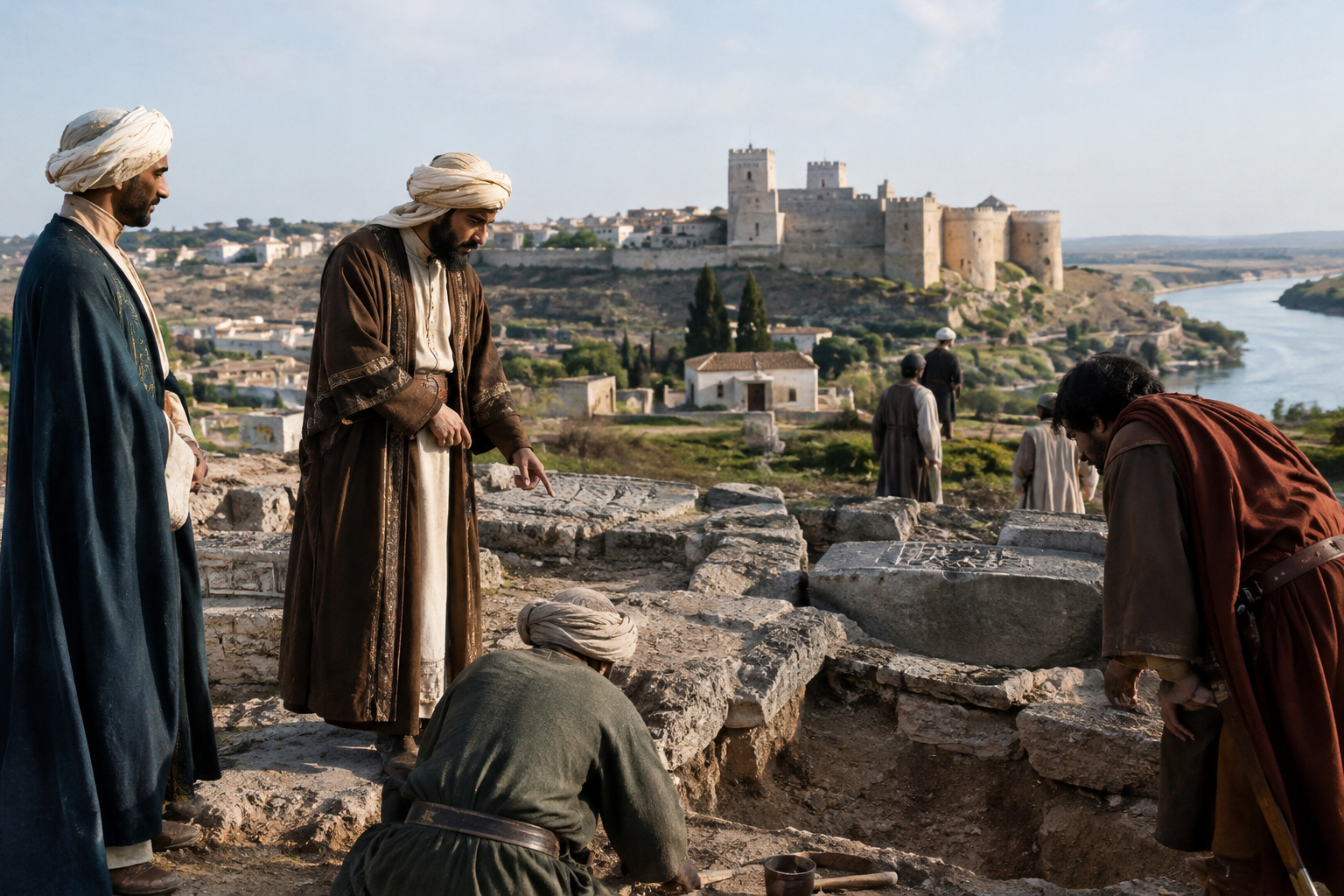
In the cemetery at Santarem in Portugal, one man buried around AD 950 carries an unexpectedly sharp clue to the human history of medieval Iberia. He is identified as LP114_10, recovered from a necropolis associated with the Umayyad period, and his reported Y-DNA assignment connects him with haplogroup J1a2a1a1b. That sounds technical, but the historical setting is anything but abstract: this was a world of frontier politics, Islamic rule, local continuity, and movement across the western Mediterranean.
Santarem matters because it sits in a region where archaeology and history have long shown contact, conquest, and coexistence, but ancient DNA now lets us ask a more precise question about paternal ancestry. A Y-chromosome lineage traces one direct male line only, not a person's whole identity or all of his ancestry. Even so, a find like LP114_10 is valuable because it places this paternal branch in a real burial ground, at a real place and time, within the social landscape of al-Andalus.
By the 10th century, Santarem was part of the Islamic world of western Iberia, though never isolated from its older Iberian foundations or its Christian neighbors to the north. The city, on the Tagus corridor, occupied strategic ground linking inland and coastal routes. That matters for genetics because places like this were not sealed ethnic compartments. They were towns where soldiers, administrators, merchants, farmers, converts, and long-established local families could all leave descendants.
The sample LP114_10 belongs to that setting. We should be careful here: one burial does not stand for an entire city, still less for all Muslim-period Portugal. But it does give us a documented instance of J1a2a1a1b, or an assignment associated with that branch, in a medieval Portuguese context tied to the Umayyad sphere. That alone is historically interesting, because J1 lineages are often discussed in broad connection with populations of the Near East and Arabia, yet ancient DNA reminds us that such lineages were also part of the lived demographic mix of medieval Iberia.
A genetic study examining medieval burials from Islamic-period Portugal has helped illuminate exactly this kind of complexity, placing ancient individuals into the wider population history of the peninsula rather than treating political rule as a simple population replacement. The research context around these burials can be found here: https://genomebiology.biomedcentral.com/articles/10.1186/s13059-025-03707-2.
The haplogroup label in this article is very specific: J1a2a1a1b. That is not the same thing as making claims about every branch of J1 over thousands of years. In popular discussions, parent haplogroups can become rather baggy historical containers, made to carry every migration story at once. Good archaeogenetics works the other way round. It asks what can be shown for this branch, in this sample, at this site, in this period.
With LP114_10, the strongest point is not a grand origin myth but a documented placement in 10th-century Santarem. In historical terms, that opens several plausible contexts: movement from other parts of al-Andalus, connections with North Africa, or continuity within a mixed local population already shaped by centuries of Mediterranean contact. What it does not allow is a neat leap from one paternal line to language, religion, ethnicity, or legal status. A man with this Y-DNA could have belonged to any number of social backgrounds within Umayyad Portugal.
If this seems disappointingly untidy, that is because medieval Portugal really was untidy in the best historical sense. Long before the 10th century, the peninsula had absorbed Roman settlement, late antique mobility, and links across the Strait of Gibraltar. After the Islamic expansion into Iberia, those older layers did not vanish. Instead, new lineages and ancestries entered a population that was already mixed.
This is why a single Santarem burial can be so evocative. It belongs to a period when political maps changed quickly, yet family histories did not reset with each conquest. In practice, Islamic Iberia included people of varied origins: some newly arrived, some descended from earlier local communities, some from families that had moved through North African or wider Mediterranean networks. A paternal lineage such as J1a2a1a1b fits naturally into that kind of world.
That wider background also helps explain why the medieval evidence from Portugal should not be read in isolation. Iberia repeatedly shows the effects of connection rather than purity: Roman towns, Visigothic rule, Islamic polities, Christian expansion, and maritime exchange all left traces. Ancient DNA is increasingly confirming what historians and archaeologists have long suspected: identities could be sharp, but populations were porous.
Santarem's Umayyad-period cemetery belongs to the western edge of a much larger political and cultural zone. The Cordoban caliphate did not simply project authority from a distant capital into an empty province. It operated through fortified towns, agricultural landscapes, river routes, and regional elites whose lives were embedded in local conditions. Western Iberia was peripheral in one sense, but also connected in a very practical one.
For a Y-line like J1a2a1a1b, that matters because western al-Andalus was one of the places where lineages from different historical backgrounds could meet and persist. Some paternal lines may have arrived with people linked more directly to the Islamic expansion or to later trans-Mediterranean movement. Others may reflect longer-standing eastern or southern Mediterranean connections that predated the caliphate. In many cases, the archaeology alone cannot separate those possibilities, and a single sample certainly cannot decide between them. But LP114_10 proves that this paternal branch was present within the burial population of medieval Santarem.
That finding sits neatly beside other recent work on Iberia's diversity under both Roman and medieval regimes. If you want a broader peninsula-wide comparison for how outside connections reshaped local populations without erasing them, the MyTrueAncestry piece on Roman Hispania's Lasting Genetic Legacy is a useful companion.
There is a temptation, when only one ancient sample is available for a haplogroup article, to overcompensate with grand claims. Better to do the opposite. LP114_10 is important precisely because he is specific. He anchors J1a2a1a1b in a medieval Portuguese cemetery associated with the Umayyad world, and that gives members of this haplogroup a historically grounded point of reference.
It also shows the value of archaeology over stereotype. Medieval Muslim Iberia was not a cartoon of uniform newcomers from one origin point. It was a layered society in which ancestry, religion, language, and law did not always line up in simple ways. Ancient DNA, when tied to actual cemeteries like Santarem, helps restore that complexity.
For someone researching haplogroup J1a2a1a1b today, the clearest lesson from Santarem is not that your direct paternal line belonged to one fixed people, but that it could move within the busy, intermixed societies of the medieval western Mediterranean. LP114_10 places this branch, or a closely associated reported assignment, in 10th-century Portugal under Umayyad influence. That is a small piece of evidence, but a vivid one: not a legend, not a modern projection, but a man buried in a known place during a known historical era.

Comments