Haplogroup J1a2

– 5 min read


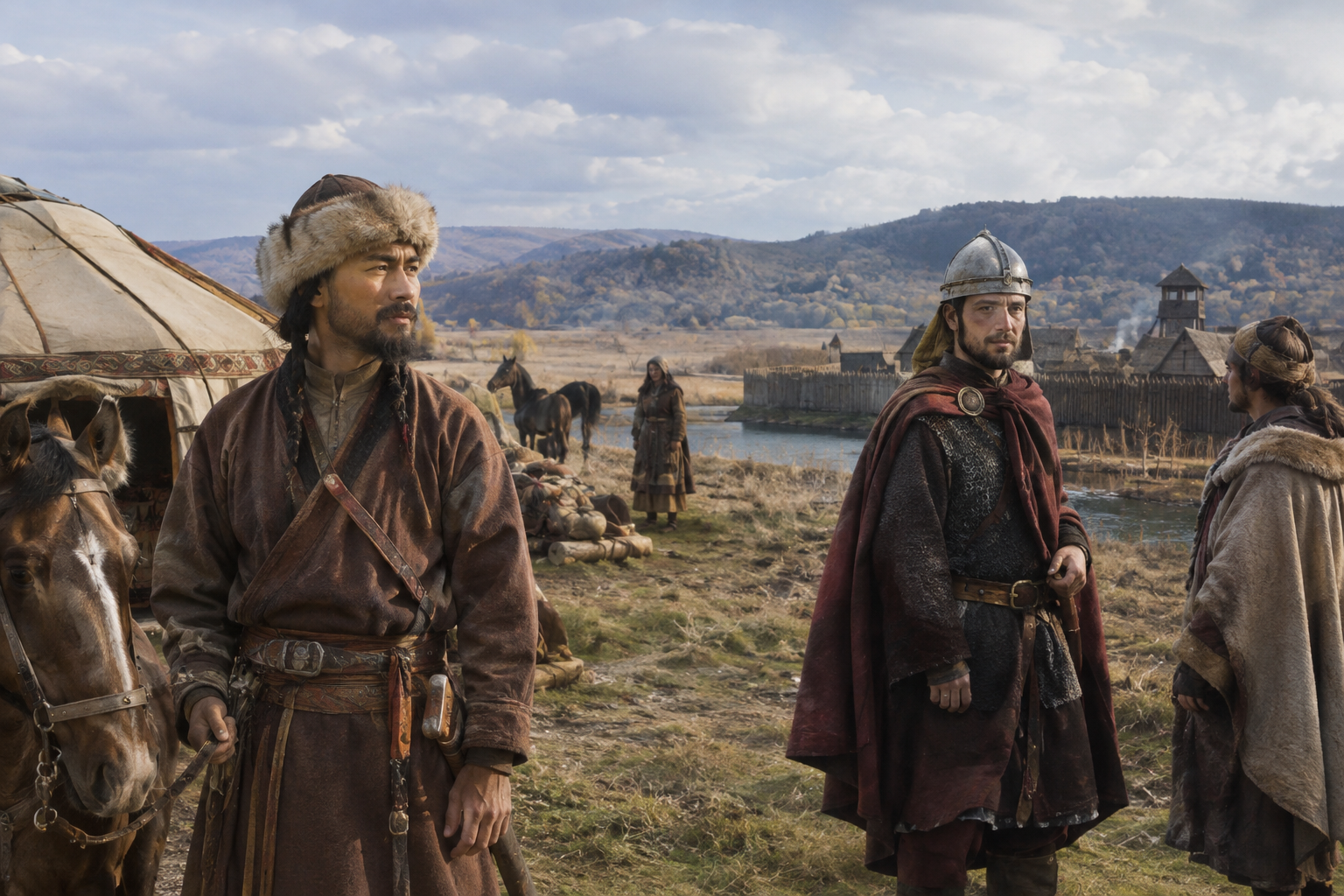
At Rakoczifalva-Szolnok in Hungary, on the old frontier zone between the Byzantine world and the Avar sphere, one ancient man identified as RKF220 was buried around AD 725. That is already an interesting setting in its own right: not a timeless "tribal" landscape, but a politically crowded borderland where armies, merchants, families, and customs crossed paths. For the Y-DNA haplogroup J1a2, this sample matters because it places the lineage in a recognizably connected early medieval world, far from any simplistic idea that a paternal line belongs to only one people or one region.
A second data point comes from much farther east, at the Konyrtobe settlement in Kazakhstan, where DA208 dates to about AD 1750. Two samples do not give us a full map of J1a2, and Y-DNA traces only one direct paternal line rather than a person's whole ancestry. But these two finds do give something more valuable than a modern frequency map alone: they show the branch appearing in very different historical settings across the Eurasian corridor, from an early medieval border cemetery in the Carpathian Basin to an early modern settlement in Central Asia.
J1a2 is a sub-branch within the broader haplogroup J1, a major paternal lineage with a deep history in West Asia and neighboring regions. The important point is that a narrow branch such as J1a2 should not be forced to carry every historical claim ever attached to its parent clade. The ancient evidence here is specific and modest: it shows men associated with J1a2, or reported under that branching framework, in two documented archaeological contexts separated by about a thousand years.
That makes J1a2 historically useful in a very archaeological way. Instead of telling a grand tale about a single migration wave, it invites us to look at contact zones: places where empires met the steppe, where settlement and mobility overlapped, and where paternal lines could travel through service, trade, marriage, or local continuity.
The Hungarian sample RKF220 is the sharper of the two historical snapshots because the setting is so charged. Around AD 725, the Carpathian Basin was still feeling the aftershocks of the Avar period, while Byzantine influence pressed and pulsed along its edges. To find a J1a2-linked male here is a reminder that frontier cemeteries are rarely simple ethnic signposts. They are usually archives of movement.
Even without inventing grave details we do not have, the site label itself tells us a great deal. "Byzantine/Avar Borderlands Hungary" places RKF220 in a zone where political identities, military service, and local community life intersected. A paternal lineage found in such a place might reflect ancestry rooted farther southeast, local incorporation into an Avar-period community, or multi-generational mixing within the basin itself. What it certainly does not justify is a neat equation of J1a2 with one named people.
This is exactly the sort of pattern that ancient DNA has been steadily clarifying in early medieval Europe: borderlands were populated by biologically varied communities, not tidy blocks of descent. A widely discussed ancient DNA study on the region and period, published in Cell, helped underline how much diversity existed across populations connected to the early medieval Eurasian world.
It is tempting, when a lineage associated today with parts of the Near East or Caucasus appears in Hungary, to start drawing bold arrows across the map. Archaeology teaches a sterner discipline. The better reading is that RKF220 belongs to a world in which the Carpathian Basin was entangled with the Balkans, the Pontic steppe, and routes leading still farther east and south.
That makes J1a2 in this context historically plausible and historically interesting. The Avar realm was never an isolated bubble. It sat amid diplomacy, warfare, tribute networks, and population movement, and its cemeteries can preserve paternal lines whose deeper origins lay outside the basin long before the moment of burial. In other words, the sample is important not because it solves everything, but because it documents J1a2 inside a real contact landscape.
The second sample, DA208, comes from the Konyrtobe settlement in Kazakhstan and dates to roughly AD 1750. At first glance this may seem late for an ancient DNA article, but early modern burials are often invaluable because they show which paternal lines remained in circulation after centuries of imperial change, trade, and regional resettlement. Central Asia, after all, is not merely a place of passing nomads in historical imagination; it is also a landscape of durable settlements, irrigated communities, and long-distance exchange.
Konyrtobe sits in a broad historical zone shaped by Turkic polities, Islamic networks, steppe pastoralism, oasis-style lifeways, and connections running toward Transoxiana and beyond. A J1a2-associated male in this setting fits a wider Eurasian reality in which western and southwestern paternal lines could be carried eastward over many generations, then become thoroughly local. By AD 1750, such a lineage need not signal recent migration at all. It may instead represent a much older thread woven into the demographic fabric of the region.
One of the useful things about the Kazakhstan sample is that it stops us from treating J1a2 as a purely Mediterranean or purely Near Eastern story. The evidence points instead to a lineage capable of appearing in communities tied to the steppe world as well as to settled frontier zones farther west.
If we place RKF220 and DA208 side by side, the most striking feature is not continuity in one single culture, but continuity in connected worlds. Hungary's early medieval frontier and Kazakhstan's early modern settlement belonged to different political orders, spoke different languages, and lived under different religious and social systems. Yet both sat within the immense exchange zone of Eurasia, where paternal lineages could persist while identities changed around them.
This is where ancient DNA is at its best. It does not flatten the past into one origin story. It shows that a lineage such as J1a2 can surface in communities that were historically distinct but structurally linked by movement across the steppe, along river corridors, through military frontiers, and within trade systems. Research infrastructures preserving ancient genomic data, including projects connected with ancient DNA sequence archives, have made it easier to compare such finds across vast distances and periods.
For readers with J1a2 today, that is a more sensible historical picture than any claim of exclusive descent from one medieval tribe or one famous dynasty. Your paternal line may well belong to a strand of history that moved through intermediary zones, changed cultural clothing many times, and left traces in places where written labels are frustratingly imprecise.
The ancient evidence for J1a2 here is still sparse, but it is already distinctive. One sample appears in an early medieval frontier cemetery in Hungary, another in an early modern settlement in Kazakhstan. Together they suggest a paternal line at home in the broad historical belt linking West Asia, the steppe, and eastern Europe - not as a slogan, but as an observed archaeological pattern. For someone researching J1a2, that means your direct paternal ancestry may connect less to a single fixed ethnic label than to the long human traffic of Eurasian borderlands and settlements.
Comments