Haplogroup J

– 5 min read


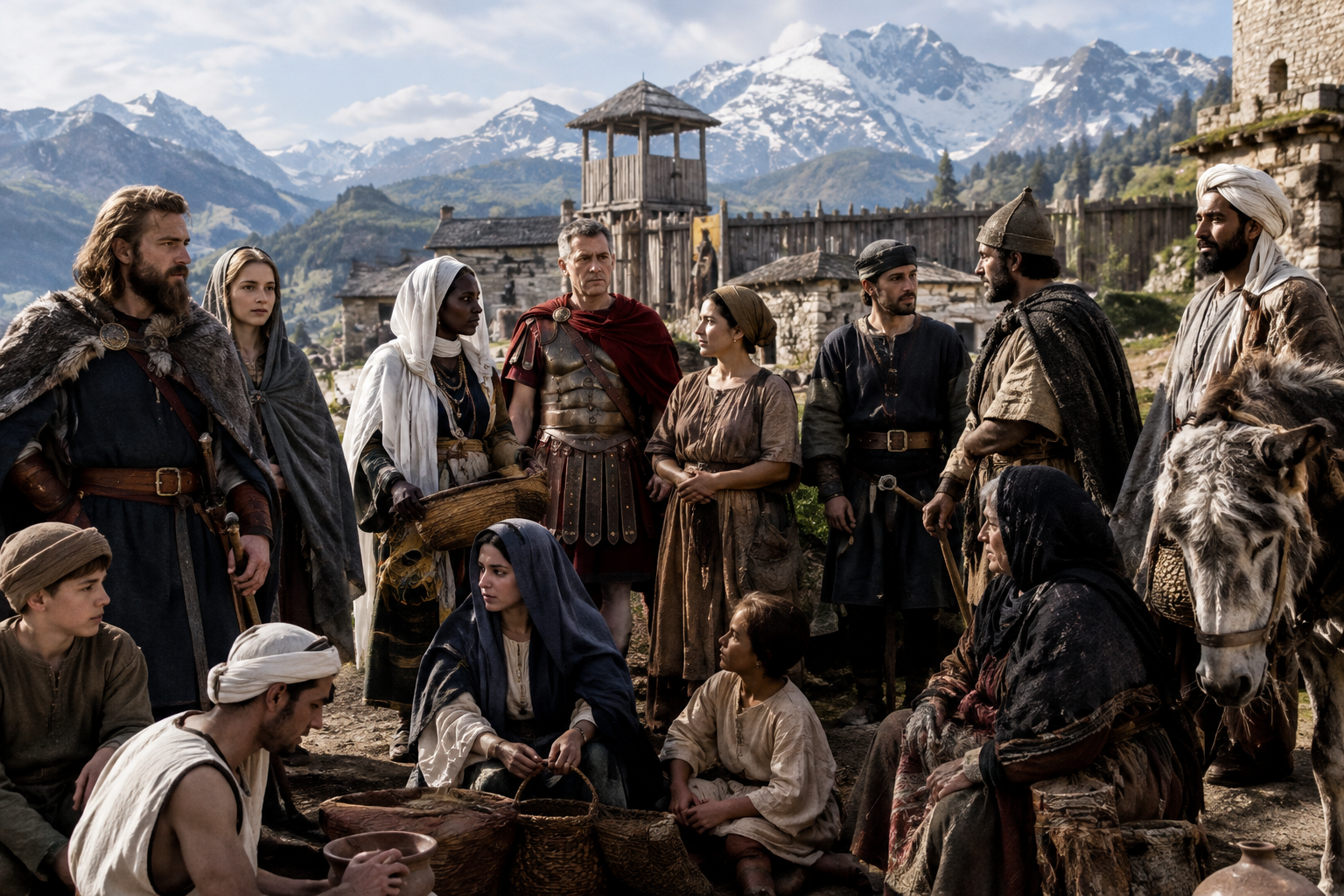
At Malles Burgusio Santo Stefano in South Tyrol, a cluster of men buried between about AD 450 and 650 carried a paternal line reported within haplogroup J: individuals 2419 and 2424 from the earlier phase, and 2423, 2423a, 2423b, 2423c, and 2423d from the later one. That is an arresting pattern, not because it proves a dynasty, but because it places the same broad Y-chromosome branch in a mountain community living through the end of Roman rule and the making of the early medieval Alps.
Haplogroup J is a wide Y-DNA lineage, and that point matters. Y-DNA follows one direct paternal line only, not a person's whole ancestry, language, or identity. Still, when the same broad branch appears in several ancient burials from the same place, and then reappears across the Mediterranean, the Caucasus, Arabia, and parts of Europe, it gives us something very concrete to follow: male-line continuity moving through real historical landscapes.
The South Tyrol series is one of the clearest hints in this set of samples that haplogroup J was not confined to any single "homeland" in the centuries after Rome. The Malles Burgusio Santo Stefano burials sit in an Alpine corridor that linked northern Italy with the transalpine world. In late antiquity and the early Middle Ages, that was not a remote backwater. It was a contact zone of movement, military service, farming communities, and changing political authority.
The repetition is the striking thing here. Sample IDs 2419 and 2424 are dated around AD 450, while 2423 and its associated individuals 2423a, 2423b, 2423c, and 2423d belong around AD 650. Even without turning this into an overconfident family tree, the broad picture is valuable: haplogroup J appears present in the same region across roughly two centuries of upheaval.
An ancient DNA study of people from the Alpine region around the time of the Tyrolean Iceman's wider landscape has helped illuminate how much continuity and mixture the Alps could contain over long periods, rather than fitting a simple tale of isolated mountain populations. See this research on ancient genomes from the Alps for the wider context into which sites like Malles Burgusio now fit.
If Malles shows J in an early medieval frontier society, the older samples point much farther east and much deeper in time. One of the oldest here is I2328 from Neolithic Hajji Firuz in Iran, dated to about 5950 BC. Another, sha004 from Shah Tepe, comes from the Early Bronze Age at about 3250 BC, and I11480 from Shahr-e Sukhteh in southeast Iran belongs to the Bronze Age urban world around 2850 BC.
These are not all the same society, nor should they be collapsed into one tidy narrative. Hajji Firuz belongs to the early farming world of the Zagros and Iranian plateau. Shah Tepe reflects later village and proto-urban developments on the northeastern Iranian plain. Shahr-e Sukhteh, by contrast, was part of the Helmand civilization, tied into long-distance exchange networks reaching across Iran, Central Asia, and the Indus borderlands.
Taken together, though, these samples make an important point about haplogroup J as a broad paternal branch: its history is deeply entangled with the agricultural and urbanizing societies of Southwest Asia. That does not mean every later J lineage came straight from one Iranian source, or that all branches behaved the same way. It does mean that when J turns up later around the Mediterranean and beyond, it already has a very long archaeological backstory behind it.
Some of the most evocative samples in this set come from the eastern and central Mediterranean. Several Late Bronze Age men from Megiddo in Canaan carry J-associated paternal lines: I2190, I10104, I10268, I10266, I2195, and I4525, dating roughly between 1725 BC and 1302 BC. Megiddo was not just any settlement. It was one of the great tells of the Levant, a place of repeated rebuilding, political importance, and regional connectivity.
Then, centuries later, J appears in unmistakably maritime settings farther west. I27075, dated around 300 BC, comes from Phoenician Malaga in Spain. ASH066_ASH_IA1, around 1150 BC, is from Iron Age Ashkelon and identified as Philistine-era. I8208x from Empuries, around 290 BC, belongs to the Greek colonial world of the western Mediterranean. BOG024 from Roman Galatia in Anatolia, dated around AD 225, and zrj003 from Iron Age Azerbaijan show the same broad paternal branch in very different political and cultural settings.
The important historical lesson is not that haplogroup J "belongs" to one famous people alone. Quite the reverse. In these samples it appears in Canaanite, Phoenician, Greek-linked, Roman Anatolian, and Caucasian contexts. That is exactly what one might expect from a paternal lineage long present in the Near East and repeatedly carried through trade, colonization, military movement, and ordinary family life around the Mediterranean basin.
A major ancient DNA study on Ashkelon has been especially important for showing how dynamic the southern Levant could be in the transition into the Iron Age; for that broader setting, see this research on ancient genomes from Ashkelon.
By late antiquity and the Middle Ages, the sample list begins to look almost deliberately unruly. GYS017 from Arrabona in Pannonia, dated around AD 425, places J in the Danubian world of the collapsing western empire. RKF227 from Avar-period Hungary, around AD 625, shows it again in a very different political order. Alh10 from Dark Ages Bavaria, about AD 475, and G37 from Merovingian Lauchheim Mittelhofen in Germany, around AD 700, put J into central European burial populations usually discussed in terms of "Germanic" archaeology.
That is useful precisely because it warns against simplistic ethnic readings of Y-DNA. A haplogroup does not map neatly onto a tribe. The presence of J in Merovingian Germany or Dark Ages Bavaria does not make those communities Near Eastern in any straightforward sense; it shows that paternal lines with deeper roots farther southeast had already become part of European populations shaped by Roman mobility and post-Roman mixture.
Further south and east, I21111 from Soqotra in Yemen around AD 900 and two medieval individuals from Mtwapa on the Kenyan coast, I23551 and I23660, around AD 1600, place the same broad lineage in the Indian Ocean world. Here again archaeology matters. Soqotra and Mtwapa were not isolated curiosities. They were tied into maritime exchange linking Arabia, East Africa, Persia, and South Asia. Haplogroup J appearing in these settings fits a history of movement by merchants, settlers, sailors, and local communities formed through long contact.
Two final samples show just how far one broad paternal branch can travel through time and context. DZ23 from medieval Dzwonowo in Western Pomerania, around AD 1300, places J on the Baltic fringe. ADELE_002_L1, a war victim from Crete dated to AD 1941, brings the story into the modern era, a grim reminder that genetics reaches us not only through famous tombs and ancient cities but also through very recent violence.
And then there is Popovo2 from Archangelsk Russia, dated around 6800 BC. It is such an early and geographically surprising occurrence that it should be handled with caution. Broad assignments at this depth can be difficult to interpret, and one isolated sample should not be forced into a grand migration scheme. But it is a salutary reminder that the prehistoric spread of paternal lineages was rarely simple.
Roman Hispania's Genetic Legacy
For someone researching haplogroup J today, the clearest lesson from these ancient men is not prestige or purity, but reach. This paternal branch appears in early farmers of Iran, Bronze Age Levantine towns, Phoenician and Greek Mediterranean settings, Roman Anatolia, Alpine frontier communities, early medieval central Europe, Arabia, and the Swahili coast. In other words, J is best understood not as the badge of one people, but as one of the durable male lines woven through the long connected history of Southwest Asia and its neighboring worlds.
Comments