Haplogroup I2a2a1b1b

– 5 min read


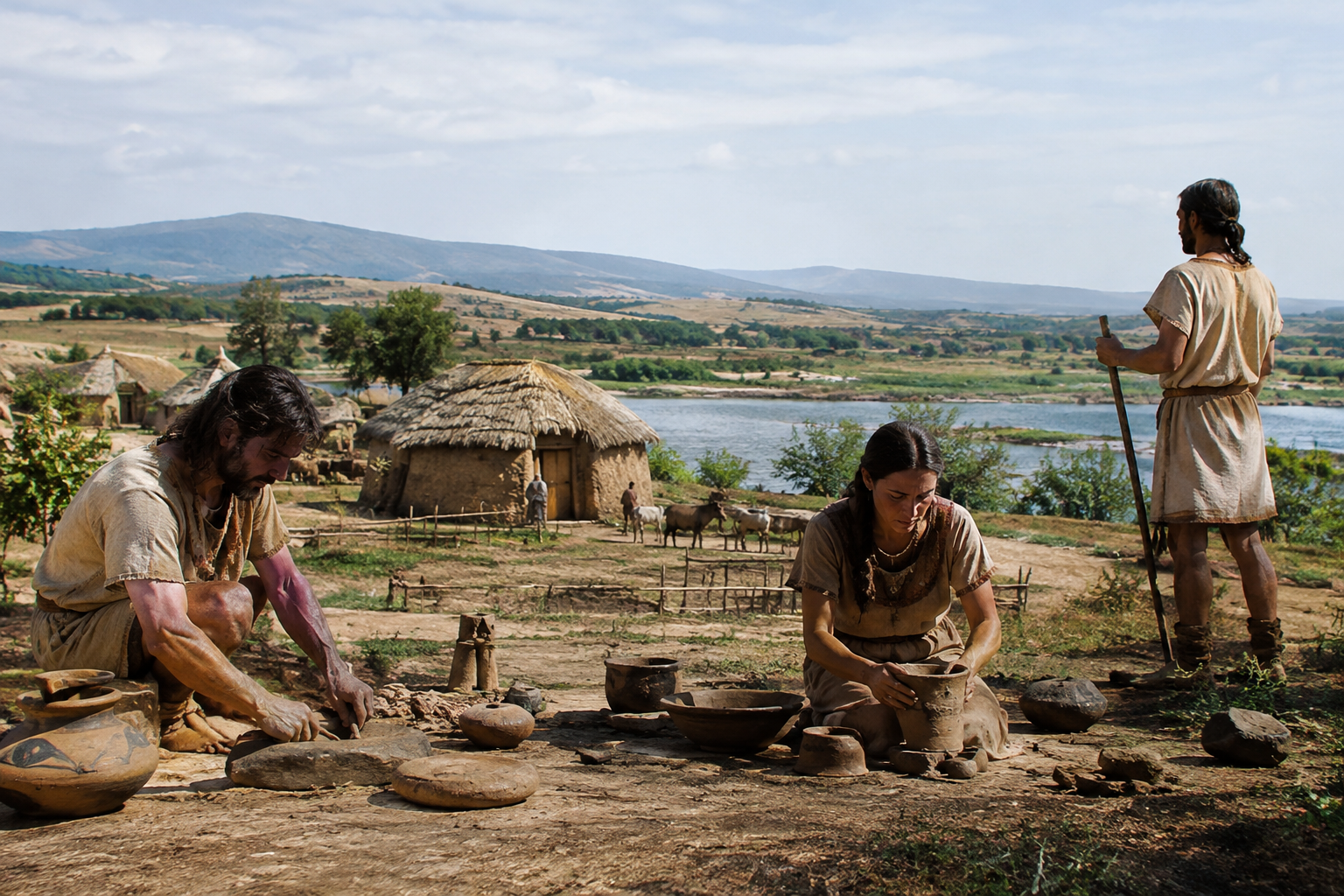
At Mednikarovo in Bulgaria, an Early Bronze Age male labelled Bul4, dated to around 2960 BC, offers one of the clearest ancient anchors for the Y-DNA haplogroup I2a2a1b1b. That may sound like a forbidding string of letters and numbers, but archaeologically it is quite concrete: a man from the Balkans, living at a moment when southeastern Europe was already deeply entangled with new forms of mobility, exchange, and ancestry.
He is not alone. Another ancient male, I2165, from Bronze Age Bulgaria and dated around 3000 BC, points in much the same direction. Taken together, these two Bulgarian finds matter because they place this paternal line in the Balkan world at the threshold of the Bronze Age, where the old farming landscapes of the Neolithic were meeting newer movements of people and ideas from the steppe and beyond. Y-DNA traces only one direct paternal line, not a person's whole ancestry, but even that single line can be historically revealing.
Haplogroup I is one of the great old European Y-chromosome families, with very deep roots in the continent. But the branch discussed here, I2a2a1b1b, is a much narrower twig on that older tree. It should not simply be equated with all of haplogroup I, or with every ancient hunter-gatherer population in Europe. What the Bulgarian evidence gives us is something more specific and more useful: proof that this paternal branch, or a very close reported association with it, appears in southeastern Europe by the opening centuries of the Bronze Age.
That is important because Bronze Age Bulgaria was no sleepy backwater. It sat in a zone where long-established Balkan populations, descendants of early farmers, and incoming groups connected to steppe-related ancestry could all intersect. In that setting, a lineage like I2a2a1b1b is not a tidy ethnic badge. It is better understood as one paternal thread surviving and circulating through a changing population landscape.
An ancient DNA study of southeastern Europe, published in Nature, helped establish just how dynamic this region was over the long run, especially in the periods leading up to and into the Bronze Age. That broader picture makes the Bulgarian samples especially interesting: they belong to a zone where local continuity and outside contact were both part of the story.
The sample Bul4 from Mednikarovo stands out because it comes from a period when the Balkans were already several millennia into settled agricultural life, yet were also beginning to show the demographic changes associated with the Bronze Age. The date, around 2960 BC, places this man near a major turning point. This was after the first spread of farming into Europe, but still early enough that local regional histories had not yet been swallowed by the better-documented kingdoms and empires of later antiquity.
Sites like Mednikarovo matter precisely because they preserve ordinary people in extraordinary times. We are not dealing here with a named king, a literary figure, or a dynastic tomb. We are dealing with a prehistoric man whose Y-chromosome lets us glimpse paternal continuity in a region often discussed mainly in terms of large-scale migration. That is one of the quiet strengths of archaeogenetics: it gives some individuality back to prehistory, even when the names are lost.
The Bulgarian setting also fits a wider pattern seen across prehistoric Europe, where older lineages did not simply vanish when new ancestry arrived. Instead, populations were repeatedly mixed, reshaped, and locally rebalanced. A paternal line present in Early Bronze Age Bulgaria could reflect survival from earlier Balkan populations, incorporation into new social groups, or both.
The second sample, I2165, dated around 3000 BC and also from Bulgaria, strengthens the case that this is not just an isolated occurrence. Two men, from roughly the same broad period and region, make a more persuasive archaeological pattern than a single outlier ever could. The value lies less in dramatic storytelling than in repetition: the branch shows up again, in the same part of the world, at the same historical threshold.
That repetition matters for anyone trying to understand where this paternal line was established in antiquity. It suggests that southeastern Europe, and Bulgaria in particular, was one meaningful early setting for the history of I2a2a1b1b. It does not prove that the lineage originated there, nor that every later carrier descends from these exact men. But it does place the branch firmly in the archaeological record of the ancient Balkans.
Research circulated through bioRxiv contributed to the emerging genomic picture of prehistoric populations in this wider region and period. Even without turning every sample into a miniature biography, such studies help show how paternal lines were embedded in real communities undergoing change.
It is tempting to imagine Bronze Age Bulgaria as a border between worlds, but crossroads is the better word. To the north and northeast lay the grasslands and steppe corridors linked to major prehistoric expansions. To the south lay the Aegean. To the west and northwest stretched the inner Balkans and the Danube routes. Communities in this zone were not merely receiving influences; they were participating in a dense network of exchange and human movement.
That makes the presence of I2a2a1b1b especially instructive. A lineage in such a place may have been carried forward through communities that were culturally mixed, mobile to varying degrees, and connected to several spheres at once. In other words, this is exactly the sort of setting where simplistic equations between a haplogroup and a single people break down.
Later Balkan history would, of course, become full of named populations, empires, and languages. But these Early Bronze Age samples predate those labels by a very long way. The men behind Bul4 and I2165 should therefore be understood first as prehistoric inhabitants of the Balkan world, not as placeholders for later ethnic categories retrofitted into deep time.
For members of the MyTrueAncestry community, the appeal of a haplogroup article is often personal: where was this line in the ancient world? In the case of I2a2a1b1b, the strongest evidence supplied here points to a real and early presence in Bronze Age Bulgaria. That is a useful historical clue because it places the lineage in southeastern Europe during a formative period of population change, rather than only in much later medieval or modern records.
It also highlights something rather attractive about ancient DNA: sometimes the most revealing evidence is not a famous burial but a repeated signal from modest archaeological contexts. Two ancient Bulgarian males, Bul4 and I2165, do not give us a royal pedigree or a saga. They give us something sturdier: a grounded prehistoric context for one paternal branch.
Anyone carrying this haplogroup today should read that evidence with both interest and caution. It suggests that one stretch of your direct paternal line was present in the Balkans by around 3000 BC, in communities living through the transition into the Bronze Age. That is not your whole ancestry, but it is a genuine fragment of deep history - and a remarkably old one.
The clearest story for I2a2a1b1b begins, at least for now, in Early Bronze Age Bulgaria. With Bul4 from Mednikarovo and I2165 from Bronze Age Bulgaria, this lineage appears in a region that was already a meeting place of old Balkan populations and newer demographic currents. That makes it less a badge of one fixed identity than a surviving paternal thread woven through one of prehistoric Europe's most important crossroads.






Comments