Haplogroup I2a2a1b
– 5 min read


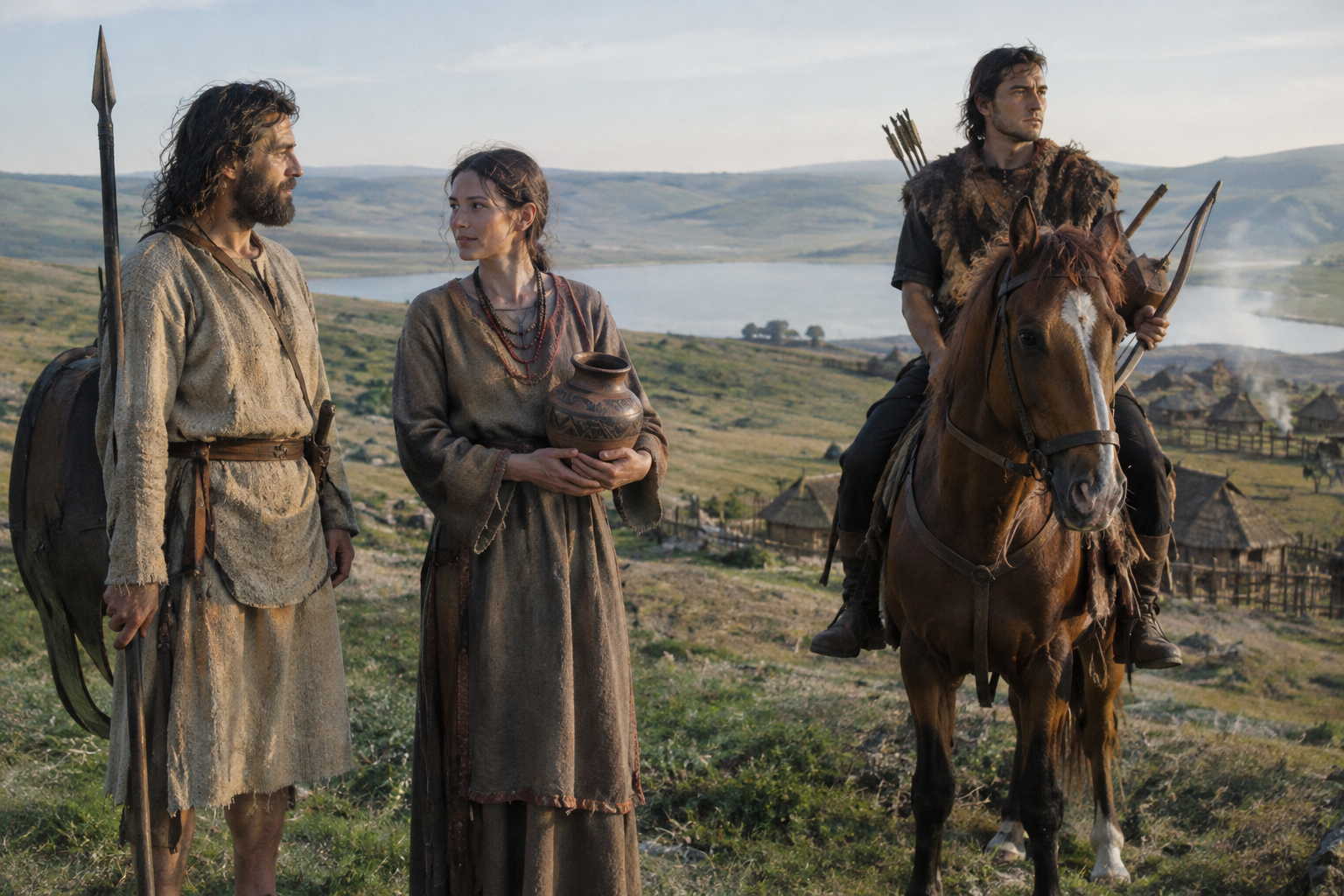
In the early Bronze Age layers of Bulgaria, one male individual labeled I2176 stands out not because we know his name or his possessions, but because his Y-chromosome points to a paternal line now identified here as I2a2a1b. Dated to around 3100 BC, he belongs to a moment when the Balkans were no quiet backwater. This was a zone where long-settled farming communities, surviving hunter-gatherer ancestry, and incoming steppe-related populations were all meeting, mixing, and reshaping the human map of Europe.
That makes I2a2a1b especially interesting. Y-DNA tracks one direct paternal line only, not a person's whole ancestry, but even so it can reveal which male lineages persisted through upheaval. In the evidence gathered here, this branch appears in at least three Bronze Age individuals from Bulgaria and Ukraine: I2176, I2441 from Bronze Age Dzhulyunitsa in Bulgaria, and ILK001, a Bronze Age horserider from Ilyatka in Ukraine. Taken together, they place this paternal line in the broad world north and west of the Black Sea during a transformative age.
The earliest of the three, I2176 from Bulgaria, belongs to the centuries when older Neolithic and Copper Age traditions had already been badly disrupted and new population patterns were emerging. By about 3100 BC, the Balkans had experienced millennia of farming life, but they were also increasingly entangled with movements of people carrying steppe-related ancestry from the north and northeast.
That is the important setting for a lineage like I2a2a1b. Haplogroup I is one of Europe's old paternal macro-lineages, with deep roots in prehistoric Europe, but a specific subclade such as I2a2a1b should not be treated as a shorthand for all of that vast history. What the Bulgarian sample suggests, more modestly and more usefully, is that one branch of this wider paternal family was still present among men living through the early Bronze Age transition in southeastern Europe.
A major ancient DNA study of southeastern Europe helped establish just how dynamic this region was during prehistory, showing long-term interaction between local Balkan populations and newcomers from the steppe in research on ancient individuals from the region. Even without claiming more than the evidence allows for sample I2176 specifically, that wider context matters: this was a world of population turnover, but not simple replacement. Older male lines could survive, adapt, and continue within newly mixed communities.
The second Bulgarian individual, I2441, is dated to around 2800 BC at Dzhulyunitsa. That date places him slightly later than I2176 but still within the same broad era of transition, when communities in the Balkans were absorbing deep changes in economy, mobility, and ancestry. Dzhulyunitsa is significant because it belongs to a landscape with long prehistoric occupation, making any Bronze Age male lineage there part of a much longer local story.
What I2441 adds is repetition. One isolated Y-DNA result can always be a curiosity. Two results from Bronze Age Bulgaria, separated by time and archaeological setting, begin to suggest that the paternal branch represented here was not merely a fleeting arrival but part of the region's lived demographic reality.
That does not mean all Bronze Age Bulgarians belonged to I2a2a1b, still less that one lineage defined a people or a language. But it does sharpen the picture. In the Balkans, continuity and change sat side by side. Some paternal lines associated with older European roots remained present even as ancestry connected with the Pontic-Caspian steppe spread into the region.
The Balkans keep producing precisely this sort of complexity in ancient DNA: not a neat replacement tale, but a human landscape built from overlap, persistence, and recombination.
The third sample, ILK001, comes from Ilyatka in Ukraine and is dated to about 2800 BC. He is described as a Bronze Age horserider, and that label alone places him in a very different social and geographic setting from the Bulgarian individuals. Here we are farther into the steppe-facing world, where mobility mattered enormously and where innovations tied to herding, wagons, and eventually horse management transformed daily life.
ILK001 is valuable because he shows that the same paternal branch, or at least a lineage reported in connection with this article's branch, appears not only in the Balkans but also in the north Pontic zone. That broadens the map. I2a2a1b was not confined to one valley or one settlement tradition. It belonged to a wider interaction sphere stretching between the lower Danube and the grasslands beyond.
Research on populations of the north Pontic and steppe-adjacent regions has emphasized just how entangled these communities were during the late Neolithic and Bronze Age in a genetic study of ancient populations from this wider zone. The significance for ILK001 is not that he can be turned into a mascot for all steppe peoples, but that his paternal line helps show how older European and steppe-connected histories met on the ground, in actual men buried in actual places.
It is tempting to ask whether I2a2a1b was "Balkan," "steppe," or something even more sharply defined. Ancient DNA rarely rewards such tidy labels. The broader haplogroup I has deep prehistoric roots in Europe, and branches of I2 are well known from hunter-gatherer and later farming-era contexts. But by the Bronze Age, lineages had already passed through thousands of years of movement, survival, loss, and reappearance in new populations.
So the safest interpretation is also the most historically interesting one. I2a2a1b appears here as a paternal line present among Bronze Age men living in contact zones: Bulgaria on one hand, Ukraine on the other. That pattern fits a world in which male lines with deep European antecedents persisted into societies being reshaped by new migrations and new ways of life.
In other words, this haplogroup is not a badge of a single tribe or ethnicity. It is evidence of survival through transition. And that can be more revealing than a simpler origin myth.
One of the most useful things about these three samples is that they resist the habit of putting archaeological regions into sealed boxes. Bronze Age Bulgaria is often discussed through the lens of southeastern Europe; Ilyatka in Ukraine belongs more naturally to north Pontic narratives. Yet men carrying this paternal branch appear on both sides of that divide.
That matters because the lower Danube and the Black Sea hinterlands were linked by movement for millennia. Goods, marriage networks, seasonal herding routes, and population shifts all crossed these supposed borders. Y-DNA cannot by itself tell us whether I2176, I2441, and ILK001 shared recent paternal kinship, and there is no basis for claiming that they did. But their presence in connected regions suggests that I2a2a1b belonged to the human traffic of this corridor, not to an isolated pocket.
The same lesson keeps turning up across prehistoric Europe: local continuity and long-distance mobility were not opposites. They often happened together.
North Pontic ancestry and migration
For someone exploring a present-day paternal line in I2a2a1b, the clearest ancient signal here is not royal glamour or a single founding hero. It is something more durable: this branch appears in the archaeological record of the Bronze Age Balkans and north Pontic region, among men living through one of Europe's great prehistoric reshufflings. The evidence points to a paternal line that endured in mixed, mobile, and changing societies rather than disappearing when new ancestries arrived.
That is a solid and rather compelling inheritance. It places this lineage in the thick of early Bronze Age southeastern Europe, where continuity and migration were woven together in the lives of real communities.
Comments