Haplogroup I2a2a1a

– 5 min read


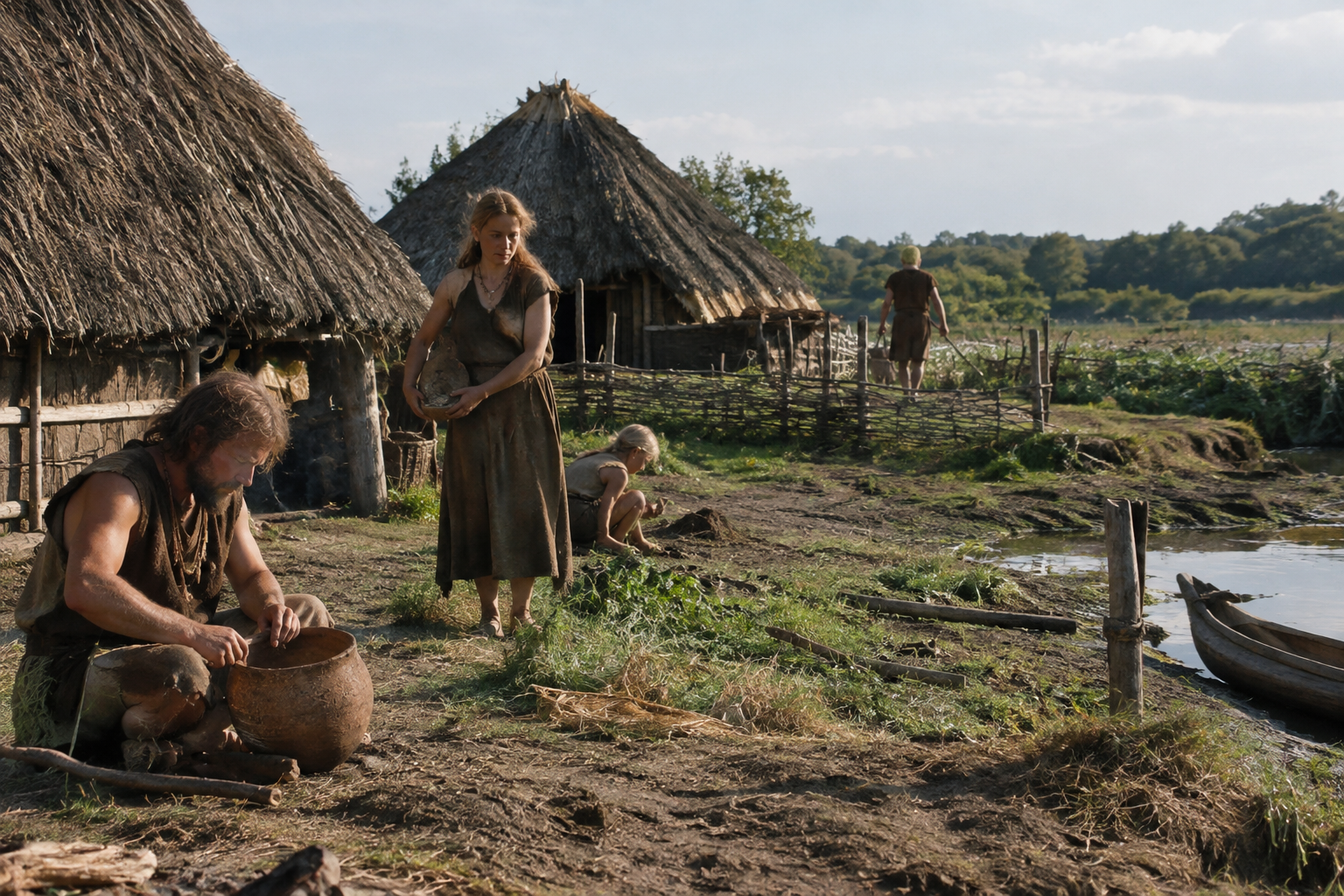
One of the earliest signposts for Y-DNA haplogroup I2a2a1a in the ancient record comes from Sorsum in Germany, where an individual identified simply as Sorsum has been dated to around 3220 BC. That is an arresting date. It places this paternal line not in the age of medieval surnames or historical kingdoms, but in the later Neolithic world of central Europe, when farming communities were long established and new social and genetic mixtures were reshaping the continent.
That matters because I2 lineages have very deep roots in prehistoric Europe, yet any one narrow branch such as I2a2a1a has to be handled carefully. A Y-haplogroup traces one direct paternal line only, not a person's whole ancestry, language, or identity. Even so, a find like Sorsum is valuable: it gives this branch a firmly ancient foothold in north-central Europe, and it places it in a period when local hunter-gatherer ancestry and incoming farming ancestry were still being recombined in different ways from region to region.
Sorsum lies in Lower Saxony, a region that would later sit within many of the great historical traffic routes of northern Europe, but in the fourth millennium BC it belonged to a very different map of longhouses, fields, woodlands, and burial grounds. The date around 3220 BC places the Sorsum individual in a world after the first spread of agriculture into central Europe, yet before the fully developed Bronze Age societies that would later dominate the same ground.
For haplogroup I2a2a1a, that is precisely the sort of context that makes ancient DNA interesting. This is not evidence of an isolated "tribe of I2 men," nor a neat ethnic label. It is evidence that one paternal branch associated with the broader I2 family was present in a mixed and changing Neolithic population in what is now Germany. In plain terms, the lineage was already part of the human landscape there more than five thousand years ago.
A major ancient DNA study on prehistoric populations of the region, available through this research publication, helped show how central and northern Europe were shaped by repeated population interactions rather than by a single simple replacement. That wider background is essential for understanding a sample like Sorsum: the man carried one paternal line, but he lived in a society formed by many ancestral threads at once.
The wider haplogroup I is one of the best-known old European Y-chromosome families, with branches found in ancient foragers and later farming-period and Bronze Age populations. But it would be a mistake to pour the entire prehistory of haplogroup I into the narrower label I2a2a1a. The ancient sample from Sorsum gives us something more modest and more solid: this particular paternal branch, or a classification associated with it, appears in prehistoric Germany by the late Neolithic.
That is a useful distinction for family historians. If your direct paternal line falls under I2a2a1a, ancient DNA does not tell you that your ancestors belonged to one named people, spoke one language, or followed one migration route. What it does suggest is that your paternal line belongs to a branch with a demonstrable presence in ancient Europe, including central European communities living thousands of years before written history.
In archaeology, modesty is often more interesting than overstatement. A single Y-line can persist through enormous cultural change: new pottery styles, new burial customs, new languages, new political worlds. The line stays, but the societies around it alter dramatically.
One reason the Sorsum finding deserves attention is geographical. Northern and central Germany were never static backwaters in prehistory. They formed part of a broad corridor linking the North Sea zone, the North European Plain, the Rhine basin, and the uplands farther south and east. A paternal lineage found here in 3220 BC sits in a region that would repeatedly absorb and transmit people, practices, and genes.
That wider pattern has become clearer as more ancient genomes have been published from Germany and neighboring regions. The story is not one of tidy blocks of population, each replacing the last without residue. Instead, the evidence points to continuity in some lines, sharp change in others, and repeated local mixtures. A haplogroup such as I2a2a1a fits very naturally into that kind of picture: persistent enough to survive, but carried by communities whose overall ancestry and cultural setting could change substantially over time.
This is also why later historical maps should not be projected backward too confidently. A lineage present in Neolithic Lower Saxony is not automatically "Germanic," "Celtic," or anything else defined by much later language and identity. The man from Sorsum lived far too early for such labels to do much explanatory work.
If there is a larger lesson in this small body of evidence, it is that paternal continuity can outlast archaeological periods. The late Neolithic gave way to the Bronze Age, then the Iron Age, then Roman frontiers, post-Roman kingdoms, and medieval lordships. Yet some Y-chromosome branches clearly endured across these transformations, passing from father to son through social worlds that would have looked utterly different from one another.
That long persistence is particularly relevant in the German lands, where later ancient DNA studies have revealed mobility, mixture, and changing population structure rather than a single immutable ancestry. Early medieval cemeteries, for example, often show that local continuity existed alongside newcomers and long-distance movement. That broader lesson helps frame the significance of a much earlier sample like Sorsum: by the time written sources begin, some paternal lines had already been present in the region for millennia.
The result is not a straight-line pedigree from one excavated skeleton to any modern tester. It is something more historically useful: proof that the branch belonged to real ancient communities in Europe and was already embedded in the demographic history of Germany deep in prehistory.
Readers sometimes expect haplogroup history to arrive as a parade of famous kings or richly furnished graves. But archaeology often works differently. A single securely dated ancient individual can matter enormously, especially for a paternal branch whose early record is still thin. The Sorsum sample anchors I2a2a1a in time and place: late Neolithic Germany, around 3220 BC.
That anchor helps in two ways. First, it shows that this branch was part of the prehistoric population structure of Europe long before historical dynasties. Second, it reminds us that the survival of a Y-line says nothing simple about prestige or power. Many paternal lines persisted because ordinary communities persisted: farmers, households, and local kin groups carrying forward one strand of ancestry among many.
For anyone exploring I2a2a1a today, the most responsible conclusion is also the most intriguing. Your direct paternal line belongs to a branch with a documented presence in ancient Germany in the late Neolithic, in a world shaped by both continuity and change. That does not give you a single tribal badge, but it does place your lineage within the deep human history of prehistoric Europe.

Comments