Haplogroup I2a1b1a2b1a2e

– 4 min read


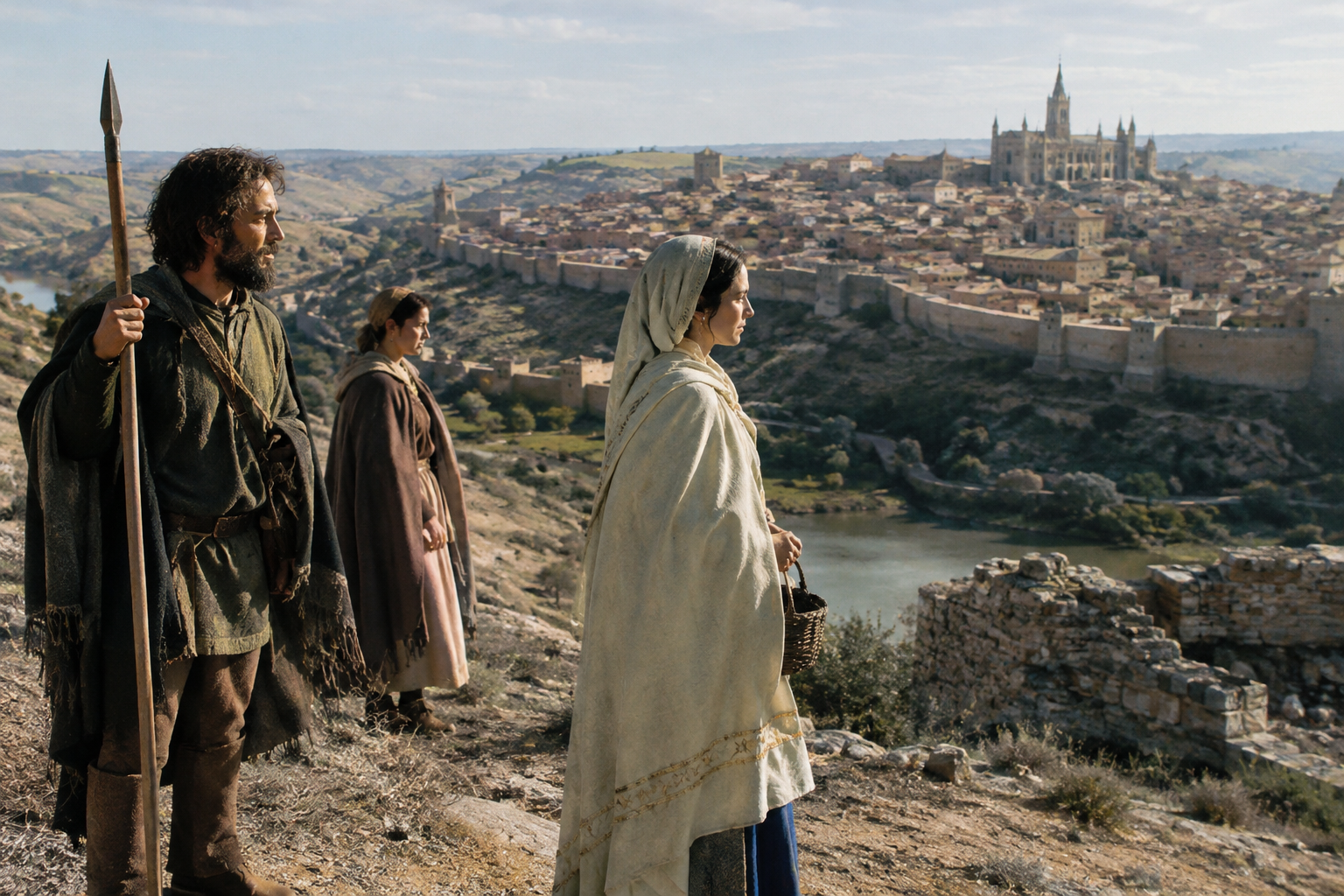
At Illescas Boadilla near Toledo, an early medieval man identified as I19904 offers a small but telling glimpse into post-Roman Iberia. He lived around AD 600, in a period when central Spain was no longer Roman in government yet still deeply shaped by Roman roads, Christian institutions, and the long afterlife of empire. His reported Y-DNA assignment is I2a1b1a2b1a2e, a very specific paternal branch within the wider haplogroup I2.
That matters because early medieval Spain was not genetically simple, and neither were its identities. A Y-chromosome line traces only one direct paternal line out of many ancestral lines, but it can still be historically revealing when it turns up in a securely dated burial. In this case, the interest lies not in a grand royal pedigree, but in seeing a fine-grained paternal lineage present in the Toledo region at the moment when Roman Hispania had given way to Visigothic Iberia.
Toledo was one of the great political and ecclesiastical centers of early medieval Iberia. By the 6th and 7th centuries it stood at the heart of the Visigothic kingdom, hosting church councils and royal power while also preserving much older layers of settlement and population. A man buried nearby at Illescas Boadilla therefore belongs to a landscape where local continuity and wider mobility met each other.
Sample I19904 should not be turned into a stereotype: not a "Visigoth" in the crude old sense, not a spokesman for all of central Spain, and not proof of one migration story by himself. What he does show is that the paternal branch I2a1b1a2b1a2e, or a reported assignment to that branch, was present in the Toledo area in the early medieval centuries. In archaeology, one securely placed person is often more useful than a hundred sweeping claims.
The important thing here is scale. I2a1b1a2b1a2e is not the same thing as the whole of haplogroup I2, which is a broad European paternal family with deep prehistory and many branches spread across different regions and periods. The narrower label points to a much more specific twig on that tree, and we should resist the temptation to assign to it every movement ever associated with I2 as a whole.
Still, the broader context is helpful. Haplogroup I is one of the old paternal lineages of Europe, and branches of I2 appear repeatedly in ancient European remains from later prehistory onward. By the early Middle Ages, an I2-derived lineage in Iberia is perfectly plausible within the mixed population history of the peninsula: indigenous Iberian roots, Roman-era mobility, and the movements of the migration period all belong to the background.
A useful recent framework for thinking about this comes from research on ancient Iberian populations published in a large genetic study of the peninsula. Even without forcing one sample into an oversized narrative, that kind of work makes clear that Iberia after Rome was a place of continuity blended with newcomers, rather than a blank slate replaced by a single people.
There is a reason finds from the Toledo-Madrid zone are so interesting. Central Iberia sat at a crossroads between north and south, plateau and river valley, old Roman urban networks and emerging early medieval power centers. A burial near Toledo is therefore not marginal evidence. It comes from one of the places where political authority and population mixture were most likely to leave detectable traces.
That broader regional picture is strengthened by other early medieval work from the center of Spain, including evidence for varied origins among 7th-century burials near Madrid. Taken together, such results push against older ideas that imagined neat ethnic blocks on a map. Ancient DNA keeps showing what archaeology has long suspected: communities were made up of people with different family histories living under the same political world.
AD 600 is a wonderfully awkward date, historically speaking. It is after the fall of Roman imperial administration in the West, but far too early for the later Islamic transformation of much of Iberia. The people of this period lived among Roman inheritances: roads, town sites, Christian institutions, farming regimes, and habits of burial and authority shaped over centuries.
That is why a lineage like I2a1b1a2b1a2e in early medieval Toledo should be read against long continuity rather than dramatic replacement. Central Spain had already absorbed centuries of movement under the Roman Empire, from soldiers and settlers to slaves, traders, and local families shifting position within imperial structures. Then came the post-Roman centuries, with new elites and new political labels layered onto that existing population.
In practical terms, this means that the paternal line of I19904 could represent a lineage already established in Iberia before the 6th century, a branch introduced through earlier Roman-era mobility, or one associated with later movements in the post-Roman world. With the evidence presently in hand, the honest answer is not to pick one story too quickly. The strength of the sample lies in its date and place, not in overconfident biography.
There is a tendency in public discussions of ancient DNA to think only huge cemeteries matter. In fact, a single named individual can be historically important when the context is clear. I19904 anchors this paternal branch in early medieval central Spain with more precision than modern surname lore or family legend ever could.
That precision is especially valuable for people exploring paternal ancestry today. If your line falls within I2a1b1a2b1a2e, this sample does not tell you that your family was "Visigothic," "Roman," or "Toledan." But it does place this branch, or a reported assignment to it, in the lived human landscape of central Iberia around AD 600. That is exactly the sort of solid foothold from which more careful historical reconstruction begins.
The most distinctive thing about I2a1b1a2b1a2e, on the evidence here, is not some sweeping tale of conquest. It is its presence in an early medieval burial from the Toledo region, at a moment when Iberia was carrying Roman inheritances into a new political age. For anyone researching this paternal line, that is a reminder that ancestry often survives not as a heroic legend, but as continuity through upheaval: one father-to-son thread running quietly through centuries of change.
Comments