Haplogroup I2a1b1a2b1a1a4

– 4 min read


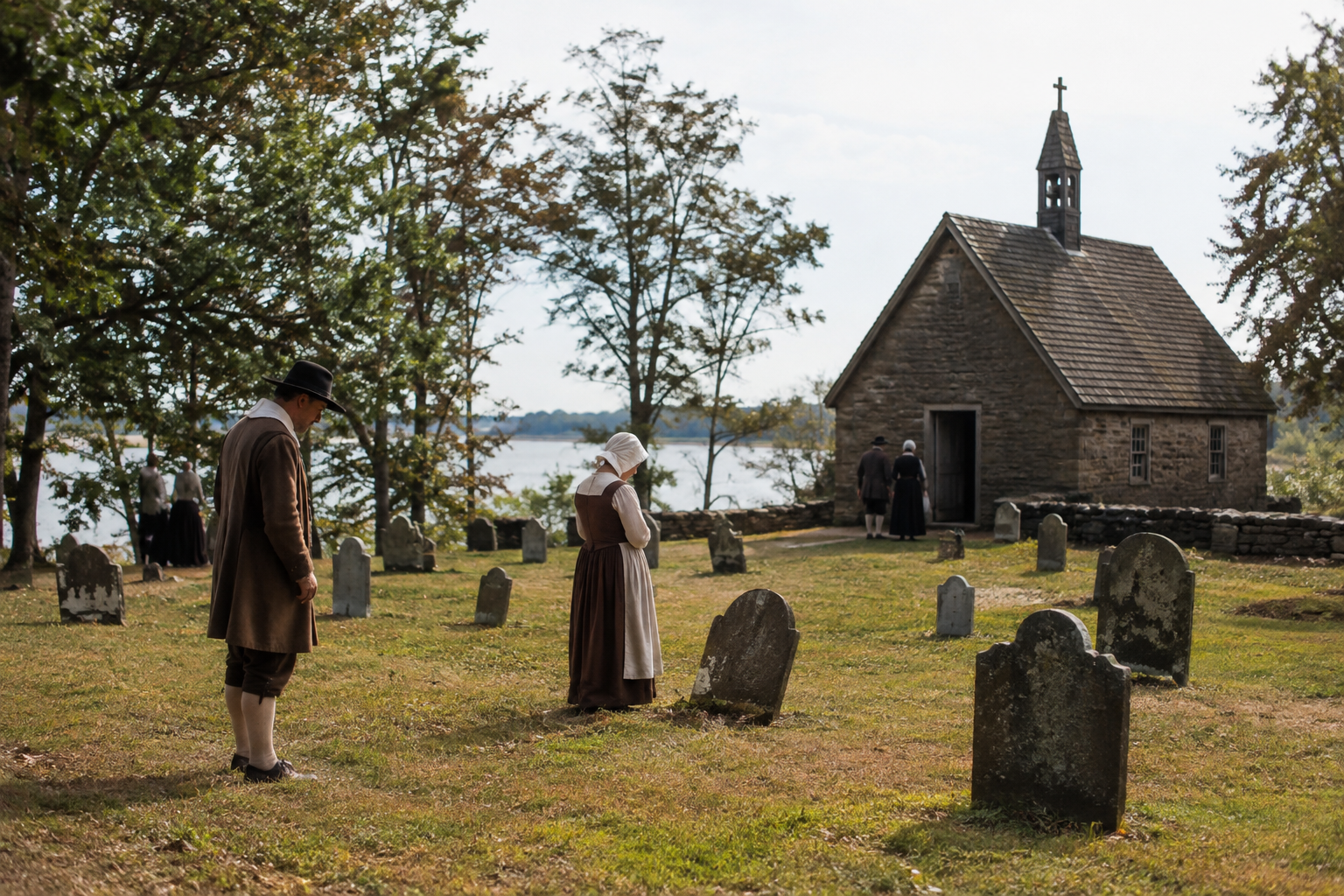
In the chapel cemetery at Historic St. Mary's City in Maryland, one excavated individual, sample I15318, offers a strikingly specific glimpse of an early colonial paternal line. Dated to 1667 AD and buried in the field cemetery associated with St. Mary's chapel, he belongs to the Y-DNA haplogroup I2a1b1a2b1a1a4, a very narrow branch within the broader European haplogroup I2.
That matters because this is not some hazy prehistoric marker floating free of history. It appears here in a documented 17th-century colonial setting: one man, one burial ground, one fragile moment in the making of English America. Y-DNA follows a direct paternal line only, not a person's whole ancestry, but even that single line can anchor a family story in a real archaeological landscape.
Historic St. Mary's City was the first colonial capital of Maryland, founded in the 1630s and active through the 17th century. Its cemeteries preserve not only the expected traces of a small colonial society, but also the demographic complexity of that world: settlers, kin groups, laborers, migrants, and people whose lives crossed the Atlantic in very different circumstances.
Sample I15318 comes from the chapel field cemetery, a Christian burial ground in that colonial setting. The importance of the find lies less in any single dramatic grave feature than in the fact that a specific paternal lineage can now be placed in early Maryland with archaeological confidence. A recent ancient DNA study of the site, discussed in research on the genetic legacy of 17th-century St. Mary's City, has helped show how much biological diversity was already present in this early capital.
For a lineage like I2a1b1a2b1a1a4, this kind of context is invaluable. The branch itself is so fine-grained that its meaning comes not from grand civilizational claims, but from where and when it appears. Here, that appearance is in a 17th-century colonial cemetery tied to one of the earliest durable English settlements in the Chesapeake.
The long name tells you something immediately: this is a downstream branch, deep inside the family tree of haplogroup I2. The broader I2 lineage is one of Europe's old paternal clades, with a complicated history that stretches back far before written records. But one must be careful here. The ancient depth of haplogroup I2 as a whole does not automatically explain the precise history of the much narrower branch I2a1b1a2b1a1a4.
What we can say responsibly is that this branch was carried by at least one man buried in colonial Maryland in the later 1600s. In practical genealogical terms, that places the lineage in the stream of Atlantic-world movement shaped by English colonization, maritime migration, and the reshuffling of populations around the North Sea and the British Atlantic.
That does not mean the line was "English" in some simple ethnic sense. Early modern colonial populations often included people with ancestry from England, Ireland, Wales, Scotland, continental Europe, and beyond. A Y-line can travel through language shifts, political changes, and repeated migration without changing its own underlying paternal signature.
There is a temptation, when faced with a highly resolved Y-DNA branch, to tell a neat story about a single origin point and a single route. Real history is usually messier. By 1667, Maryland sat inside a wide network of movement linking parish communities in the British Isles, port towns in England, merchants, indentured labor systems, and expanding plantations along the Chesapeake.
A burial like I15318 belongs to that world. Whether this man was locally born or an immigrant cannot be assumed from the haplogroup alone. Yet the archaeological setting lets us say something more grounded: this paternal line had become part of a colonial society that was already settling its dead in consecrated Christian ground and creating the institutional rhythms of parish life.
That is one reason colonial aDNA is so powerful. It moves us away from abstractions like "settler stock" and back toward individual people in known places. A branch such as I2a1b1a2b1a1a4 is no longer just a code on a modern test result; it is attached to a man who lived and died in the formative decades of Maryland's history.
At first glance, a single ancient sample may seem slight evidence for an article about a haplogroup. In fact, single well-contextualized finds are often where good history begins. They keep us honest. Instead of projecting sweeping claims onto a lineage, we start with what is actually in the ground.
With I15318, the secure point is a 17th-century chapel cemetery in Maryland. That immediately places the branch in a society created by migration, religion, land hunger, labor demand, and imperial ambition. It also suggests why colonial cemeteries are becoming so important to family historians: they bring named or datable communities into dialogue with paternal-line testing in a way that prehistoric finds often cannot.
The wider lesson is that lineages do not only belong to remote prehistory. They remain historically active. A branch that once passed quietly through medieval and early modern generations can surface in a colonial burial and suddenly become legible again through archaeology and genetics together.
Because the burial is in an English colonial context, the most cautious historical reading points toward the population streams feeding the Chesapeake from the British Atlantic world. That includes England above all, but also neighboring regions whose people entered English colonial networks. The paternal branch may have reached Maryland through any number of family histories before ending up in St. Mary's City.
This is where broad regional studies help with background, even when they do not identify this exact terminal lineage. Work on migration and language spread around northern Europe has shown just how entangled biological and cultural histories can be, especially in the North Sea zone and its colonial extensions.
Germanic-language spread and genomes
Still, caution is the watchword. It would be too much to claim that I15318 proves a specific medieval ethnic identity, a direct link to one named kingdom, or a route from some particular prehistoric community. What it does give us is a fixed historical foothold: this branch was present among the men of early colonial Maryland.
If your paternal line belongs to I2a1b1a2b1a1a4, the most useful insight from this evidence is not a romantic tribal label but a documented historical setting. This branch is attested in sample I15318 from the St. Mary's chapel field cemetery in Maryland, around 1667 AD, showing that the lineage was present in the colonial Chesapeake during the 17th century. For descendants, that makes the haplogroup part of a story about migration, settlement, and the making of early America, not just an abstract position on a tree.




Comments