Haplogroup I2a1b1a2a2a

– 4 min read


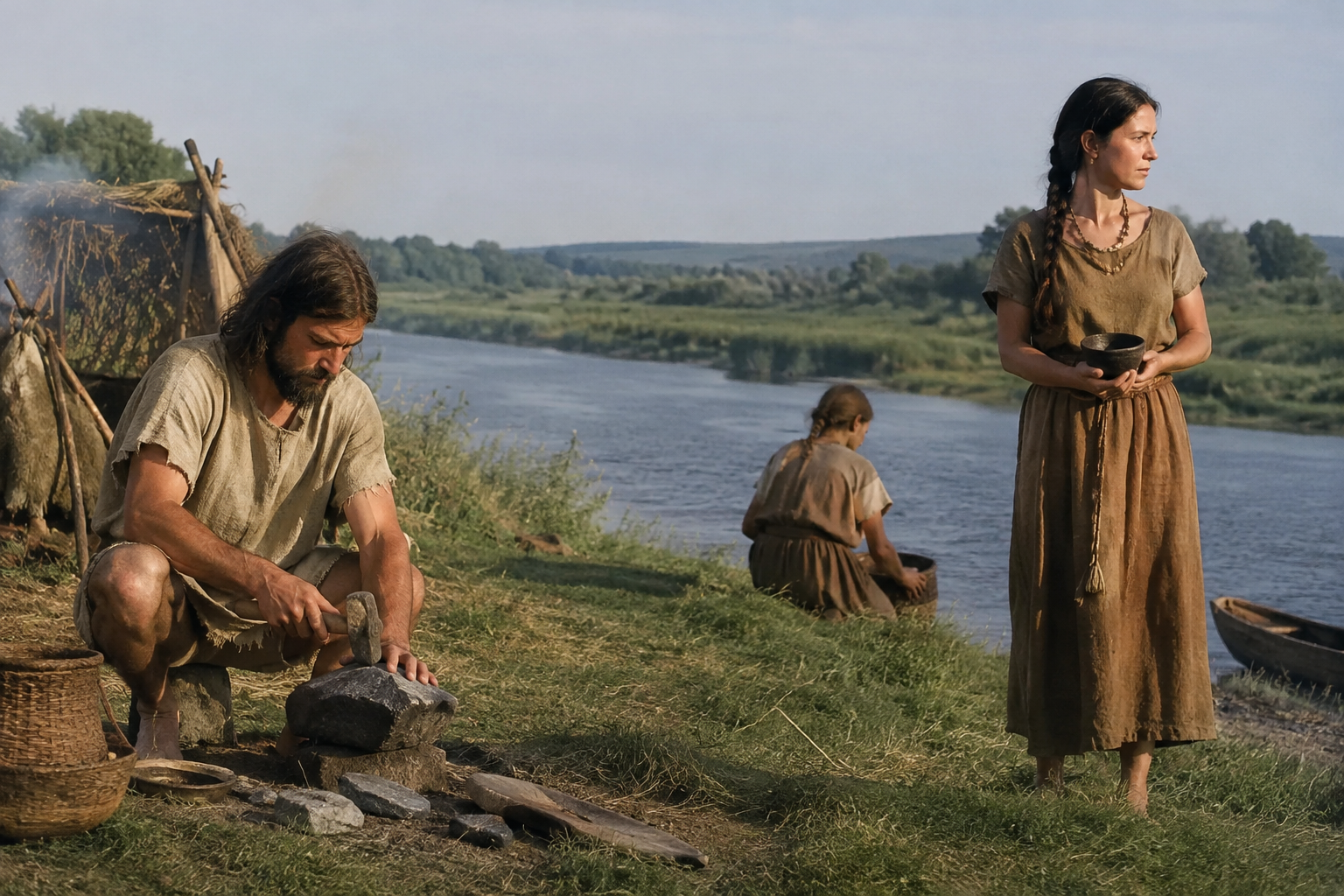
At Vovnihy 2 in Ukraine, one ancient male sample stands out for anyone tracing the Y-DNA haplogroup I2a1b1a2a2a: individual I1738, dated to around 5398 BC. This is not a king in a chronicle or a warrior from legend, but a man from the Neolithic north of the Black Sea world, living in a landscape where farming communities and older forager traditions were still meeting, mixing, and negotiating daily life.
That matters because haplogroup I2, in its broader sense, is one of the old paternal lineages of Europe. But this article's branch, I2a1b1a2a2a, is much narrower than the parent haplogroup, and we should not lazily project the whole history of I2 onto it. What the ancient evidence here does show is something more interesting: a paternal line associated with very different worlds across time, from Neolithic Ukraine to Iron Age Bohemia.
Vovnihy 2 belongs to the great north Pontic zone, the broad region stretching around the northern Black Sea. In prehistory this was never a blank corridor between "Europe" and "the steppe"; it was a lived-in frontier of river valleys, cemeteries, settlements, and long-term population contact. Sample I1738, placed at about 5398 BC, gives us one early point for the branch in that wider world.
We should be careful with labels here. A Y-chromosome lineage tracks one direct paternal line only, not a person's whole ancestry, language, or identity. Still, a lineage found in Neolithic Ukraine is archaeologically meaningful because it places this paternal branch in a region central to some of the biggest demographic developments in later European prehistory.
A genetic study of ancient populations in the north Pontic region provides the wider research setting for such finds, and is worth reading for the broader landscape of ancestry and movement in this zone: https://www.nature.com/articles/s41586-021-04287-4.
For a man like I1738, the historical significance lies less in biography than in placement. He shows that the branch was present in the north Pontic sphere during the Neolithic, in a period when eastern Europe was anything but static. Communities were absorbing new subsistence strategies, maintaining older regional traditions, and contributing to the human background from which later Bronze and Iron Age populations emerged.
There is a temptation, when one sees an early sample, to declare an "origin." That would be too much. One ancient occurrence does not prove that I2a1b1a2a2a began at Vovnihy 2, nor that every later carrier descends from this exact local population. But early occurrences do help anchor a lineage in real archaeological ground rather than in modern distribution maps alone.
For the broader I2 family, eastern and southeastern Europe are repeatedly important in ancient DNA. The narrower branch here appears, at least from the evidence in hand, in places tied to long-lived continental networks. That is exactly the kind of pattern that often matters in paternal history: not a single triumphant migration, but survival through changing local worlds.
In other words, I1738 does not give us a neat founding myth. He gives us something better: proof that one branch of an old European paternal stock was already present in Neolithic Ukraine, in a region whose populations were deeply entangled with the making of later Europe.
The second ancient sample associated here with I2a1b1a2a2a is I15040, dated to around 180 BC from Teplice in what is now the Czech Republic. By this point we are in a completely different historical setting: Iron Age central Europe, centuries after the Neolithic world of Vovnihy 2 had vanished.
That gap is the point. The value of these two samples is not that they form a tidy family tree, but that they show the branch in widely separated times and regions. Teplice places the paternal line in Bohemia during the later Iron Age, in a landscape usually discussed in relation to Celtic-speaking groups, regional chiefdoms, exchange networks, and increasing connections across central Europe.
One must not leap from geography to ethnicity. A male buried in Iron Age Bohemia is not automatically "a Celt" in some total biological sense simply because historians associate the region with Celtic-speaking populations. But the sample does show that this paternal line had become part of central European Iron Age society, whatever the precise local language or identity of the individual may have been.
Put those two finds together and a modest but suggestive picture emerges. The branch is attested first in Neolithic Ukraine and later in Iron Age Bohemia. That does not prove one direct migration route from the Dnipro region to Teplice, and it certainly does not mean the branch was continuously common everywhere in between. But it does place I2a1b1a2a2a inside the long continental story linking the Black Sea hinterland with central Europe.
Archaeology has been telling us for years that these zones were connected by more than occasional contact. Raw materials, technologies, marriage networks, and eventually large-scale demographic processes crossed them repeatedly. Y-DNA cannot, on its own, tell us which mechanism carried this particular paternal line westward or maintained it in multiple regions. It can, however, show that the line belonged to populations participating in those larger processes.
That is especially worth stressing because modern discussions of ancestry can become absurdly overconfident. A haplogroup is not a tribe, and a tribe is not a genome. Yet neither is a haplogroup meaningless. In cases like this, it marks the survival of one paternal thread through enormous historical change.
A broader dataset of ancient individuals assembled through archaeogenetic research also helps frame these long-term patterns across Eurasia and Europe: https://dataverse.harvard.edu/dataset.xhtml?persistentId=doi:10.7910/DVN/7RVV9N.
For someone whose paternal line falls under I2a1b1a2a2a, the most responsible reading of the evidence is not a claim to one ancient people, but a connection to an old European male lineage with documented presence in both the Neolithic north Pontic world and the Iron Age heart of central Europe. That is a substantial historical span, and a revealing one.
The two ancient individuals here, I1738 and I15040, do not create a royal pedigree or a simple migration map. What they do offer is archaeological depth. They place this paternal branch among real ancient communities living in very different settings: early farming-era Ukraine and later Iron Age Bohemia. If your line belongs here, its story is unlikely to be narrow or provincial. It sits inside the long, untidy, fascinating history of how European populations endured, mixed, and moved.

Comments