Haplogroup I2a1b1a1b1b

– 5 min read


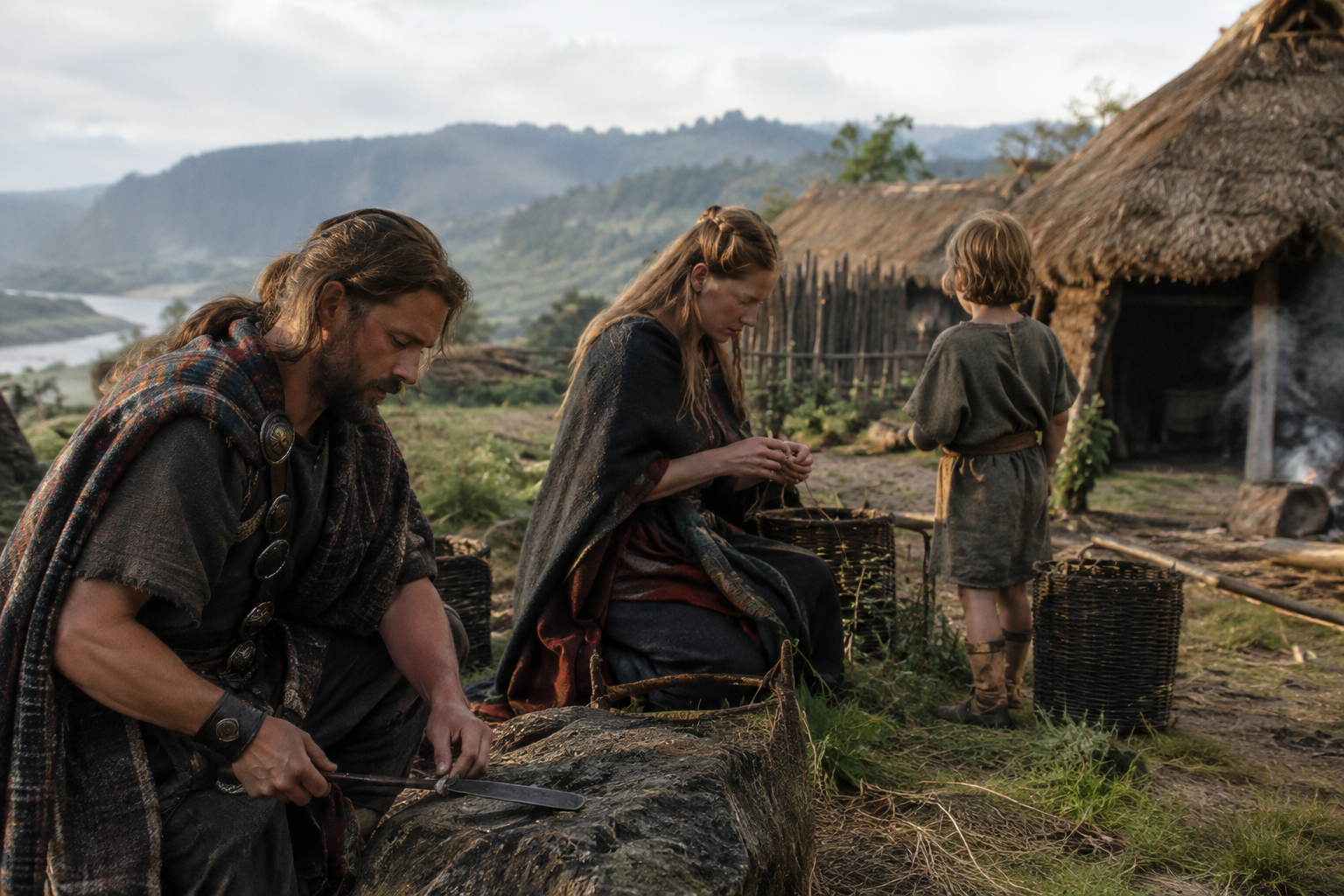
At Polaky in what is now the Czech Republic, one Iron Age man has become unexpectedly important to the story of Y-DNA haplogroup I2a1b1a1b1b. He is recorded as sample I15071, dated to around 550 BC and identified as a Celtic Iron Age individual. That may sound like a dry catalogue note, but it is exactly the sort of evidence that matters: one real person, from one real community, showing this paternal line present in Central Europe during the period when early Celtic societies were taking shape.
That is the key point to hold onto. Y-DNA traces one direct paternal line only, not a person's whole ancestry, language, or identity. Still, when a branch like I2a1b1a1b1b appears in an Iron Age burial from Bohemia, it gives us a firm archaeological foothold. Instead of treating the lineage as an abstract string of letters, we can place it among the people living in the heart of temperate Europe in the centuries before Rome expanded north of the Alps.
Polaky sits in a region that would later be drawn into the broad cultural sphere archaeologists associate with early Celtic Europe. Around the 6th century BC, this was a world of changing settlement patterns, developing elites, expanding exchange networks, and increasingly recognisable regional identities. Sample I15071 belongs in that setting, not in a romantic fog of "tribal Europe," but in a specific archaeological landscape where communities were already tied into wider continental connections.
The value of I15071 is not that he can stand in for every Celt. He plainly cannot. The value is that he shows the branch I2a1b1a1b1b, or a very closely associated reported paternal line, present in a documented Iron Age context in Central Europe. For anyone carrying this haplogroup today, that makes the lineage archaeologically visible in a place long important to debates about Celtic expansion and regional continuity.
This branch belongs within the wider I2 family, one of the old European Y-chromosome lineages. That larger family has a deep and complicated history across the continent, appearing in different forms over very long periods. But one must be careful here: the ancient breadth of I2 is not the same thing as the specific history of the much narrower branch I2a1b1a1b1b.
What the Polaky evidence allows us to say, cautiously, is that this paternal line was part of the male landscape of Iron Age Central Europe. It may represent continuity from earlier populations, incorporation into emerging Celtic-speaking groups, or both. Ancient DNA often shows precisely that sort of pattern: language, culture, and political identity can spread without wiping away all earlier paternal diversity.
That matters because the old habit was to imagine prehistoric populations as neat blocks marching across the map. Archaeology has spent years dismantling that picture, and genetics has helped. A lineage can be local, long-rooted, and still fully part of a new cultural world. An Iron Age man buried in a Celtic context does not need to come from some pure or exclusive "Celtic bloodline" to be genuinely part of that society.
One reason I2a1b1a1b1b is interesting in a Bohemian Iron Age sample is that Central Europe had already seen millennia of population change before 550 BC. Neolithic farmers, later Bronze Age communities, and groups shaped by steppe-related ancestry had all left their mark. By the early Iron Age, the region was already a densely layered human landscape, not a blank stage waiting for "the Celts" to arrive.
A major ancient DNA study of later prehistoric Europe, published in Nature, helped clarify just how entangled those developments were. One of the broad lessons from this work is that the spread of Celtic-associated culture in Central Europe is best understood through interaction, movement, and mixture rather than a single simple replacement. In that wider setting, a lineage like I2a1b1a1b1b fits perfectly well as part of the inherited paternal diversity of Iron Age populations.
So Polaky is useful not because it lets us tell a fairy tale about one heroic founding father, but because it pins the lineage to a real period of transformation. The man behind sample I15071 lived when older Bronze Age foundations and newer Iron Age identities were meeting on the ground.
Late Bronze Age Central Europe
Bohemia is often treated as peripheral in popular history, but that is quite wrong. In later prehistory it sat at a crossroads between river systems, exchange routes, and cultural zones linking the Danube world, the Elbe basin, and regions farther west and south. Communities there were never sealed off. They were plugged into a wider European conversation in metalwork, burial customs, and social display.
That broader geography sharpens the significance of I15071. A paternal line found at Polaky could have been part of a population shaped by local continuity and long-distance contacts at the same time. This is exactly the sort of setting where ancient DNA is most helpful: it stops us forcing people into tidy boxes. A man can be archaeologically "Celtic Iron Age" and genetically part of a much older and more regionally entangled paternal story.
For descendants exploring I2a1b1a1b1b today, that means the haplogroup should not be read as a simple ethnic badge. What the evidence does support is a connection to the kind of Central European population history that fed into Iron Age Celtic worlds. That is subtler than the old nationalist myths, but far more interesting.
With only one ancient individual explicitly supplied here, honesty matters. We cannot claim that I2a1b1a1b1b was the dominant lineage of Celtic Bohemia, nor that every later carrier descends from this one man, nor that the branch originated at Polaky. But a single well-placed ancient sample can still change the discussion, because it moves the lineage from speculation into archaeology.
That is especially valuable for Y-DNA research, where many people first encounter their haplogroup through modern testing alone. Modern maps can show where a branch is common today, but they do not tell you when or in what historical setting it was present. Sample I15071 does. He anchors this paternal line in Iron Age Central Europe, in a region central to early Celtic archaeology.
Iron Age Europe and continuity
The most responsible reading of haplogroup I2a1b1a1b1b is not a grand claim about kings or tribes, but a grounded link to Europe's older paternal landscape surviving into the Iron Age communities of Central Europe. Through sample I15071 at Polaky, this branch is visible among people living in the Celtic world of around 550 BC. That gives the lineage a proper historical setting: not vague antiquity, but a documented place in Bohemia at a moment of major cultural change.
For someone researching this haplogroup today, that is the real prize. It suggests that your direct paternal line may belong to the long human continuity behind Iron Age Central Europe, including communities archaeologists recognise as Celtic.
Comments