Haplogroup I2a1b1a1a2

– 5 min read


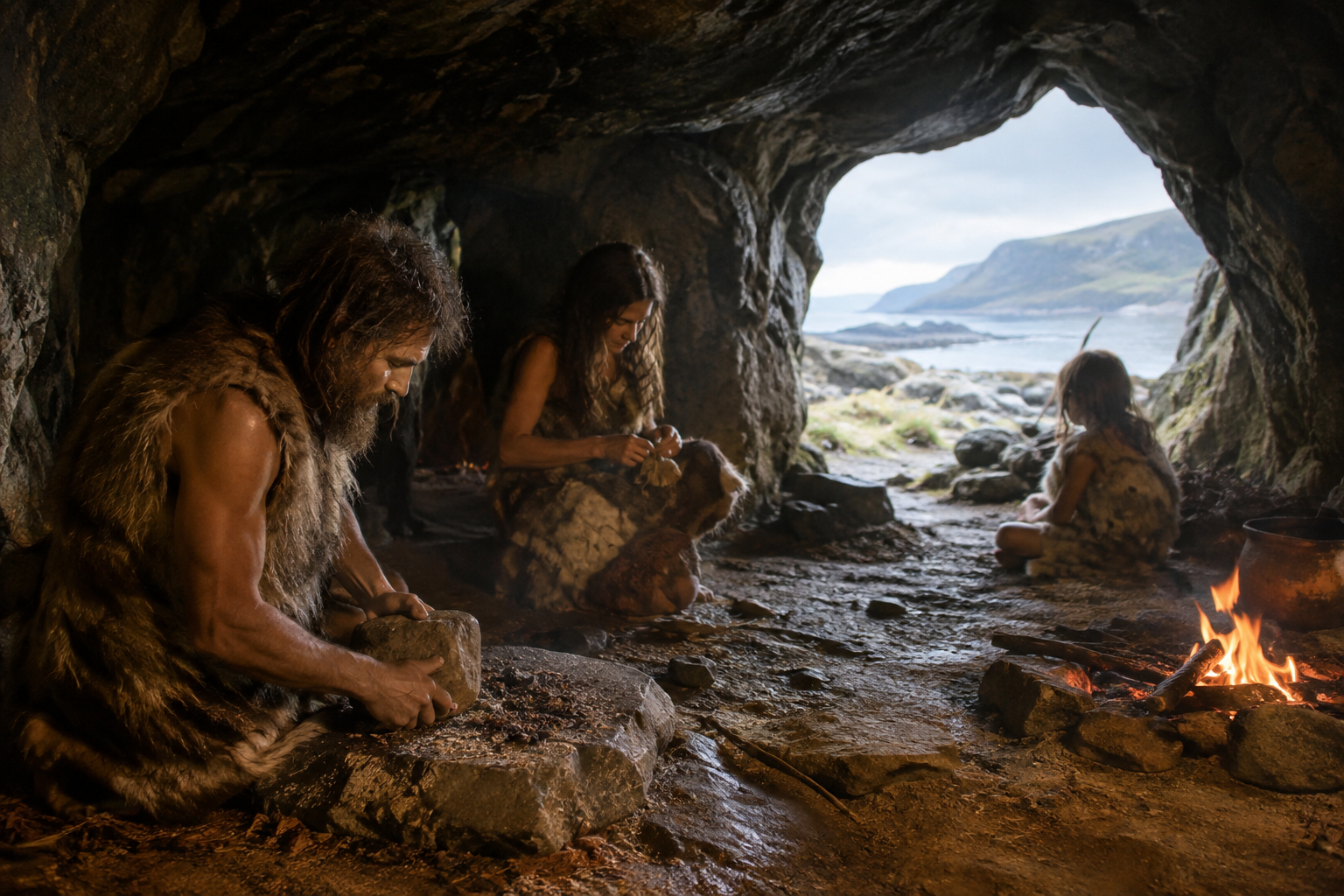
At Distillery Cave near Oban in Argyll and Bute, archaeologists recovered the remains of an individual dated to around 3669 BC, known in genetic datasets as I2691. That is a strikingly early appearance for the Y-DNA line discussed here, I2a1b1a1a2, in Atlantic Scotland. The sample matters not because one man can stand for an entire people, but because he places this paternal branch in a very specific landscape: the western seaways of Neolithic Britain, where caves, coastlines, and incoming farming lifeways met older local traditions.
That is the useful starting point for thinking about I2a1b1a1a2. Y-DNA traces one direct paternal line only, not a person's whole ancestry, language, or identity. But when an ancient male line turns up in a securely dated setting, it gives us a hard archaeological anchor. In this case, the anchor is early Neolithic western Scotland.
Distillery Cave sits in a region that was never some remote backwater. Oban and the Firth of Lorn connect mainland Scotland to the Inner Hebrides and beyond, and those sea routes were already important in prehistory. By the fourth millennium BC, farming had arrived in Britain, but its spread did not erase older patterns of movement or local variation. Coastal western Scotland remained a place where people, materials, and ideas circulated across water as much as over land.
The individual I2691 is therefore valuable less as a lone curiosity than as evidence for continuity and mixture during the Neolithic. Haplogroups within the wider I2 family are often associated in European prehistory with deeply rooted male lines present before and during the spread of farming. That does not mean every I2 branch has the same history, and it would be careless to project the entire story of haplogroup I2 onto the narrower branch I2a1b1a1a2. Still, this Oban sample fits a broader pattern in which some paternal lines linked to earlier European populations persisted within farming-era communities rather than disappearing overnight.
A major ancient DNA study of Neolithic and Bronze Age Britain, published in Nature, helped establish just how dramatic and uneven these changes could be. Western Britain and Ireland, in particular, have repeatedly shown that Neolithic communities were not genetically uniform blocks. The Distillery Cave individual belongs in that larger conversation.
The exact article haplogroup is I2a1b1a1a2, a very specific twig on the much larger Y-chromosome tree. Readers are often tempted to leap from a narrow branch to sweeping claims about "the Celts," "the first Britons," or a timeless Atlantic people. Ancient DNA is less romantic and more interesting than that. It shows that paternal lines can persist through major social change, but they can also be absorbed into entirely new cultural worlds.
So what can responsibly be said here? First, this branch, or a reported association with it, appears in Neolithic Scotland by around the mid-fourth millennium BC. Second, that placement makes it part of the story of early farming Britain, not just later clan history or medieval genealogy. Third, because a Y-chromosome records only one male line out of thousands of ancestors, someone carrying I2a1b1a1a2 today may have a family story shaped by many later migrations that the haplogroup itself cannot summarize.
That is worth stressing because western Scotland has a habit of attracting grand origin stories. Archaeology usually prefers smaller, firmer claims. A cave burial near Oban tells us that one paternal line within this branch was present in Atlantic Scotland in the Neolithic. It does not by itself prove ethnic continuity from that man to any later named population.
There is another reason Distillery Cave is such a good case study: the setting itself. Cave use in later prehistory is often awkward to interpret. Caves can be burial places, places of deposition, or places revisited over long spans of time. They sit slightly to one side of the grander monument story that usually dominates accounts of Neolithic Britain, with its chambered tombs and ceremonial landscapes.
That matters for I2691 because it reminds us that the Neolithic was never culturally flat. The arrival of farming brought new ancestry into Britain on a large scale, but local communities used landscapes in different ways. Western Scotland, with its broken coastline and maritime links, was especially likely to preserve regional practices. An ancient male line from this setting may reflect not an isolated relic population, but a community negotiating new lifeways while retaining local habits and connections.
In other words, the cave context helps rescue the sample from being reduced to a dry string of letters and numbers. I2691 was part of a human world structured by boats, shorelines, kin groups, and remembered places. The Y-DNA branch is one clue among many to that world.
Neolithic tomb-building networks
One of the most important lessons from British archaeogenetics is that population change happened in pulses, not in a single neat episode. Early farmers entering Britain carried ancestry ultimately rooted in continental Europe, and over time they transformed the genetic landscape. Yet older European male lines did not vanish everywhere at once. Some persisted, sometimes at low levels, within the new Neolithic populations.
The wider I2 family is relevant here because it appears repeatedly in prehistoric Europe, especially among hunter-gatherer and early farmer contexts. But again, the branch in this article is narrower, and caution matters. We should not assume that every later carrier of I2a1b1a1a2 in Britain descends locally from I2691, nor that this one Scottish example maps the full distribution of the branch in the fourth millennium BC.
Still, the Oban sample gives the haplogroup a grounded British prehistory. For many readers, that is the real fascination. Instead of a vague statement that a lineage is "old in Europe," we have an actual person from an actual place: Atlantic Scotland, around 3669 BC, in a cave above the sea routes of the west.
This fits well with broader discussions of how forager ancestry persisted and interacted with incoming populations in northwestern Europe. The Lower Rhine and North Sea worlds show similar long-term complexity, though in different proportions and periods.
Denmark's Neolithic transition
Argyll and the Oban area occupy a useful position in prehistoric studies because they are both peripheral and connected. From the perspective of later political maps, this is the far west. From the perspective of Neolithic travel, it is part of a sea-linked zone stretching through western Scotland, Ireland, and the Irish Sea world. That difference is crucial.
A paternal lineage found here could belong to people who were highly mobile by boat, locally established for generations, or both. The archaeology of Britain increasingly suggests that coastlines were not margins but arteries. So the significance of I2691 is not just that he lived in Scotland; it is that he lived in a maritime Scotland that was bound into wider networks.
For members of the MyTrueAncestry community with matches to ancient individuals from Britain or Ireland, this is often the most productive way to think about such a haplogroup. Not as a badge of one later nation, but as a line already present in the complicated human mosaic of the Atlantic Neolithic.
I2a1b1a1a2 is not made important by grand royal claims or by forcing it into every chapter of British history. Its interest lies in something simpler and sturdier: this branch is linked to a male individual from Distillery Cave near Oban, around 3669 BC, placing it in the early Neolithic world of Atlantic Scotland. For anyone researching this paternal line today, that suggests a deep prehistoric foothold in northwestern Europe, within communities shaped by both incoming farming traditions and older local roots.
Comments